Hugh Cairns V.C., D.C.M.
Ces fiches établies par les Allemands et retrouvées récemment au sud de Namur par C. Philippart (Blog du 148eRI) que je remercie, sont rédigées sur un modèle qui semble avoir été imprimé par (pour ?) la IIe Armée allemande et destiné aux informations sur leurs soldats décédés. Parmi elles quelques soldats du Corps Expéditionnaire Britannique. Ces documents ont peut-être été abandonnées par la 2e armée, qui était en charge du secteur à l'époque des décès, lors de son recul fin 1918.
J'ai rassemblé ci-dessous un maximum d'information pour chacun, limité en ce par les accès à des sites de généalogie payants que je ne nommerai pas, aidé par la 'Commonwealth War Graves Commission' qui recense la totalité des morts du Commonwealth et entretient remarquablement leurs tombes, et les informations que le web a bien voulu me livrer, via des sites qui sont toujours en lien.
6 sont inhumés actuellement dans l'extension du cimetière communal de Villers-Plouich (Nord)
où il reposent maintenant dans l'extension gérée par la CWGC :

source CWGC
3 (GODDARD, POTTER & TOMS) sont inhumés dans le cimetière de Gouzeaucourt (Nord),
après une inhumation dans un cimetière provisoire :
source CWGC
Les deux cimetières d'origine :
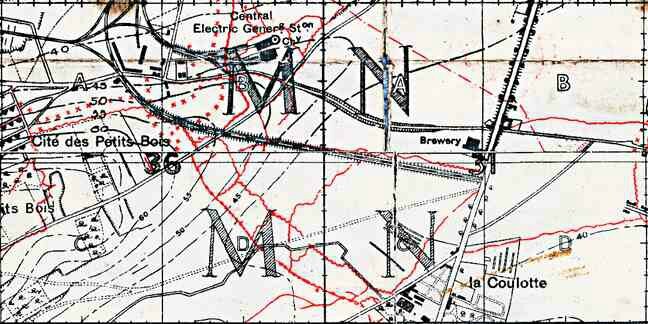
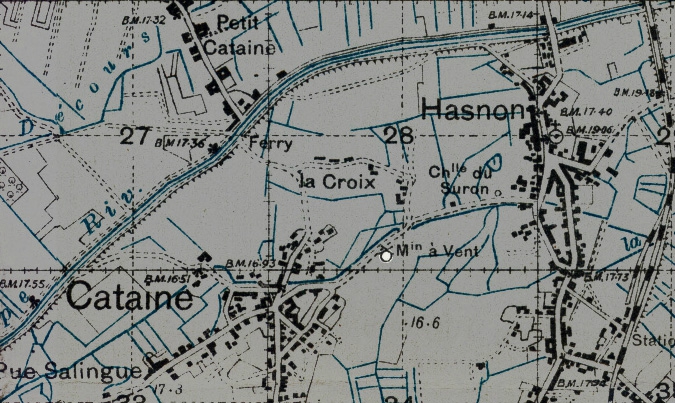
En vert au nord-est de Villers-Plouich, le cimetière communal ; en rouge au nord de Gouzeaucout, l'emplacement temporaire (Feldgrab sur les fiches) d'où les 3 soldats seront conduits vers l'actuel cimetière britannique de Gouzeaucourt au sud de la ville.
Deux autres cimetières britanniques ont été établis autour de Villers-Plouich ; "Sunken road" (le chemin creux, en haut de la ligne graduée qui sépare les carrés 18 et 13) et "Fifteen Ravine" carré 19.
Traduction d'une fiche vierge :
|
Nom de famille : Prénom : Lieu d'origine : Né le : Grade : Affectation : Date de décès : Emplacement de la tombe : Tombe n° : Kommandantur ou district administratif : Commentaire possible voir verso On trouve également écrit à la main |
|

Texte extrait d'un cantique écrit par William H. Bathurst (1796-1877), dans lequel on retrouve une autre épitaphe fréquemment gravée "Thy will be done" (Que Ta volonté soit faite)

Il existe deux fiches au même nom, les différences sont peu significatives, et il se pourrait que des erreurs de transcription en soient la source :


Une église d'Ypres
Ecouter par Nóirín Ní Riain
Survoler ici pour le texte

La Société des "Sac-au-Dos" a été fondée en septembre 1915. Son but est clairement défini par l'article 1er de ses statuts:

"Grouper les Français du Canada ayant fait du service dans la guerre commencée en 1914, afin de se mieux connaître et de s'entr'aider au besoin, perpétuer le souvenir de leur séjour sous les armes, faire connaître la part prise par la France dans cette guerre, propager et encourager l'amour de la Patrie et l'attachement à son drapeau; de plus, au moyen de contributions ou souscriptions volontaires, dons ou donations de ses membres et du publie, secourir les affligés par suite de maladie, accident ou revers de fortune, les veuves, les orphelins, les vétérans de la guerre et leur famille de nationalité française.
C'est pour répondre à l'un de ces engagements que le Livre d'Or a été composé et publié."
Sorti de l'imprimerie "La Patrie" à Montréal en 1921, le livre contient la liste des donateurs, un certain nombre de publicités, des pages d'Histoire Franco-Canadienne et une liste de 317 noms de Français du Canada Morts pour la France. "Il nous a été impossible, comme on s'en apercevra, d'obtenir les renseignements nécessaires pour tous nos morts. Cette liste est donc forcément incomplète."
|
Parmi les morts, les quinze cent mille morts que la France a perdus il en est quelques centaines dont le sacrifice est peut-être plus spécialement digne d'hommage et d'admiration. Ce sont les Français qui, vivant au loin à l'étranger, sont venus mourir pour leur pays que certains d'entre eux n'avaient même jamais vu. Mais ceux qui vinrent du Canada, où était leur foyer, où était leur ferme, où étaient leurs amis, où était leur famille? Ils avaient quitté le sol de France pour aller chercher fortune dans ce pays nouveau, si plein de promesses, où ils savaient retrouver des cousins. Ils avaient emmené leur famille ou bien ils en avaient fondé une dans leur seconde patrie. Il en était parmi eux — et des plus glorieux — qui, nés au Canada, n'avaient jamais vu cette France dont leurs parents leur parlaient avec tendresse. Et c'est à elle qu'ils ont dédié le sacrifice le plus volontaire, le plus libre, le plus désintéressé qui ait jamais été fait. Ils auraient pu rester. Nul gendarme ne serait venu les chercher. Mais ils sont partis. Ils sont partis sans hésiter, dès le premier jour, par le premier bateau. Car le sang français né se perd pas et au nom de la France, les plus blasés, les plus, sceptiques d'entre eux, — ou ceux qui affectaient de l'être - sentaient bien que leur cœur battait plus fort. La France était menacée, la France était envahie: à quoi bon raisonner? Le devoir était clair. Ils sont partis. Ils sont partis, sachant pour la plupart qu'ils auraient à combattre dans le rang : comment leur éloignement leur aurait-il permis de gagner des galons dans la Réserve? Certains d'entre eux n'avaient même jamais fait de service militaire. C'était la vie inconnue, pleine de pièges et de dangers. Qu'importe? Ils sont partis. Ils sont partis, abandonnant les affaires commencées, les promesses de prospérité que leur travail leur avait gagnées, et sachant bien qu'ils sacrifiaient — nombre d'entre eux au moins — cette fortune qu'ils étaient venu chercher si loin. Ils sont partis, sachant que pendant de longs mois, de longues années, ils resteraient loin des affections et des tendresses qui soutiennent le cœur de l'homme. Il en est — et combien! — qui ne purent jamais revenir en permission. Ils sont partis, enfin, sachant qu'ils avaient à faire le sacrifice de leur vie. Qui ne le savait, que cette guerre serait terriblement sanglante et que la mort faucherait largement dans les rangs serrés des combattants? Mais ils ont fait ce sacrifice. Ils l'ont fait à la France, cette France qui, pour beaucoup, n'était plus qu'un souvenir, et pour certains, même, qu'une tradition. Aussi faut-il que, morts pour un souvenir, le souvenir de leur mort soit la récompense de leur sacrifice. Que leurs noms, gravés dans ce livre, restent dans la mémoire des hommes, qu'ils vivent dans le souvenir de tous ceux qui, au Canada, aiment le nom de la France. Qu'ils portent témoignage pour ceux de leurs frères qui, plus heureux, ont pu, après la guerre, reprendre leurs places dans leur seconde patrie. Et qu'ils soient la preuve irréfutable que c'est un peu du meilleur de son sang que la France envoie dans ce pays lointain, cette nouvelle France d'autrefois qu'elle ne saurait ne pas aimer. |
J'ai reproduit cette liste à l'identique, en attendant d'avoir terminé toutes les recherches, ajoutant lorsque c'était possible et qu'il n'y avait pas trop d'équivoque, le lien vers la fiche du site Mémoire des Hommes : MDH, ou ACC (Anciens Combattants du Canada) quand le soldat appartenait à un régiment Canadien : on accède alors à sa fiche d'enrôlement, voire au dossier pdf complet.
(229 identifiés au 11/05/2015)
Dans le cas contraire figure une observation sur les noms trouvés pour lesquels il faut examiner leur État Signalétique et des Services pour une éventuelle adresse au Canada (en cours : toutes les archives départementales n'ayant pas -encore ?- publié les registres).
Toutefois il y a parfois des différences (date de décès "légèrement" différente, ordre des prénoms; ...), je n'ai ajouté le lien que lorsque le risque d'erreur était minime, toute rectification sera la bienvenue.
Certains sont énoncés avec si peu de renseignements qu'il est impossible de savoir s'ils figurent sur le site, l'original utilisé n'étant pas exempt d'erreur : je laisse au lecteur le soin de compléter la recherche, et si elle aboutit, d'avoir la gentillesse de m'en avertir.
| Nom Prénom Regiment Grade | Décès | Références |
| ACHARD, Jacques, 86 R.I. | Tué à Vermandonvillers le 11 Octobre 1916. | MDH |
| AGULHON, L. | - 3 réponses | |
| ALATERRE, Henri, 8 Génie | Décédé à Montréal le 4 Juillet 1918. | - |
| ALBERT, L.-P. | - 3 réponses | |
| ALLAIN, Henri, Eugène, 329 R.I. | Tué à Tahure le 13 Octobre 1915. | MDH |
| R. P. ANGE MARIE. | - | |
| D'ARBURN, Pierre, | Décédé à Fréjus (Var) le 28 Mai 1915. | MDH |
| ARNAUD, Alfred, 27 Bton chasseurs à pied. | Tué à Mosh (Hte Alsace) le 6 Mars 1915. | MDH |
| AUDOUX, Louis, Inf. Col. | Décédé à Verdun, 14 Juin 1916 | MDH |
| AUDRAIN, J. | - 20 réponses | |
| AUFFRAY, Albert, 21 Inf. Col. | Tué en Champagne le 25 Septembre 1915. | MDH |
| AUGAIT, Alcide, Sergent, 170 R.I. | Tué à Notre-Dame-de-Lorette le 23 Mai 1915. | MDH |
| AUGEY, Louis, S-Lieut. 273 R.I. | Venu en convalescence, mort accidentellement. | -1 lieutenant mais 10eRI |
| AULAGNON, J. | - 3 ou 4 réponses | |
| AUZEBY, Alex., 3 Zouaves | Tué en Serbie le 8 Dec. 1915. | MDH |
| BALLOT, Georges, 155 R.I. | Décédé à Vienne-le-Château. | MDH |
| BALES, | Disparu. | - 9 réponses |
| BARBE, Maurice 64 R.I. | - 12 réponses | |
| BARBIER, Jules, | Décédé aux Armées le 9 Juin 1916. | MDH |
| BARDOU, Geo., 100 R.I. | Disparu à Verdun le 15 Juillet 1916. | MDH |
| BARLATIER, Emile, Serg. aviateur. | Tué le 22 Juillet 1916. | MDH |
| BARREAU, Jules, 3 Bton F.E.C. | Tué le 8 Octobre 1916 | - |
| BAUER. | - 78 réponses | |
| BAYLE, Paul. | Tué le 14 août 1915 à la tranchée devant Réménauville (village détruit) | MDH (1) |
| BEAUMONT, Hippolyte, Sergent, 161 R.I. | Tué à Froméréville le 16 Mai 1916. | MDH |
| BENARD, Jean, M. des L., 54 d'Art. | MDH | |
| BENGOLD, Paul, 18 Bton chasseurs à pied. | Tué à Mesnil-les-Hurlus en Mars 1915. | MDH |
| BERGAUD, Jean. | - 3 réponses | |
| BERGES, Joseph. | - 7 réponses | |
| BERNIGAUD, Philippe. | MDH | |
| BERNUY, Vic., 19 T.E.M. | Décédé à l'hôpital de Chaumont le 2 Décembre 1918. | MDH |
| BERTRAND, Donat, 2 R. Lég. Etr. | Tué à Prunay (Marne) le 19 Décembre 1914. | voir les Canadiens du Monument de Montréal ci-dessous |
| BERGOEND, Fabien. | MDH | |
| BERTRAND, Jus., 112 R.I. | Tué à la Côte 304 (Verdun). | MDH |
| BEZARD, Albert. | Tué le 23 Octobre 1918. | MDH |
| BILLARD, Henri, 102 R.I. | Tué à Perthes-les-Hurlus le 24 Février 1915. | MDH |
| BILLARD, Vital René | Tué à Verdun le 3 Dec. 1914. | MDH |
| BLANDIN, Antoine | Décédé le 6 juillet 1915 à l'Hôpital de l'Ecole Polytechnique, Paris | MDH (1) |
| R. P. BLANQUET, Ernest. | MDH | |
| BLAS, Victor, 327 R.I. | Tué en Champagne le 7 Octobre 1915. | MDH |
| BLONDEAU, Louis. | - 25 réponses | |
| BOELLE, Georges. | MDH | |
| BOISSEAU, Prosper, Méd. Mil., 304 R.I. | Décédé à l'hôpital de Verdun le 7 Mai 1915. | MDH |
| BONARD, Joseph, 37 R.I. | Décédé à l'hôpital de Bordeaux le 29 Novembre 1917. | MDH |
| BONNIER, Raphael, | Disparu à Thélus (Pas-de-Calais). | MDH |
| BOUARD, Léon. | - 2 réponses | |
| BOUDERLIQUE, Emile. | MDH | |
| R. F. BOULET, Eugène. | - 6 réponses | |
| BOURGEOIS, René, Lieut., 14 Bton. Royal Montréal Régiment | Tué devant Lens le 17 août 1917. | ACC |
| BOUTEAUD, Célestin, | Décédé à Metz le 19 Dec. 1918 | MDH |
| BOYER, J.-B., 76 R.I. | Tué à Souchez le 27 Sep. 1915. | MDH |
| BRASIER, Charles, C. | Disparu. | MDH |
| BRIEN, Armand. | MDH | |
| BRILLARD, Armand, Cap. 273 R.I. | Tué à la Ferme du Temple le 10 Octobre 1916. | MDH |
| BRIZARD, Geo. 123 R.I. | Tué dans l'Aisne le 18 Septembre 1914. | MDH |
| BRUNELLE, E. | - | |
| BUGNET, Jean, Joseph, Serg. 227 R.I. | Décédé à l'hôpital de Commercy le 28 Octobre 1914. | MDH |
| CANTELOUP, Jean, 144 R.I. | Décédé à l'hôpital sanitaire du Bequet, Bordeaux. | MDH |
| CADOUX, Antoine. | Tué le 8 Mai 1915. | MDH |
| CARON, Paul, 1 Rég. Etr. | Tué à Reims le 16 Avril 1917. | voir les Canadiens du Monument de Montréal ci-dessous |
| CASSAGNE, J. | - | |
| CAYLOTTE, Paul. | - | |
| CAZAUX, Gaston. | Disparu à Chavonnes le 2 Novembre 1914. | MDH |
| CHABANCE, Antoine. | Tué le 25 Octobre 1914. | MDH |
| CHANOT, Jean. | - 2 réponses, Quimper et Seine | |
| CHARLES, Pierre. | - 25 réponses | |
| CHAUDERLOT, Maurice. J. | MDH | |
| CHAUVE, Benoit, Auguste 216 R.I. | Né à Roche par Montbrison (Loire). | MDH |
| CHAUVE, François, Benoit. 333 R.I. | Disparu dans l'Aisne le 27 Mai 1918. | MDH |
| CHAUVET, André, J. M., 66 R.I. | Décédé à Loos (Pas-de-Calais) le 4 Décembre 1915. | MDH |
| CHERON, Abel, 84 R.I. | MDH | |
| CHEVILLARD, Hector. | - 83 CHEVILLARD, pas d'Hector. | |
| CHOOUET, A. | - 21 réponses | |
| CLOAREC, Fidèle,(Rév. Père). | - 122 CLOAREC, pas de Fidèle | |
| COMMUNE, Jacques, 52 R.I. | Décédé le 15 Octobre 1916. | MDH |
| CONAN, Jos., Caporal. 8 Bton chasseurs à pied | Disparu en Argonne le 30 Juin 1915. | MDH |
| CONRATTE, Emile, 275 R.I | Tué le 14 Octobre 1915. | MDH |
| CORMIER, Fortuné. | Tué le 8 Novembre 1916 | MDH |
| COSSET, Léon. | MDH | |
| de COUSIN de la TOUR FONDUE, 295 R.I. | Tué à Souchez le 11 Octobre 1915. | MDH |
| COUSIN, Charles, 271 R.I. | Décédé en captivité à Nershem le 1er Décembre 1918. | MDH |
| COÛTANT, Eugène, Capor. | Disparu à Fleury le 10 Juillet 1916. | MDH |
| COUTON, Louis. | Tué le 15 Avril 1916. | MDH |
| COUTON, Eugène, 131 R.I. | Disparu à Vauquois le 21 Décembre 1914. | MDH |
| R. P. CROIZIER. | Tué le 26 octobre 1915 à Zuydschoote (Nord) | MDH (1) |
| DAGON, H. | - | |
| DAGON, Ernest, Brigadier. | - DAGON Ernest, 2e Classe ? | |
| DAGUERRE, Jos. 22 R.I. | Décédé le 4 Octobre 1915. | MDH |
| DASSONNEVILLE, Henri, 43 R.I. | Tué à Foy (Somme) le 18 Septembre 1915. | MDH |
| DEBRIS, Achille, 106 Bton chasseurs à pied | Disparu à la Côte 321 (Verdun). | MDH |
| DANGELZER, Henri, | Disparu le 13 Janvier 1915. | MDH |
| DELCAMBRE, Hector. | Disparu à Chappv (Meuse) le 25 Septembre 1914. | MDH |
| R. P. DELEGLISE. | Tué le 14 juin 1915 à Hilsenfirst (Haut-Rhin) | MDH (1) |
| DELEMONT, Célestin | Tué à Vauxaillon (Aisne) le 20 Juin 1917. | MDH |
| DELFORGE. | - 45 réponses | |
| DELOURME, Charles, 127 R.I. | Tué près Combles le 3 Septembre 1916. | MDH |
| DESCAMPS, Anat., 18 Bton chasseurs à pied | Décédé à Vic-s-Cher le 27 Septembre 1914. | MDH |
| DESETTE, Georges, 4 Zouaves. | Mort en captivité. | MDH |
| DESMARQUET, Victor, 14 R.I.T. | - 1 réponse au 24e RI | |
| DESMARS, Etienne. | MDH | |
| DESQUEREAUX. | - | |
| DEVILLENEUVE, René, 418 R.I. | Tué à Verdun. | MDH |
| DEVILLERS, Joseph, 251 R.I. | Tué au Mort-Homme le 28 Avril 1916. | MDH |
| DIEULEFET, Frédéric, 2 Z. | MDH | |
| DINANT, Pascal, 265 R.I. | Décédé à l'hôpital d'Issy les Moulineaux le 7 Dec. 1914. | MDH |
| DIRAISON, Saylor. | MDH | |
| DOUBLET, Maur., 72 R.I. | Disparu en Septembre 1914. | MDH |
| DOUMIC, Max. | MDH | |
| DUBOIS, Jean, 8Bton chasseurs à pied, | Tué à Reillou (Meuse) le 12 Juillet 1916. | MDH |
| DUGAS. Marcel, serg., 24 R.I. | Tué à la Targette (P. de C.) le 18 Octobre 1915. | MDH |
| DUHAMEL, Marcel, 10 Bton chasseurs à pied. | MDH | |
| DUMAS, Adrien, 3 Zou. | Décédé à l'hôpital de la Charité le 17 Janvier 1915. | MDH |
| DUMAS, Eugène, Capor. 46 Ch. Alp. | Tué à Vailly le 1er Novembre 1917. | MDH |
| DUON. | - 5 Réponses | |
| DUPONT, Jean, 52 R.I. | Tué le 13 Mars 1916. | MDH |
| DURAND-DAUBIN, Lieut., 2 de Marche d'Afrique. | Mortellement atteint au combat à Strumitza le 3 Nov. 15 | MDH |
| DURIEUX, Jean, s-Lieut., 251 R.I. | Tué au Mort-Homme le 29 Avril 1916. | MDH |
| DURIN, Charles. | - 6 réponses | |
| R. P. EDOUARD. | - 68 réponses "EDOUARD" | |
| ELOQUIN, Jean-Baptiste. | MDH | |
| ESBRAYAT, Charles, 4 R.I. | Tué au Bois de la Chalade (Meuse). | MDH |
| EYBALIN. | MDH | |
| FIQUET, Marcel, Sergent. | Tué en Octobre 1917. | MDH |
| FLEURY, Marcel. | - 21 réponses | |
| FLEURIEL, Paul, 156 R. I. | Tué à St-Julien le 11 Décembre 1914. | MDH |
| FOREST, Achille. | MDH | |
| FOURDRINIER, César, 1 Art. | Décédé à l'hôpital du Hâvre le 17 Avril 1916. | MDH |
| FOURNIER, Louis, C, 418 R.I. | Tué à Lyzerne (Belgique) le 26 Avril 1915. | MDH |
| FRANÇOIS, Auguste. | - 29 réponses | |
| R. P. FRIDOLIN. | - 3 "FRIDOLIN" | |
| GALIBERT, Calixte, | Tué à Béthincourt le 20 Décembre 1914. | MDH |
| GALLET, Lucien, E., Serg. 161 R.I. | Décédé à l'hôpital de Lyon le 22 Janvier 1916. | MDH |
| GASPARD, Joseph, 273 R.I. | Disparu à Somme-Py le 6 Octobre 1915. | MDH |
| GAUTER, Maurice, M. des L. 84 R.A.L. | Décédé à l'hôpital d'Auxerre. | - 84 réponses "GAUT* Maurice", 0 GAUTER. GAUTIER ? |
| GENAIRON, Paul. | MDH | |
| GETIN, Louis, 44 R.I. | Tué à Malumbois,29oct. 1914. | MDH |
| GIBERT, Raoul. | - 2 réponses | |
| GIROUARD, Jules, 43 R.I. | Tué à Sapincourt (Marne) le 29 Mai 1918. | MDH |
| GRAND, Pierre, Tir. Ind. | Tué à Neuville-St-Vaast (P. de C.) 21 Juin 1915. | - Nombreuses réponses (LE)GRAND *Pierre* mais non id° |
| GRANGER, Xav. 142 R.I. | Tué à Beauséjour le 23 Mars 1915. | MDH |
| GRASSET, Jean. | - 20 réponses | |
| GRENOUILLON, Maurice, 246 R.I. | Tué au Bois des Buttes le 11 Mars 1916. | MDH |
| GRESSIER, Pierre. | - 2 réponses | |
| GRIVEAU, Louis. | MDH | |
| GUELOU, Jean-Baptiste. | Tué à Mihaucourt (Somme) le 7 Septembre 1916. | MDH |
| GUEZILLE | Décédé le 26 Mars 1918 à Kermaria, Sask. | - |
| GUICHERET, Félix, 4 Génie | Décédé à l'hôpital de Commercy le 13 Avril 1915. | |
| GUILLERY, Paul, 3 R.I. | Tué au front de Salonique le 15 Août 1916. | MDH |
| GRISEZ, Emile, Capitaine. | Tué. | MDH |
| GUILLOUET, Gabriel. | MDH | |
| GUY, Charles. | MDH | |
| GUYOMARD, Charles, 101 R.I. | Tué en Champagne le 1er Octobre 1915 | MDH |
| GUYOT, Albert. | - 21 réponses | |
| GUYON, Raoul. | MDH | |
| HAMON, Raoul. | - 2 réponses | |
| HENRI, Fernand. | MDH | |
| HENRY, Louis, J., 369 R.I. | Décédé le 25 Octobre 1917. | MDH |
| HERBART, Paul. | MDH | |
| HERBOMETZ, Victor, 164 R.I. | Tué à Béthincourt le 26 Novembre 1915. | MDH |
| HERMAN, David, 16 Dr. | Décédé à Furnes le 22 Décembre 1914. | MDH |
| HERSIN, Emile, 91 R.I. | Tué aux Eparges 3 le 27 Avril 1915. | MDH |
| HOOPER, François, J. E. Caporal, 65 R.I. | Tué à Mesnil-les-Hurlus le 21 Septembre 1915. | MDH |
| HOUZET. | - 16 réponses "HOUZET" | |
| HUCHERY. | MDH | |
| HUE, Jean, Marie, | Tué le 26 Octobre 1918 à Bannongues (Ardennes). | MDH |
| HUGUET, Georges, Serg. | Disparu le 25 Septembre 1915. | MDH |
| JACOB, Corentin, 318 R.I. | Tué à Tracv-le-Mont le 3 Avril 1915. | MDH |
| JACOT, Louis, 22 R.I. | Tué le 15 Février 1915. | MDH |
| JACQUEMART, René, | Décédé (suites de blessures). | MDH |
| JACQUOT, Auguste, 26 R.I. | Décédé en Juillet 1916. | MDH |
| JENVRIN, Pierre. | MDH | |
| JOECKEL, Louis. | - Edmond Louis STOECKEL (?) | |
| JOUBERT, M. 8 Bton chasseurs à pied, | Tué le 27 Mai 1915. | MDH |
| JOUBIN, Auguste. | MDH | |
| R. P. JUSTINIEN. | MDH | |
| KERN, Léon, E., 170 R.I. | Disparu à Mesnil-les-Hurlus le 21 Mars 1915. | MDH |
| KOCK, Gaston. | MDH | |
| LACHERY, Julien, 1 Gén. | Tué le 12 Novembre 1915. | MDH |
| LAIGLE, Hippolyte, 6 Gén. | Disparu à Berry-au-Bac le 21 Juin 1916. | MDH |
| LANCELEVE, Moïse, 3 Gén. | Tué à Méry le 11 Juin 1918. | MDH |
| LANGLE DE BEAUMANOIR. | MDH | |
| LARCHER, Henri, 33 R.I. | Décédé à Anderlu-le-Priez, (Somme) le 15 Sept, 1916. | MDH |
| LA RUE DU CAU, 3 Dr | Décédé à Ypres (Belgique) le 13 Mai 1915. | MDH |
| LAURENS, Charles. | MDH | |
| LAURENT, Adol. 360 R.I. | Tué le 19 Décembre 1914 | MDH |
| R.P. LAURENTIC, François | - | |
| LEAU. | - 27 réponses "LEAU" | |
| LE BAILLY. | - 4 réponses "LE BAILLY" | |
| LE BORGNE, Michel, | Décédé (suite de blessures) Arras le 28 Avril 1915. | MDH |
| LEBOUIS, Anatole, 43 R.I. | Décédé à Fontenoy (Aisne) le 18 Juillet 1918. | MDH |
| LEBARBANCHON, Louis, 4 Zouaves. | Disparu à Ripont (Marne) le 27 Septembre 1915. | MDH |
| LEBOULVAIS, François, Caporal 116 R.I. | Tué à Oulchies (Aisne) le 29 Avril 1917. | MDH |
| LE BIHAN, Fran., 129 R.I. | Tué à Souchez le 22 Juin 1915. | MDH |
| LECOURS, Adol., 1 Etr, | Tué le 11 Juillet 1918. | voir les Canadiens du Monument de Montréal ci-dessous |
| LEDEVEHAT, Julien, 289 R.A.L. | Mort (suites de blessures) le 9 Août 1918. | MDH |
| LEDU, J. | - 52 réponses "LEDUC J*" | |
| LEFANT, Jacques, I.C. | Mort à Diego-Suarez le 10 Juin 1917. | MDH |
| LEFEBVRE, Ale, 127 R.I. | Mort (suites de blessures) le 4 Août 1916. | - 44 réponses "Lefe* Ale*" : ni Rgt ni date |
| LEGALL, Guillaume. | - 21 réponses "LE GALL Guillaume" | |
| LEGRAND, Albert, Ser. 143 R.I. | Tué à la Main de Massiges le 27 Septembre 1915. | MDH |
| LOGODIN, Jean, M., Serg. 65 R.I. | Mort à Thiaumont le 17 Juin 1916. | MDH |
| LEGUYON. | MDH | |
| LE MOAL, Pierre. | Tué à Anthuile (Somme) le 26 Octobre 1914. | MDH |
| LE NOAILLES, Louis. | MDH | |
| R. P. LEON D'ASSISE. | - 4 "*ASSISE*", pas de Léon | |
| LE PRAT, Joseph. | MDH | |
| LEROUX, Barthe., 6 Gén. | Mort (suite de blessures) le 24 Novembre 1915. | MDH |
| LE ROY, Peter, 318 R.I. | Mort le 25 Septembre 1915. | MDH |
| LESIEUR, Louis, Serg. 87 R.I. | Tué à Mesnil-les-Hurlus le 1 Mars 1915. | MDH |
| LESTAGE, Jean, Gabier 3 Dep. Eq. Flotte. | Mort à Salonique le 22 Août 1916. | - Aucune réponse pour le 3eDEF |
| LE TEXIER, Jean-Baptiste 74 R.I.C. | Mort en captivité à Hensberg le 5 Décembre 1918. | MDH |
| LlDOUREN, J. | - 3 "LIDOUREN" pas J | |
| LOISEAU, Fernand. | - 5 "LOISEAU Fernand" | |
| MACHERAS, J., 23 R.I. | Tué le 31 Août 1914. | MDH |
| MAILLARD, Cl, 161 R.I. | Tué en Champagne en 1916. | MDH |
| DE MAILLY. | - 42 DEMAILLY (pas de DE MAILLY) | |
| MALANDIN, H. A., 129 R.I. | - 4 MALANDIN (pas de H.A., ni 129RI) | |
| MALLET DE CHAUNY. | MDH | |
| MANTHE, André. | Mort le 5 Mai 1917. | - 10 MANTHE, pas d'André ni décès ce jour |
| MARCHAND, Edouard, 109 R.I. | Mort à Noulette le 18 Dec. 1914. | MDH |
| MARLE, Gaston, Lieut. | Tué à Vandy le 20 Oct, 1918. | MDH |
| MARTIN, Yves. | Mort le 25 Septembre 1915. | MDH |
| MARTIN, Abel. 159 R.I. | Disparu près Arras le 22 Oct. 1915. | MDH |
| MASSOL, Léon, Caporal, 38 R.I. | Mort à Vitry-le-François le 22 Décembre 1915. | MDH |
| MASSU, Louis, A., 25 R.I. | Disparu le 21 Mai 1917. | MDH |
| MAURIETTE, Henri. | - aucun MAURIETTE, mais (M/L)ORIETTE,(M/L)ARIETTE, | |
| MAZURAT, François. | Décédé le 14 Sept, 1916 25/09/1915 par suite de blessures. | MDH (1) |
| MAZURE., Aug. Cap. 1 Col. | Tué le 2 Août 1915. | MDH |
| MÉNAGER, E. | - 19 réponses "MENAGER E" | |
| MESNAGE, Alex. 104 R.I. | Tué à Douaumont le 3 Nov. 16 | MDH |
| MEUNIER, Justin, 128 R.I. | Tué Tranchée de Calonne le 23 Juin 1915. | MDH |
| MICHAUD, Wilfrid. | Mort le 5 Juillet 1916. | MDH |
| R. P. MICHEL, Marie. | - 31 réponses "MICHEL Marie" | |
| MIGNON, Albert. | Mort le 11 Mai 1917. | MDH |
| MILET, Albert, J., 162 R.I. | Disparu à Sillery (Marne) le 30 Septembre 1914. | MDH |
| MINET, Albert, G., 43 R.I. | Tué à La Neuville en Sept. 1915. | MDH |
| MOISAN, François | Tué le 16 Avril 1917 à Laffaux, (Aisne). | MDH |
| MONIER. | - 278 réponses "MONIER" | |
| MOREL, Louis, 25 R.I. | Tué au Bois de la Grurie le 17 Décembre 1915. | MDH |
| MOREL-FOURRIER, Eug. 54 R.I. | Mort à l'hôpital de Besançon le 24 Juin 1915. | MDH |
| MORIN, André, 73 R.I.T. | Disparu. | MDH |
| MORIN, Antony | Mort le 7 Avril 1917 à l'hôpital de Houlgate (Calvados). | MDH |
| MOULY, Marguerite. | - 87 "MOULY" (pas de Marguerite) | |
| MOUTON, C, H., 54 R.I. | Mort en Serbie le 9 Mai 1917. | MDH |
| MOUTON, Joseph. | - 10 résultats "MOUTON Joseph" | |
| MULLON, Jean, Lt. 58 R.I. | Mort (suite de blessures) le 24 Mai 1918. | MDH |
| MUTEREL. | MDH | |
| NASSU, Louis. | - Aucun "NASSU", 2 "MASSU Louis" | |
| NEOLET, Jos., A., 21 R.I. | Tué le 8 Mars 1916. | MDH |
| NICOULEAU, Jean,V.,2G. | Disparu à Verdun. | MDH |
| NOUVION, Jules, 355 R.I. | Tué à la Ferme Navarin le 27 Septembre 1915. | MDH |
| NUTEREL. | - Aucun NUTEREL (voir MUTEREL ?) | |
| OBALSKI, Marcel | MDH | |
| OLLU, Corentin, 34 R.I | Mort à l'hôpital de Sens. | MDH |
| OMNES, Jean, 118 R.I | Mort à Pont-l'Abbé (Finistère) le 25 Juillet 1915. | MDH |
| PAGNIER, François, 2 Zou. | Mort à Fontenov le 31 Octobre 1914. | MDH |
| PELTON, Alfred, Serg.Lég.Etr. | Décédé près Montdidier le 31 Mai 1918. | voir les Canadiens du Monument de Montréal ci-dessous |
| PETERSON, GUS., 341 R.I. | Mort le 19 Juin 1916. | MDH |
| PETIT, Raoul. | Disparu le 18 Mai 1916 à la Côte 304 (Meuse). | MDH |
| PEYRAT, Paul. | MDH | |
| PHILLIPPE, Julien, 118 R.I. | Tué à La Boisselle (Somme) le 21 Mars 1915. | MDH |
| PORISSE, Paul, 412 R.I | Mort à Vierzv le 21 Juillet 1918. | MDH |
| POULET, Xavier, 3 Génie | Tué à Ville-s-Cousances le 20 Mai 1916. | MDH |
| PRIVAT, Maximilien. | Mort de ses blessures le 16 Octobre 1918. | - 160 réponses "PRIVAT" pas de *Max* |
| PROBST, Emile, s-Lt. 3 Z. | Tué en Juillet 1918. | MDH |
| PUDDICOMBE, Sydney, 1 Lég. Etr | Mort à l'hôpital de Châlons-s-Marne le 23 Avril 1917. | MDH |
| QUIBEL, Louis, Caporal 132 R.I. | Tué à Berry-au-Bac le 16 Avril 1917. | MDH |
| RADLAUER, Louis, Sergt. 36 R.I. | MDH | |
| RANNOU, Yves. | - 20 "RANNOU *Yves-" | |
| REBOUL, Phil. Ser. 24 R.I. | Tué à Vaux le 15 Avril 1916. | MDH |
| RENAUT, Alf., 32 R.I. | Mort en captivité le 29 Avril 1915. | MDH |
| REVOL, A. F., Lieutenant. | Tué en Champagne le 27 Septembre 1915. | MDH |
| RIOUX, François, 47 R.I. | Tué à Bras (Meuse) le 28 Juin 1916. | MDH |
| ROCHEREAU DE LA SABLIERE. Charles Eugène Marie Emmanuel (source MDH) |
Tué à Orfeuil (Ardennes) le 03/10/1918 (source MDH) | MDH |
| RONDEAU, Eugène, 4 Zou. | Mort le 12 Mai 1915. | MDH |
| RONDOT, François, 4 Zou. | Disparu à Souain le 6 Oct. 1915. | - 2 "RONDOT *François*" différents |
| ROSTIAUX, Pierre. | MDH | |
| ROY, Emile. | ||
| DE ROYERS. | - 28 "ROY *Emile*" | |
| SALABERRY, Pierre. | MDH | |
| SALOMON, Aug., 418 R.I. | Mort le 17 Avril 1917. | - 9 "SALOMON *Aug*" |
| DE SANCY. | - 3 DE SANCY | |
| SAUTOT, Paul, 30 R.I. | Tué à Quesnoy-en-Santerre le 27 Janvier 1915. | MDH |
| SAUVAGE, H., Sg. 146 R.I. | Mort à l'hôpital en 1915. | MDH |
| SEITZ, Auguste, 54 R.I. | Disparu à Parvillers (Somme) le 7 Octobre 1914. | MDH |
| SHULLER, 60 R.I. | Disparu. | MDH |
| SIGNORET, Pierre. | - 2 "SIGNORET *Pierre*" | |
| SINGHER, Et., Caporal, | Tué le 17 Août 1916 à Fleury (Meuse). | MDH |
| SIVHAN, Yves, | Tué en 1914 à Mametz (Somme). | MDH |
| SOMMER, Mat., 70 R.I. | Tué le 3 Novembre 1914. | MDH |
| SONNIER, Alfred. | Mort le 7 Octobre 1918. | MDH |
| STERVINOU. | - 14 réponses. Finistère. Pas de mention CDN | |
| SUEUR, Raoul. | - 4 "SUEUR *Raoul*" | |
| TAFFET, Georges, 68 R.I. | Tué à Bonnebecque (Belgique) le 4 Décembre 1914. | MDH |
| TESSE, Julien, 103 R.A.L. | Tué le 3 Mai 1916. | MDH |
| TEULIERE, Charles, Serg. 44 R.I. | Tué à Chaudefontaine le 11 Décembre 1915. | MDH |
| TEXIER, Ernest, 319 R.I. | Disparu à Mametz (Somme) le 17 Décembre 1914. | MDH |
| THIERCELIN, Ur., 160 R.I. | Mort le 30 Octobre 1915 | MDH |
| THOMAS, Robert, Capor. 175 R.I. | Disparu aux Dardanelles le 12 Juillet 1915. | MDH |
| THOMAS, Félix, | Mort en mission à Pittsburg (E.U.) | MDH |
| THUILLIER, Louis, 2 Ch. | Mort le 4 Août 1915. | - 23 "THUILLIER *Louis*" |
| TONGUETTE. | - | |
| DE TORQUAT, Capitaine. | Tué le 9 mai 1915 à St-Nicolas (Pas-de-Calais). | MDH |
| TOURNEUX, Eugène, Sous-Lieut, 24 R.I. | Tué à la Ferme Fronteny (Aisne) le 20 Juin 1918. | MDH |
| TREMEL, Alain, 94 R.I. | Disparu. | MDH |
| TROHEL, Louis, L., 47 R.I. | Mort le 15 Juin 1915. | MDH |
| TROMEUR, P., 328 R.I. | Tué à Verdun le 21 Avril 1916 | MDH |
| TROMEUR, Fer., Marin, | Coulé (sic) sur vapeur "La Drôme" en Décembre 1917. | MDH |
| VANDEL, Louis, 171 R.I. | Mort le 4 Janvier 1915 | MDH |
| VANDENDRIESCHS. | - 15 VANDENDRI* | |
| DE VANTIBAULT. | - DE VAUTIBAULT Marie Jacques ? Pas de mention CDN | |
| VASSELET, Vic, 6 R.I. | Tué à Suippes le 11 Octobre 1915. | MDH |
| VENNAT, Jean, aspirant, 319 R.I. | Mort le 12 Novembre 1915. | MDH |
| VERY, Antoine. | - 3 "VERY Antoine" | |
| VIGNAL, Julien, Marius. | Disparu aux armées le 2 mars 1918. | MDH |
| FRERE VlTALIEN, Louis. | - LITALIEN Louis Marie François? |
(1) Merci à Darryl Toews de la Manitoba Historical Society pour son aide et ses informations. Retour
A Montréal au Québec, un monument inauguré en 1931 est dédié
" Aux morts français de Montréal
et
aux volontaires canadiens de l'armée française
1914-1918
1939-1945
Extrême Orient Afrique du Nord "
Il est situé dans le par la Fontaine, le long de l'avenue Papineau. On y relève 106 noms de la première guerre et 5 de la seconde.

depuis le site Les beautés de Montréal
La plupart de ces noms figurent dans la liste ci-dessus, 11 viennent s'y ajouter :
Certains nés outre-atlantique figurent sous la mention "Canadiens" :

| BERTRAND Donat | Né le 17 avril 1887 à Lowell (USA), probablement au Massachusets, dont la population de Canadiens Français était importante. Il s'engage à la mobilisation générale dans le 2e Régiment de Marche du 1er Étranger. Il est tué le 19 décembre 1914 dans le secteur de Prunay vers 9h par un éclat d'obus alors qu'il se trouvait dans la tranchée de tir de sa section (JMO). Déclaré "Mort pour la France" (à l'Hôpital d'Evacuation) (MDH), il est inhumé à la Nécropole Nationale de SILLERY (Marne), tombe 5301 (SDG) avec le prénom de Benoit sous son matricule d'incorporation (LM 902). |
| CARON Paul | Né le 29 octobre 1889 à St Thomas de Montmagny (Canada). Fils de Paul Caron et de Diana Poirier ; frère de Mélidine. En décembre 1909, il entre au quotidien montréalais Le Devoir comme sténographe, puis est promu au Service des abonnements en février 1910. Il ne commence sa carrière de journaliste qu'en mars 1911. Il signe des articles dans Le Devoir, Le Nationaliste, La Vérité de Québec, La Justice et Le Temps d'Ottawa. Enrôlé volontaire dans la Légion étrangère en septembre 1914, il est affecté par la suite au 3e bataillon du 133e régiment d'infanterie de l'Armée française. (MDH) Nommé aspirant officier en septembre 1916, il est tué au combat lors du tragique échec de l'offensive française de Nivelle le 16 avril 1917. (JMO) Il reçoit la Croix de guerre à titre posthume en 1920.(source). Les documents retrouvés ont fait l'objet d'un livre "La grande guerre de Paul Caron", par Béatrice Richard, Presses de l'Université Laval, 2014 |
| LECOURS Adolphe | Né le 19 novembre 1898 à Maisonneuve (Québec) ; ainé de 5 enfants en 1911 il réside avec sa famille 2071 Rue Jeanne-Mance à Montréal (census). Il s'engage en 1918 à Paris dans le Régiment de Marche de la Légion Etrangère. Caporal à la 7e compagnie, il est tué le 11 juillet 1918 dans le secteur de Dommiers-Chaudun au sud de Soissons (Aisne) : durant des travaux d'organisation du secteur, un bombardement "assez violent de nos lignes surtout à la tombée de la nuit, nombreux obus toxiques" fait 2 morts et 6 blessés (JMO). Mort pour la France (MDH), il est inhumé dans la Nécropole Nationale de VILLERS-COTTERETS, tombe 258 (SDG). |
| LINOSSIER Henri Jules | Né le 1er octobre 1893 à 8h à Larin sur Félines (Ardèche). A la mobilisation il réside avec ses parents au Canada (peut-être à Dauphin au Manitoba (census)) ce qui l'empêche de rejoindre en temps. Il s'engage à son arrivée au Havre en 1914 (LM 74) dans le Régiment de Marche de la Légion Etrangère.(En fait dans un Régiment de Marche du 1er Régiment Etranger, qui devient RMLE en 1915). Soldat de 1e classe à la 6e compagnie, il est "Mort pour la France" le 4 juillet 1916 vers 19h lors d'une opération menée pour la prise de Belloy-en-Santerre (Somme) (MDH) ; les pertes du régiment pour la journée sont de 25 officiers et 844 soldats ; 750 prisonniers ont été capturés (JMO). Décoré de la croix de guerre, il reçoit la médaille militaire à titre posthume (JO du 24/09/1920). Il est inhumé à la Nécropole Nationale de DOMPIERRE-BECQUINCOURT, tombe 1026. |
| PELTON Alfred Digby |
Né le 9 septembre 1886 à Montréal (Canada), marié, demeurant 386 Sherbrooke Street (Montréal), engagé le 27 février 1917 au 1er Régiment Étranger au titre de l'aviation, breveté pilote le 16 juillet 1917 sur Caudron, caporal le 24 à l'escadrille N151 (du 27 septembre au 1er Décembre 1917). Après une permission il revient le 5 mars 1918 en France avec le grade de sergent, à l'escadrille N97 jusqu'a sa mort le 31 Mai 1918, jour où il a été abattu lors d'un combat au dessus des lignes ennemies prés de Soissons. (MDH)
Son nom est inscrit sur le Monument aux Morts de Soissons. Bien que n'ayant pas appartenu à l'escadrille Lafayette 124, il est le seul non-américain à faire partie du Corps Lafayette des aviateurs (américains) ayant combattu dans l'aviation française. Il est inhumé à Marne la Coquette au Mémorial Lafayette. Son nom figure au grand Livre du Souvenir Canadien. Le 10 juin 1922, André Maginot lui octroie la Croix de Guerre avec étoile d'argent (JO du 01/08/1922). |
| RAMSAY Archibald Hamilton |
Né à Montréal le 31 mai 1884, il travaille dans une banque à Paris de 1909 à la déclaration de guerre. Célibataire, il s'engage dans le 2e régiment de la Légion Étrangère le 12 août 1914, où il est chauffeur et interprète entre les état-majors, qui lui refusent son transfert en unité combattante. Lorsqu'au printemps 1915 la possibilité est offerte aux britanniques de la L.E. de rejoindre l'armée de Kitchener, il est admis comme sous-lieutenant dans le régiment "Oxfordshire & Buckinghamshire Light Infantry". D'abord instructeur grenadier, il rejoint un bataillon combattant (le 2nd) le 25 septembre 1915.
Le 13 octobre il est tué en menant une attaque désespérée à la grenade contre la redoute Hohenzollern lors de la bataille de Loos. La vie d'un officier grenadier au front était estimée à 7 jours. Des 25 hommes qu'il commandait, 5 sont revenus. Ramsay a été le premier à tomber, son corps n'a pas été retrouvé. Il y a une plaque en son honneur à l'église de l'ambassade britannique à Paris. (source et portrait) Son nom est inscrit au mémorial britannique de Loos, panneau 83, il figure depuis peu sur l'anneau de mémoire de Lorette : ![]() |
| RENAUD Napoléon Joseph | Né le 18 octobre 1891 à Saint Léonard de Port Maurice, actuellement St-Léonard arrondissement de Montréal (Québec). Engagé Volontaire dans le Régiment de marche de la Légion Etrangère à Paris-central (LM 11836). Elément de la 11e compagnie, il est mort pour la France le 20 août 1917 au secteur de Cumières (Marne).(MDH) Ce jour-là le régiment compte 1 officier et 52 hommes tués, et 2 officiers et 254 hommes blessés. (JMO) Le 22 mai 1922 il est inscrit au tableau spécial de la médaille militaire à titre posthume (citation). |
| SMITH Harley Gianelli |
Né à Toronto (Canada) le 5 mai 1894, il s'engage en 1918 dans le régiment de Marche de la Légion Etrangère (LM 12497). Il est "Mort pour la France" au secteur de Dommiers-Chaudun au sud de Soissons (Aisne) le 18 juillet 1918 (MDH) (7 jours après LECOURS Adolphe ci-dessus). Photo. PS : le prénom inscrit au monument est Hadey, probablement une contraction erronée de"rl" |
7 restent à déterminer :
Sur le site Mémoire des Hommes, quelques natifs du Canada ont été répertoriés, généralement sans autre précision que la ville et "'Canada", leurs fiches ont été transcrites : 19 au 26/04/2019.
Quelques noms figurent sur les deux listes.
| Nom | Prénom(s) | Date et lieu de naissance |
|---|---|---|
| AUBRY | Auguste | 18-11-1887, Québec |
| AUZEBY | Alexandre Jean | 07-11-1893, Montréal |
| BARBANCHON | Louis Jean | 15-04-1895, Kennebec (vérifié sur ESS) |
| CARON | Paul | voir les Canadiens du Monument de Montréal ci-dessus |
| DE_BEAULAINCOURT | Joseph Antoine Hardy Marie Ange Chacachas | 02-01-1891,Whitewood-Station |
| ETCHEVERRY | Edouard | 11-02-1892, Grand-Banc (T.N.) |
| GALIBERT | Calixte | 31-08-1877, Montréal |
| HAREAU | Casimir Claudius | 22-02-1892, St Mathias |
| HEUILLON | Joseph Edouard Eugène | 26-12-1896, Montréal |
| LECLERCQ | Louis Augustin Leon Adolphe | 19-12-1882, Sorel |
| OESER | Eugène Maurice | 04-11-1890, Victoria |
| PELTON | Alfred Digby | voir les Canadiens du Monument de Montréal ci-dessus |
| RAYMOND | André Emile | 01-09-1878, Scherbrooke |
| RENAUD | Napoléon Joseph | voir les Canadiens du Monument de Montréal ci-dessus |
| ROCHEREAU DE LA SABLIÈRE | Charles Eugène Marie Emmanuel | 02/01/1894, Toronto |
| SANCE | Alfred Joseph | 27-12-1895, Fannystelle Manitoba |
| SEZENNEC | Edouard Laurent | 05-06-1880, St John |
| SMITH | Harley Gianelli | voir les Canadiens du Monument de Montréal ci-dessus |
| VIDAL | Fernand Charles Henri | 29-04-1892, Montréal |
Nouvelle recherche : Pays de naissance : Canada
Figurent également dans le livre d'or du Québec, non morts pour la France, (cliquer la miniature pour la citation)
Les Français du Canada décorés de la Légion d'honneur :
CHALIEUX, FELIX, Winnipeg.
DEMIANS, JOSEPH, Dufrost, Man.
EKENFELDER, LEON, Trochu, Alta.
FOURNIER, EUGENE, (et médaille militaire). Kaslo, B.C.
DR. GALLIOT, Notre-Dame de Lourdes, Man.
GARNIER DE LABAREYRE, Gergovia, Sask.
GALLIN, ALBERT-.J., Montréal.
LEFEBVRE DU PREY, Montréal.
PASQUIN, MARCEL, (et croix de guerre) Montréal.
Les Français du Canada décorés de la médaille militaire française :
BOISSEAU, PROSPER, Montréal.
BOBB, LEON, Oka (Monastère de la Trappe.)
BONNET, PAUL, Morinville, Alta.
CARROT, JEAN, MARIE, Limoilou-Québec,(Monastère des Capucins.)
CHEVALIER, SALVADOR, Montréal.
CHEVERLANGE, ELIE, Toronto.
DEVILLENEUVE, RENE, (posthume) Ste. Sophie de la Corne.
DUBOIS, ANDRE, Montréal.
DURAND, JUSTIN, Montréal.
DUVENAUD, CLAUDE, Sperling, Man.
FOURQUIE, JOSEPH, St. Boniface, Man.
GEFFROY, Louis, MARIE, Québec.
GOSSE, ANDRE, Toronto.
GROSVALET, ERNEST, Montréal.
HARMONIAUX, JULES, St. Pierre et Miquelon.
JOURNET, PIERRE, La Conception, Comté Labelle (P.Q.)
LANNUZEL , JEAN, MARIE, Meanook, Alta.
LANTERNIER, EDMOND, Victoria.
LECORRE, AIME, Carlton, Sask.
LEFEBVRE, FELIX, Edmonton.
LE FLOCH, FRANCOIS, Montréal.
LE FLOCH, JOSEPH, Port Colborne, Ont.
LEGUIA, JEAN, Mort.
LEROUX, BARTHELY, Mort.
NASSANS, ANDRE, Gravelbourg, Sask.
PAPILLARD, EDGAR, Trochu, Alta.
PIRIOU, MAURICE, Québec.
POIRIER AUGUSTE, St. Claude, Man.
QUINSON, GASPARD, Montréal.
ROBERT, ARSÈNE, Calgary, Alta.
SACOUMAN, JEAN, Vancouver.
VALADE, FRANCOIS, Montréal.
VANDEPATTE, RAOUL, Mort.
La 23e batterie d'artillerie de campagne canadienne (23rd battery, Canadian Field Artillery) compose avec les 17e, 18e, et 20e batteries la 5e Brigade canadienne d'artillerie (5th Canadian Field Artillery Brigade), formée à Winnipeg au Canada en Janvier 1915 ; la spécificité de la 23e est d'être une batterie d'obusiers de tranchées de 105mm (4.5 inches howitzers). La brigade forme - de 1916 à 1918 - avec la 6e brigade (15e, 16e, 25e et 22e Batteries) l'artillerie divisionnaire de la 2e Division Canadienne.
les 3 autres batteries sont dotées de canons de 18pdr. (84mm)
La 5e brigade embarque à Halifax le 10 août 1915 à bord du R.M.S. "METAGAMA" et débarque à Plymouth le 18, d'où elle rejoint Otterpool camp, 12 km à l'ouest de Folkestone, qui n'a de camp militaire que le nom, tant les aménagements sont inadaptés.

Après 5 mois de formation militaire, la brigade rejoint Le Havre depuis Southampton le 19 janvier 1916.
La 23e Batterie atteindra le Rhin à Bonn le (vendredi) 13 décembre 1918 après un parcours émaillé de "Battles of honour" :
CAESTRE, ST.ELOI, YPRES, THE SOMME, VIMY, HILL 70, CINNIBAR TRENCH, PASSCHENDAELE, ARRAS, AMIENS,
CAMBRAI, VALENCIENNES et MONS.
cliquer pour accéder au livre sur archive.org
La batterie (dont nous n'avons malheureusement pas le journal de guerre), venant de Bourlon épaule les attaquants britanniques dans la prise de Cambrai, sa mobilité lui permettant d'agir rapidement là où c'est nécessaire. La bataille sépare canonniers qui sont déjà à Ramillies et les conducteurs, restés à Sailly.
Participant à la capture de Thun-St-Martin puis d'Iwuy, elle remonte vers Hordain en traversant le Riot de Calvigny sur le pont du chemin de fer, la route étant barrée d'arbres abattus :
Mais le manque de succès de l'opération à laquelle ils participent ramène les artilleurs à Iwuy, puis à Wavrechain-sous-Faulx (et non au-bac, à moins que ce ne soit le village voisin de Wasnes-au-bac) "une autre division ayant pris le relais ne nous laissait plus de place sur le front" dit l'auteur comme à regret ; probablement se rendaient-ils déjà compte de la proximité du dénouement qu'ils ne voulaient pas rater.
La batterie est le 28 octobre à la Pyramide-de-Denain, carrefour orné d'une sorte d'obélisque (sans pyramidion) aussi appelé pyramide d'Haulchin, commémorant la bataille de Denain le 24 juillet 1712 où les armées françaises commandées par le maréchal de Villars furent victorieuses des Austro-Hollandais du Prince Eugène ; l'original ayant été détruit en 1793 par les ... Autrichiens, le monument -toujours debout- fut reconstruit en 1823. Les artilleurs de 1918 y furent rapidement et copieusement bombardés par les Allemands dès leur arrivée.
Trois jours plus tard, leurs canons participent depuis Maing au tir de barrage décisif organisé par le général A.L. McNaughton pour la libération de Valenciennes, qui permettra à l'infanterie de prendre le Mont Houy d'assaut :
puis probablement à celui en direction de la ligne Marly-Saultain-Préseau :

La batterie peut alors s'avancer jusque Trith St-Léger où les hommes s'abritent dans la fonderie, puis contourner Valenciennes par l'est via Estreux, Rombies et Quiévrechain pour prendre la direction de Mons :
Les artilleurs mettait en place un bombardement préparatoire à une attaque dans la matinée du 11 novembre, lorsqu'elle reçut à 7h55 le message : "Les Hostilités cessent à 11 heures aujourd'hui, - ne tirez plus", (pour éviter que nous n'adressions un dernier message amical à l'ennemi - ajoute le rédacteur). Elle se déplace ensuite vers Havré où le matériel est également arrivé.
"Nous avons célébré ici d'une façon beaucoup plus calme que nous ne l'avions imaginé le jour qu'avait si anxieusement attendu le monde durant 4 longues années"
Une grande marche (25 jours) les amènera de Havré au Rhin après une semaine de repos. De retour en Belgique en mars 1919, ce n'est qu'en avril qu'ils regagneront Le Havre pour rentrer au pays.
(in René Delame : "Valenciennes Occupation allemande 1914-1918.
Faits de guerre et souvenirs" Hollande & Fils ed. 1933
&
Jules Thiroux "La délivrance")
La Ville avait, d'accord avec la division canadienne, organisé la fête de la Délivrance pour le jeudi 7 novembre, quand le Colonel Marshall vint nous aviser que le chef du premier corps d'armée canadienne voulait en prendre la direction. Ce changement amena quelques ennuis car la division, qui avait tout organisé ne voulait plus nous prêter son concours.
Après avoir attendu toute la journée l'officier qui devait nous apporter les instructions, MM. Damien, Jules Billiet et moi, allâmes chez le général Watson, qui nous retint à prendre le thé dans la maison de Louis Piérard, Place Froissart, où il avait pris son quartier général.
Déjà la ville avait placardé la proclamation suivante :
|
PROCLAMATION
Cérémonie militaire pour commémorer la délivrance de Valenciennes Le général Horne, Commandant de la première armée britannique passera la revue des troupes.
Les Vétérans des armées de Terre et de Mer sont invités à se rendre à la place qui leur sera désignée. |
Le mercredi 6 novembre, nous reçûmes enfin dans l'après-midi, la visite d'un Commandant, nous apportant le plan pour le défilé :
|
PLAN Les Généraux commandant le 22e corps et le corps canadien, se présenteront au Général commandant la 1ère armée à son arrivée. |
On retrouve ces indications dans le journal de guerre du Corps Canadien, Administrative Branches of the Staff Appendix "I", notamment le plan de la Place d'Armes :
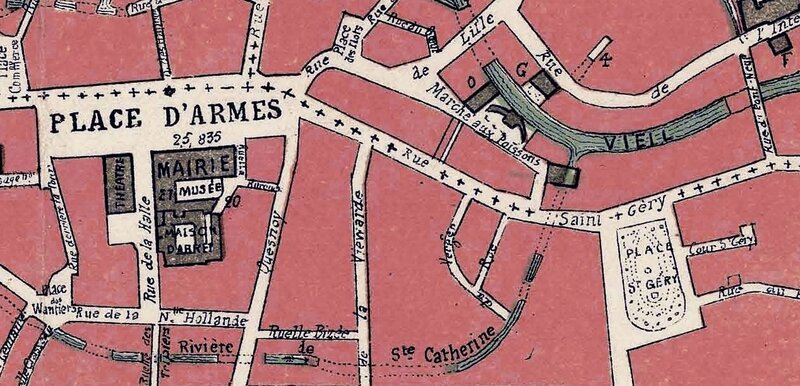
Plan du centre ville montrant également la place St géry:
Delame reprend :
Pendant ce temps, les Canadiens poursuivant leur route, avançaient et entraient dans Quiévrain à midi, par une pluie, battante: l'aile droite dépassait Sebourg. Nous entendions sans cesse le canon dans la direction de Condé, qui était encore occupé par les Allemands.
Le jeudi 7 novembre 1918, fut une journée d'allégresse, la Ville fêtant l'entrée des Canadiens. Une estrade ornée de plantes vertes avait été dressée sur la Grand 'Place, les drapeaux tricolores sortant de leurs cachettes pavoisaient la Mairie.
A dix heures, suivant l'horaire prévu, les troupes anglaises, écossaises et canadiennes, vinrent prendre leurs positions sur la Grand 'Place, précédées chacunes par une musique.
Le général, son Etat-major et le prince de Galles, firent leur entrée au milieu de vibrants hourrahs, la musique jouant la Marseillaise, God save the King, et l'Hymne canadien [Ô Canada ???].

Revue des troupes:
en tête M. DAMIEN, le général Horne et le brigadier général Odlum (casque)
au second rang, regardant les soldats, le Général Currie et le Prince de Galles.

on aperçoit à gauche R.Delame derrière le Préfet Naudin
et, caché par le militaire casqué, J.Billiet.
Puis, des enfants habillés de blanc, qui se tenaient sur le côté de l'estrade, remirent des fleurs aux officiers supérieurs.
Les trois appariteurs se tenaient derrière MM. Billiet et Damien, portant les oriflammes aux armes de la Ville qui devaient leur être offerts.
Notre concitoyen, le peintre M. Membré, avait illustré le discours qu'allait prononcer M. Damien, d'une aquarelle représentant l'Hôtel-de-Ville défendu par des canons. Aussi, le général Horne et le prince de Galles en demandèrent-ils un exemplaire.
M. le Préfet Naudin, MM. F. Damien, et J. Billiet s'avancèrent vers le général pour lui souhaiter la bienvenue en ces termes :

La Grand'Place le 7 Novembre pendant le discours de M. DAMIEN (source J. Thiroux)
M. F. Damien remit alors à chacun des Généraux un diplôme, ainsi qu'un pavillon de soie aux couleurs françaises, sur lequel étaient peintes les armes de Valenciennes.

M. DAMIEN durant la réponse du général HORNE
au premier plan le Général Canadien CURRIE
derrière M. DAMIEN : M. Jules BILLIET
Le général Horne répondit :
|
Monsieur le Maire, Je désire, au nom de la 1ère Armée britannique que j'ai l'honneur de commander, vous exprimer, ainsi qu'à vos concitoyens, combien nous sommes sensibles à l'accueil que vous nous avez réservé aujourd'hui. Nous nous réjouissons avec vous d'avoir pu aider à la libération et au retour à la france de l'historique et important Ville de valenciennes. Nous sommes profondément touchés par l'expression de votre gratitude et nous nous empressons de vous assurer de notre sincère sympathie pour vous et vos concitoyens pour toutes les souffrances auxquelles vous avez été soumis pendant ces quatre dernières années, et qui ont été si noblement supportées. Nous considérons avec indignation l'évacuation de vos habitants, la dévastation de votre Cité, le vol de vos oeuvres d'art, le pillage de la propriété privée et les autres atrocités commises par les Allemands. Nous déplorons la destruction de vos édifices du fait des nécessités militaires, mais nous remercions Dieu qu'il vous soit possible de nous donner l'assurance qu'aucun citoyen n'a été victime d'un obus britannique. Je suis très sensible, et je parle aussi au nom du Général Currie et du Général Godley, de l'honneur que vous nous avez fait en nous conférant le titre de de Citoyen de votre bonne et franke Cité. Nous acceptons ce titre avec orgueil et reconnaissance. Nous conserverons toujours comme de glorieux souvenirs les drapeaux que vous avez bien voulu nous offrir en ce jour mémorable. Nous vous faisons remarquer que nous n'avons mérité cet honneur par aucun fait ou action spéciale de notre part, mais nous reconnaissons que c'est le témoignage que vous voulez bien donner à la bravoure, à la ténacité et aux durs combats soutenus par les troupes Britanniques, dont le résultat a été la libération de votre belle Cité. |
Puis le prince de Galles remercia à son tour, se déclarant "heureux que ce fut au courage des armées britanniques qu'eût été due la délivrance de Valenciennes"
Pendant toute cette cérémonie, la chèvre fétiche du régiment écossais allait de banquette en banquette manger les fleurs que portaient les enfants.
A ce moment se produisit un incident amusant. Le Prince de Galles confondit le préfet en uniforme avec l'appariteur municipal, également en uniforme, et c'est à ce dernier qu'il tendit alors la main. l'appariteur n'en fut nullement intimidé et demanda au Prince des nouvelles de son "père". L'assemblée s'amusa fort de cette confusion.
On retrouve sur le site canadien "Office national du film", une séquence montrant à partir de 3:19 sur les 9min31, des officiers montant en voiture, à 3:44 la place St Géry avec l'arrivée du général Currie et des officiels descendant de voiture devant la maison du n°19, puis officiels et soldats alliés sur la Grand'Place de Valenciennes. (fin à 6:19)
Puis, commença le défilé, et nous pûmes admirer la belle tenue des troupes canadiennes. Les Ecossais, de leur côté, recueillirent également les applaudissements des Valenciennois.

87th Battalion Band playing outside Hotel de Ville. November, 1918
Le Général et le prince de Galles retournèrent ensuite à Denain et M. Billiet présenta à M. Naudin les derniers otages, MM. Gravis et G. Ewbank, [de retour de Lithuanie] à qui il adressa quelques paroles de félicitations. [voir Otages en Lithuanie]
Les membres de la Croix-Rouge de Valenciennes eurent une pieuse pensée pour l'infirmière Mme Besnard, qui s'était tant dévouée pour ses concitoyens et qui eût été si heureuse d'assister à cette magnifique manifestation.
Nous apprîmes bientôt que les Canadiens, poursuivant leur avance étaient arrivés à Boussu [Belgique], et que des parlementaires allemands étaient partis pour Paris, afin de traiter de l'Armistice.
Quand commence le mois de Novembre 1918 les derniers préparatifs pour la capture de Valenciennes ont amenés nombre de bataillons Canadiens aux portes de la ville. Notamment, pour une attaque venant de l'Ouest, le 38e Bataillon qui doit pénétrer par le Faubourg de Paris, et le 72e bataillon plus au Nord.
|
In the evening of October 31, we heard that Austria-Hungary, separating itself from Germany, was asking for peace, accepting the conditions listed by America, what which made us great pleasure. German soldiers did not want to fight, being completely discouraged, too, before the last counter-attacks, one distributed them a liter of alcohol, a litre of wine, beer and coffee. The sentry guarding the Incas Street in front of my home asked me for civilian clothes to hide himself. On November 1st, the attack began at six o'clock in the morning, the city being surrounded by a circle of fire. It was an indescribable rollover with crash of glass and bricks. Our beds were shaking, but we were not at all impressed, thinking to our deliverance. From the “Vieille-Poissonnerie” street, where we had our quarter in the cellars of M. Gabet, to the Chapel Saint-Gery, there are approximately 200 meters. Not wanting to spend All Saints without attending Mass, we went there hugging the walls, and hastening the pace. The shells burst over our heads and large pieces fell at our feet. In the chapel, there were twenty people, when the dean, bishop Jansoone, began the mass that he said as quickly as possible. At the time of communion, three bombs fell a few meters away causing great damage. However, we remained impassive, and when the Dean was given the blessing, he turned and said: "Let everyone come down to the basement immediately." We stayed there three quarters of an hour before returning to our home in the cellars of M. Gabet. Despite the rain of shells, Jules Billiet who was nearly killed, went to the Commandanture commander if the men who were to respond to the call could stay at home, not wanting to take responsibility for an accident. It’s under this rain of shells that they hastened to return home Feeling our deliverance close, Mr. Billiet wrote a dispatch that the municipality should sent to the President of the Republic. Around half past ten a great roar of heavy artillery succeeded a relative quiet. At eleven o'clock, the instant is exciting, fires have started rue de Famars. A breathless fireman tells us that the English are the Boulevard Saly and fight at the entrance of the Famars Street, the Germans hiding in doorways for their riposte. Meanwhile, troops gather to retreat, leaving only the machine gunners to protect them. Large water mains are punctured. Mr. Giard, baker, arrives breathless to tell us a shell felt in his oven and it was miraculously saved, the plain of Mons having suffered much At three o'clock, the situation becomes more and more thrilling. We finished lunch in the cellar of Dean Jansoone with Mr. and Mrs. Jules Billiet, when we are told that the English arrived in the Rue Saint-Jacques. We leave hurriedly and see indeed the Germans soldiers at the corner store "At the Worker gun, at the ready to fire on them, and the officers who observed the movement from the upper Saint-Gery church tower coming down hurriedly to escape Meanwhile, the house of Mr. Chamfort was burning At five o'clock one came to tell us that the house next to our store of flour, 115, rue de Famars was also burning. I went there with Mr. Malaquin Three machine guns were installed in front of the Impasse des Cardinaux, firing on English men. It was dangerous to cross the street. The Germans arrested their fire to let us pass. Mr. Billiet rejoined us with the firefighters Mr. Malaquin took command. As there was no water, they had to make do, firefighters using their ax. After half an hour, Mr. Malaquin had the control and our flour was saved On the way home I stopped at Mr. Verdavaine house, Oultremann Street, where lived the regimental commander, who had left my house Boulevard Watteau where he was no longer safe. He said he pushed back the English on Boulevard Saly, but as they were not many, they were forced to retreat: indeed his men had had their bag packed and waited in the cellar for a lull to get under way Also, is it all happy that I went back to our encampment of Vieille-Poissoniere Street, having the certainty to be delivered the next morning. For its part, the X° Canadian Brigade had attacked and captured Mount Houy, and had advanced up to the Faubourg de Paris. It was a particularly brilliant feat, which had prevented the bombing of the town and villages in the south where Canadians knew there were still civilians. X° brigade had made 1800 prisoners, exceeding the number of assault troops, not counting the eight hundred Germans who had been buried. In the evening, the troops of the XII° Canadian Infantry Brigade had forced a passage through the dried canal, near the mill Gilliard are preparing themselves to free Valenciennes the next day. (in Delame : "Valenciennes Occupation allemande 1914-1918. Faits de guerre et souvenirs" Hollande & Fils ed. 1933) |
Le journal de guerre du 38e Bataillon, bien que succinct, permet de suivre les opérations telles qu'elles se sont déroulées. La chance veut que la Bibliothèque Archives du Canada ait mis en ligne un certain nombre de photos - sans ordre chronologique - que je vais tenter de réorganiser.
Le plan est simple : les 1 et 2 novembre les 38e et 72e bataillons de la 12e Brigade d'Infanterie Canadienne attaquent par l'Est, le 38e sera rejoint au sud par le 47e bataillon de la 10e brigade, tandis que 44e et 46e de la même brigade attaquent par le sud le point hautement fortifié du Mont Houy que n'ont pas pu prendre les troupes britanniques les jours précédents.
Le 38e Bataillon part du faubourg de Paris, traversera le Canal de l'Escaut (puis le vieux lit de l'Escaut) et enfin la ville en direction de Marly en deux lignes parallèles après la traversée du canal.
Le 72e fait une manoeuvre similaire au Nord. Tous convergent vers la "ligne verte", qui part du Cimetière St-Roch et longe la Rue du Rôleur qui une fois atteinte ouvre la voie vers Mons (où le CEC sera le 11 novembre 1918), le 72e empruntant alors la Route Nationale qui conduit à la frontière.
Ligne de front |
1/11 |
Le bataillon est en première ligne sur la rive ouest du canal de l’ESCAUT. Le bataillon a commencé à traverser le Canal de l’ESCAUT en E.14.b.00.60 à 11h45. Traversée terminée à 12h40 - pour porter l'attaque sur VALENCIENNES. Une résistance considérable est rencontrée de la part de mitrailleuses ennemies et tireurs d'élite, et quatre postes ont été décimés. Le bataillon se positionne pour la nuit le long des voies de chemins de fer et le contact a été établi avec le 72e Bataillon de notre Brigade Canadienne à gauche et la 10e Brigade d'Infanterie à notre droite ; des patrouilles ont été envoyées en la ville la nuit et ont rencontré une considérable résistance de la part de mitrailleuses et de mortiers de tranchée. Pertes - Un officier blessé (mort ensuite de ses blessures) - lieutenant. E.T. Mennie, MD. Autres grades : sept blessés et 3 tués. Beau temps
|
|
id |
2/11 |
Le bataillon se prépare pour une autre attaque sur VALENCIENNES à l'aube et les compagnies ont progressé jusqu’à la banlieue est de la ville et s’établissent à E.10.a.35.30. à J[sic, mais obligatoirement E . NDT].16.A.05.75. où un imposant barrage leur est opposé. Quelques prisonniers et du matériel ont été capturés bien que la plus grande partie ait été évacuée au cours de la soirée précédente. Le bataillon se retranche en E.10.a.35.30. et J[sic, mais obligatoirement E . NDT].16.a.05.75 mais à environ 18h00 le bataillon reçoit l’ordre d’épauler le 102e Bataillon devant ST.SAULVE de E.6.c.40.90. le long de la route en contrebas à E.6.d.3.0. Le Bataillon à relever a été difficile à trouver, mais les compagnies "C" et "D" ont pris la position demandée, avec la compagnie «B» en appui et la compagnie «A» en réserve. B.H.Q. Place St.Géry, VALENCIENNES. Victimes : - Autres grades -. Blessés 13 et disparu : 1. Beau temps
|
|
Ligne de front |
3/11 |
La matinée est consacrée à la réorganisation en prévision de l'attaque de l'après-midi. À 14h30 avec les compagnies dans le même ordre, le bataillon s’élançait à l’attaque. Quelques oppositions occasionnelles ont été rencontrées et au crépuscule une ligne était occupée à partir X.26.c.05.10 à environ X.26.d.6.0. Le Quartier général du bataillon est avancé dans la nuit à White Chateau à X.25.b.10.45 sur la route de MONS. Le bataillon a reçu l’ordre d'attaquer de nouveau à 06h00 le 4/11. Pertes : autres grades - 4 blessés et un disparu. Temps maussade.
|
L'aile droite progresse en remontant l'Avenue du Faubourg de Paris vers les Boulevards et la Place du Canada (alors place de Famars). Ce sont donc probablement eux qu'a rencontrés la voisine de ma grand'mère paternelle, qui est accourue lui crier : " Nathalie, in est Inglais !"
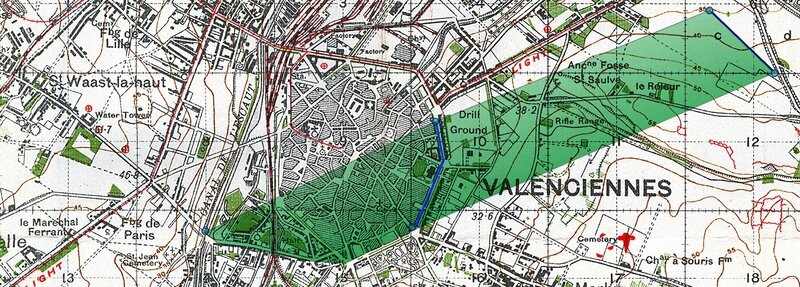
La position adoptée le 2 va de la Place Poterne, près du champ de manoeuvres (Drill ground) -actuellement Plaine de Mons- à la Place Cardon en empruntant les Boulevards (sur l'emplacement des anciennes fortifications) Pater et Watteau.
La position rejointe après 18h place le 38e le long du "Chemin de Saultain", qui porte toujours ce nom, à St Saulve, dans une zone maintenant très urbanisée :
Voici maintenant les photos, réorganisées en fonction de la progression du bataillon. J'ai gardé pour chacune la légende d'origine en Anglais.
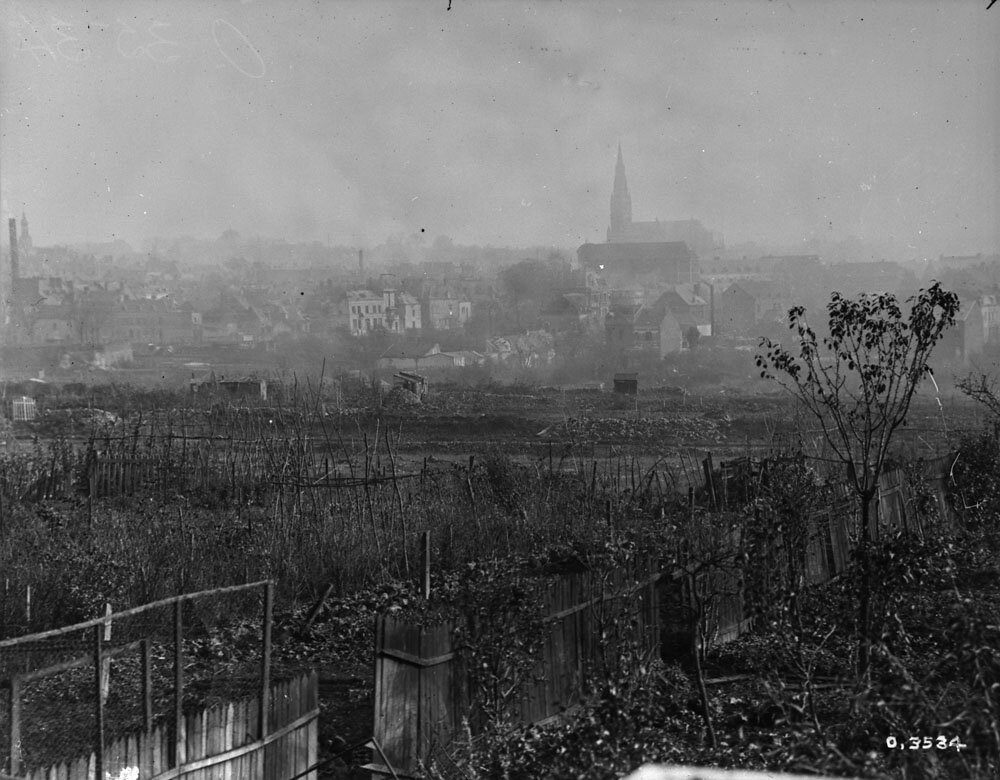
1/11/1918 o.3508
"View of Valenciennes."
Vue de valenciennes
Parmi les fumées s'élevant très probablement de zones bombardées on distingue très nettement la silhouette de la basilique Notre-Dame du St-Cordon, devant laquelle s'impose l'Hôtel-Dieu, alors Boulevard Saly. On reconnaît devant ce bâtiment la silhouette de l'immeuble qui fait le coin du Boulevard, avant que ne commence le Boulevard Beauneveu, bâti comme le précédent sur le tracé des anciennes fortifications.
Cet alignement permet de localiser le lieu de la prise de vue, dégagé, en surélévation, à deux pas de la position de Trench Mortars sur l'avenue de Denain (photo suivante) :
L'avenue de Denain et ses alentours étant désormais bâtis, il n'est plus guère possible de prendre la même vue depuis la position du photographe :
Le photographe a d'ailleurs fait une autre photo en plan plus large, montrant ainsi tout à gauche, dans la fumée des incendies et explosions, le campanile de l'Hotel de Ville :
On pourrait rapprocher cette vue de celle du siège de Valenciennes en 1677 par les troupes de Louis XIV, peint par Van der Meulen :

Ne cherchez pas de ressemblance entre les monuments, les ans (et la Révolution) sont passés par là.
Une vue panoramique à partir d'images extraites d'un film tourné par les caméramen accompagnant l'avancée du bataillon :
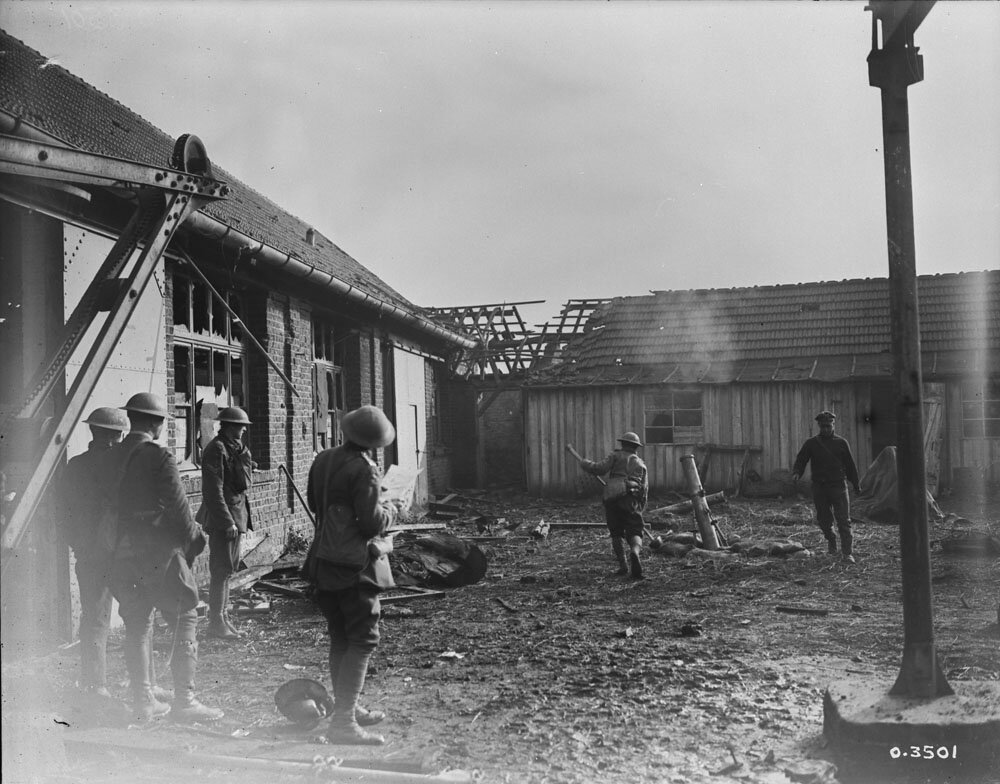
1/11/1918 o.3501
Selon les témoins (ceux qui ont laissé des souvenirs, dont Gabriel Pierard), les mortiers étaient installés à l'entrée de l'Avenue de Denain près de l'actuel emplacement de l'école Dampierre, à quelques 1500m à vol d'oiseau de la Place d'Armes (voir photo précédente).
Moins de 500m de celle-ci situerait déjà la batterie sur les boulevards extérieurs (Beauneveu par exemple) et suppose avoir passé le Canal de l'Escaut :
|
Le Journal de Marche et Opérations Les 4 canons en position à [la] Sentinelle ont tiré 220 coups [durant] l'attaque de ce matin : un succès pour nos troupes qui ont traversé Valenciennes. Un mortier d'une des batteries "Y" détruit mais pas de blessé. Bombardement de Denain avec des Obus à Haute Vélocité |
La localisation "La Sentinelle" à 1Km au sud-ouest de l'emplacement cité plus haut correspond à une situation toujours au-delà du canal de l'Escaut, sur une hauteur dominant Valenciennes, mais qui nous éloignerait d'autant du centre ville.
Il semble qu'un soldat Allemand qui s'est rendu traverse la cour :
Le mortier que le soldat se prépare à écouvillonner avant rechargement est un mortier Newton de 6 pouces, soit 152mm dont un tube hors d'usage est visible en arrière-plan. Il lance entre 100 et -au mieux- 1700m un obus hautement explosif de 24kg.
Le soldat au premier plan regarde comme s'il voyait partir le projectile, (ce qui n'est pas impossible).
Fiche Technique du mortier de tranchée, dont on peut voir -entre autres- un exemplaire à Lisbonne
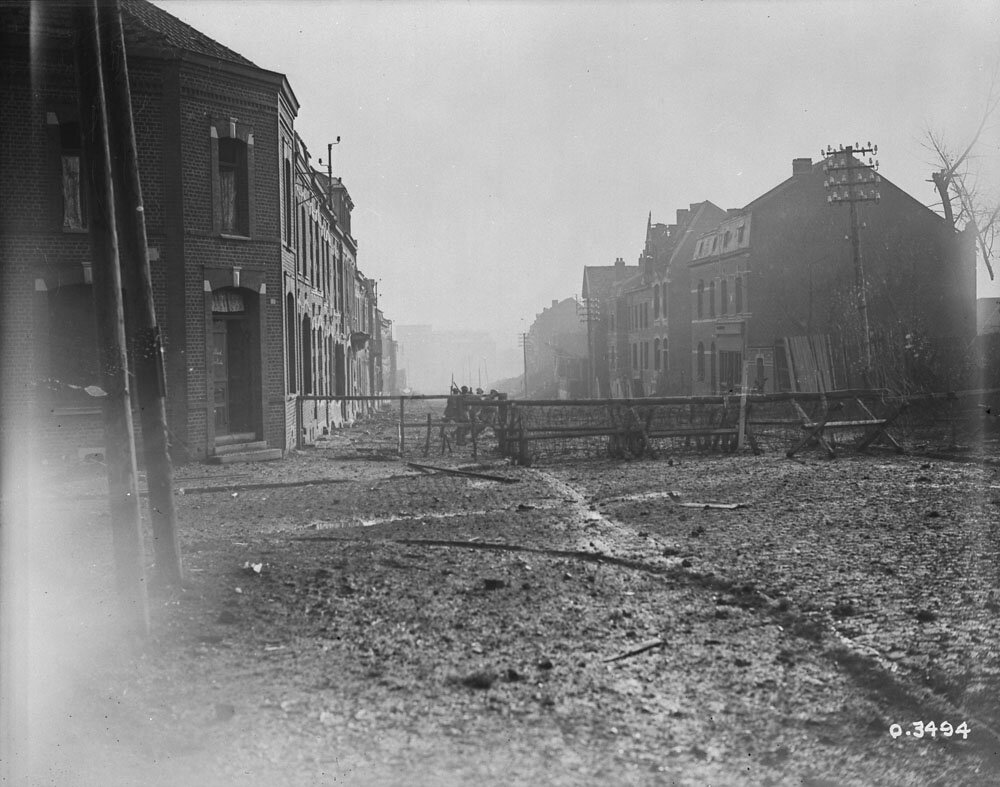
1/11/1918 o.3494
"The first Canadian patrol entering Valenciennes from the West"
La première patrouille canadienne entre dans Valenciennes par l'ouest
Un groupe de 5 hommes vient de passer une barricade de chevaux de frise dans une rue portant les stigmates des combats. Il semble que le photographe les ait saisis au moment où - face à des tirs de l'ennemi ? - ils vont rompre la formation.
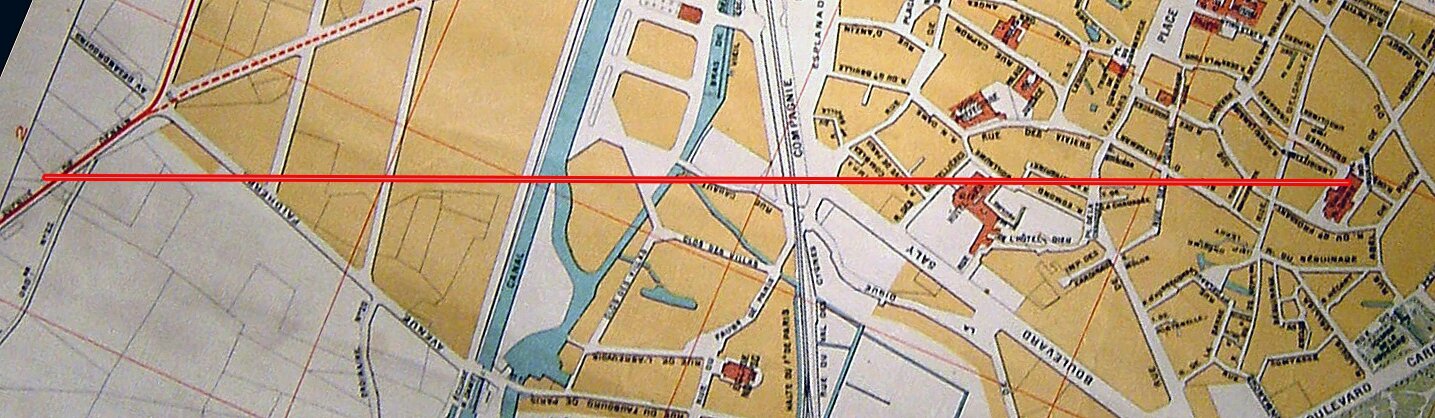
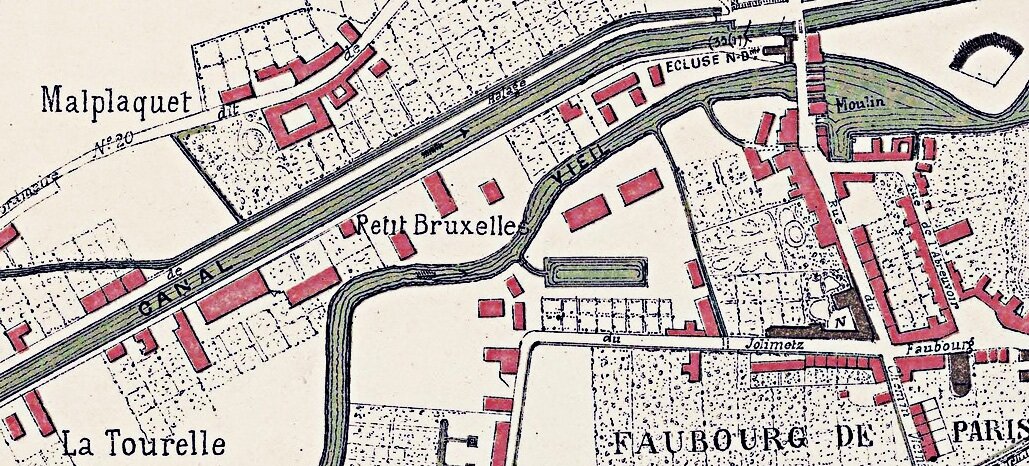
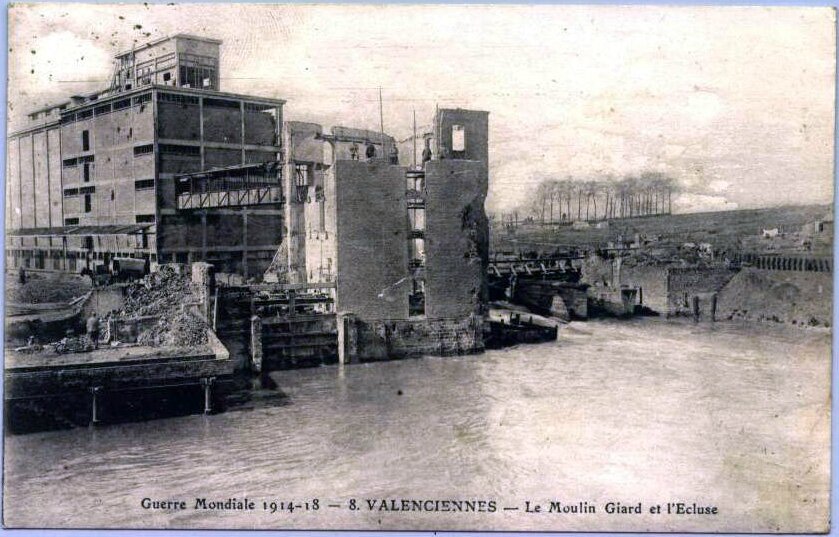
On distingue au fond la silhouette du moulin Gillard, situé au delà du pont sur le canal de l'Escaut, les soldats descendent donc l'avenue Faidherbe, en venant de la pyramide Dampierre et au-delà par l'avenue Désandrouins.
Le photographe s'est placé un peu avant le carrefour de l'avenue et des rues du Général Despinoy à gauche et Désiré Gernez à droite. (lien vers la localisation du carrefour)
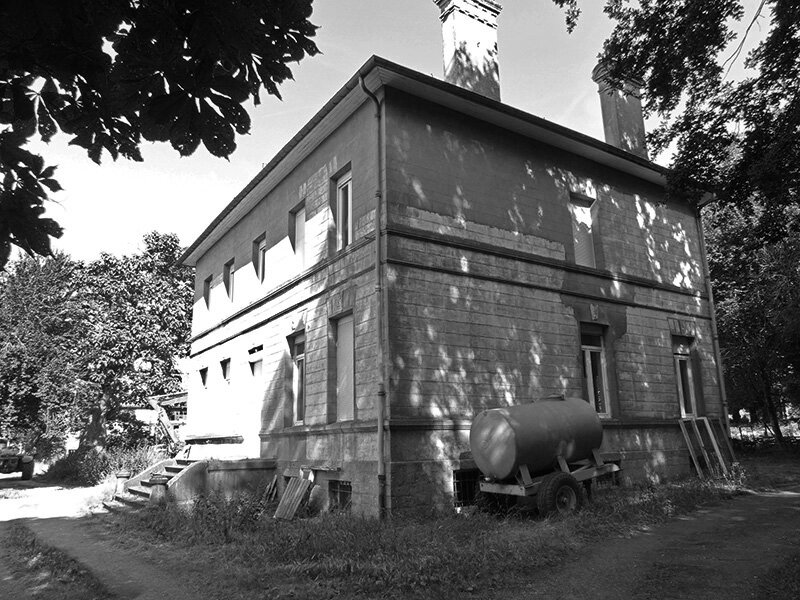
Les maisons telles qu'elles apparaissent de nos jours :

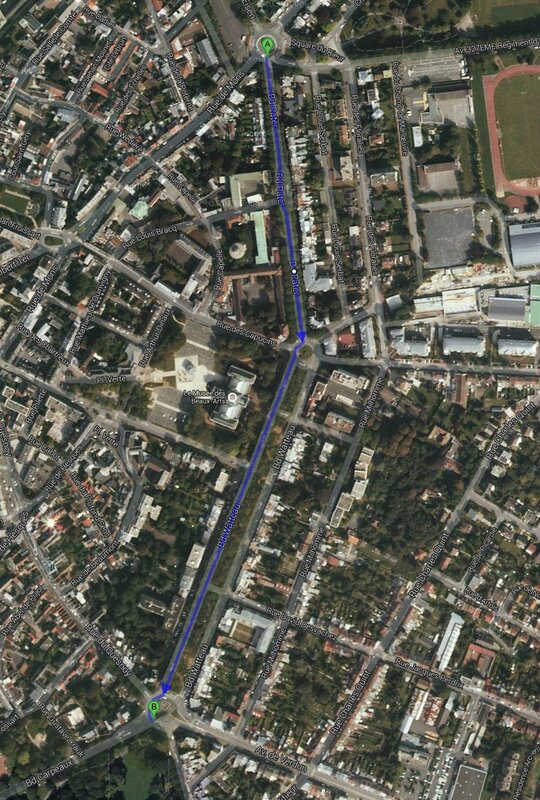
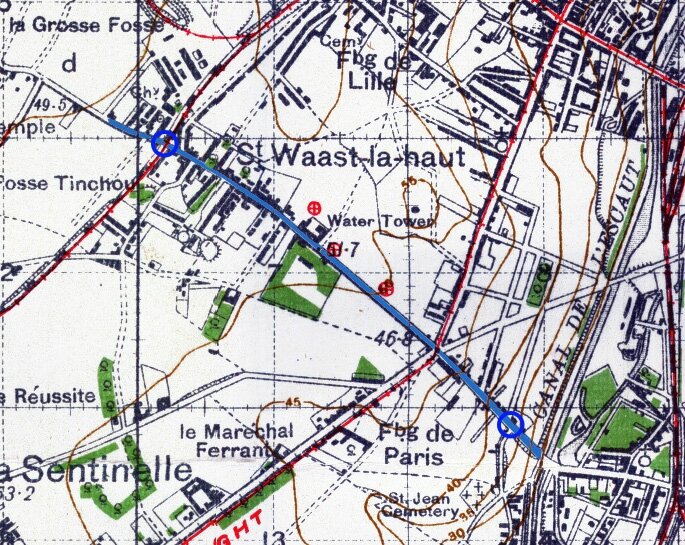
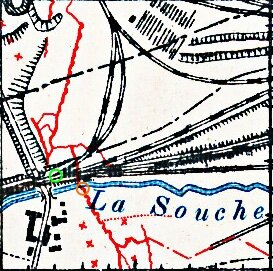
La route fait un coude à gauche avant le pont, ce qui met le bâtiment du moulin, situé à droite de la route, dans l'axe de l'avenue, le carrefour est dans le cercle bleu en bas de la carte ci-dessous :

1/11/1918 0.3506
"Canadians dashing into Valenciennes under heavy gun fire"
Canadiens s'élançant dans Valenciennes sous un feu nourri.
On distingue en arrière-plan 5 hommes qui approchent en courant et que l'officier placé à droite surveille ; le photographe est légèrement décalé par rapport à la photo suivante, mais le lieu est le même, juste après la traversée du canal de l'Escaut au niveau du moulin Gillard avant de pénétrer dans le faubourg de Paris.
(au bas de la ligne bleue sur la carte ci-dessus)
1/11/1918 o.3504
"The first Canadian platoon to enter Valenciennes from the west, advancing towards the Canal."
La première escouade Canadienne à entrer dans Valenciennes par l'ouest avance vers le canal.
Nous assistons aux premiers pas après le franchissement du pont sur le Canal de l'Escaut à l'écluse Notre-Dame, le photographe est sensiblement ici :
La photo suivante, bien datée, faite sous un angle identique, le photographe s'étant baissé, est légendée : un Canadien blessé lors de la traversée des restes de l'écluse du Canal de l'Escaut reçoit les premiers soins.
"A Canadian wounded while crossing the remains of the lock in the Canal de l'Escaut, being attended to by First Aid men". 1 November, 1918
1/11/1918 o.3505
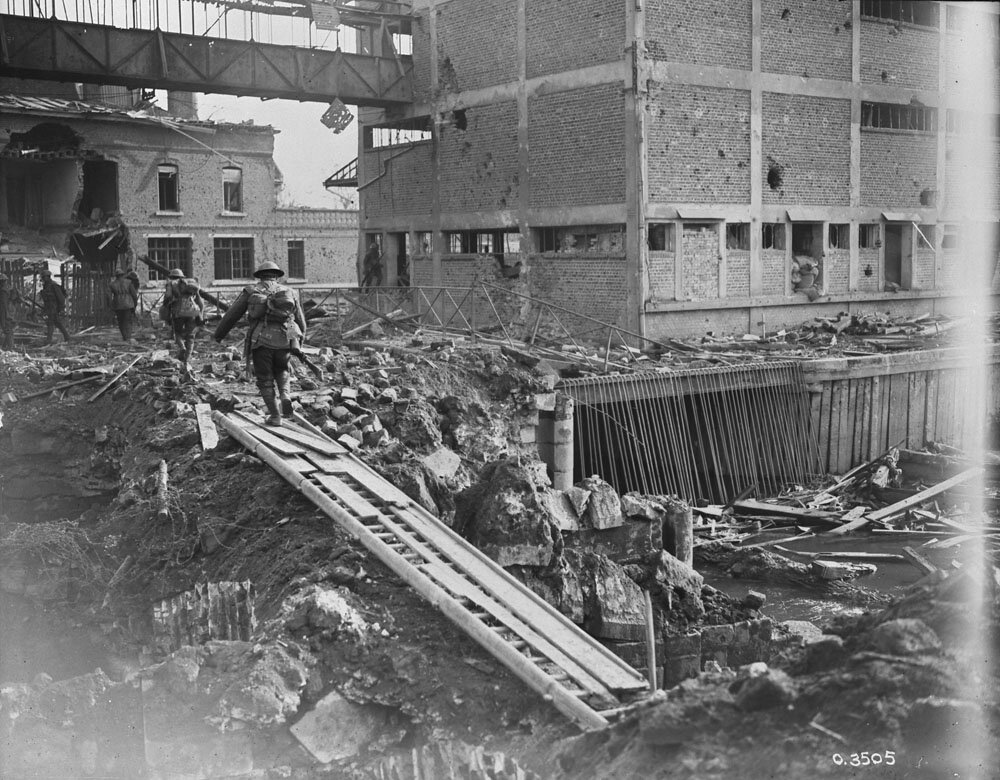
"Canadians going into Valenciennes over improvised bridge"
Canadiens entrant à Valenciennes sur un pont improvisé
Cette passerelle improvisée leur permet de franchir l'écluse du moulin, dont on distingue un bief juste à droite, et un peu plus loin, la grille filtrant les eaux qui a bien du mal à retenir les débris. Ce franchissement fait suite à celui de l'écluse Notre-Dame sur le Canal de l'Escaut, le moulin Gillard étant situé sur le "vieil Escaut", ancien lit du fleuve avant qu'il ne soit canalisé. Est-ce le même groupe de 5 hommes que suit toujours le photographe ?
1/11/1918 o.3500
"The first German prisoner crossing the Canal de l'Escaut Valenciennes."
Le premier Allemand prisonnier traversant le Canal de l'Escaut à Valenciennes
Un bien jeune prisonnier qui n'est pas très à l'aise sur la passerelle improvisée de l'écluse du Moulin, que les soldats Canadiens franchissaient plus allègrement sur la photo précédente.
1/11/1918 o.3497
"A Canadian post in Valenciennes."
Une position canadienne à Valenciennes
C'est une vue partielle des ruines du Moulin Gillard. On distingue un clocher derrière le soldat, c'est celui de l'église Notre-Dame du Sacré-Coeur du Faubourg de Paris, bien abîmée par les bombardements. Sa reconstruction se termine en 1922, elle sera démolie définitivement en 1980 pour des raisons de sécurité.

Ces photos, très connues, montrent les dégâts de la libération :

Sur le mur de la maison dont le pignon a résisté, tout à gauche au premier étage
un point noir : un boulet du siège de 1793 enchassé comme souvenir.

1/11/1918 o.3530
"One of the many fires started by the enemy before the Canadians drove him from Valenciennes."
Un des nombreux incendies allumés par l'ennemi avant que les Canadiens ne le chassent de Valenciennes.
Si la localisation n'est pas précisée, les photos suivantes donnent la solution :
On aperçoit à gauche un militaire qui semble courir avec un papier en main : peut-être un agent de liaison.

1/11/1918 o.3533
"One of the many fires started by the enemy before the Canadians drove him from Valenciennes."
Un des nombreux incendies allumés par l'ennemi avant que les Canadiens ne le chassent de Valenciennes.
Le photographe s'est reculé un peu, dégageant la vue sur le bâtiment du moulin Gillard dont on apercevait la pointe de la verrière sortir de l'ombre sur la gauche de la photo o.3530, et le format s'approche ici du paysage et non plus du portrait.
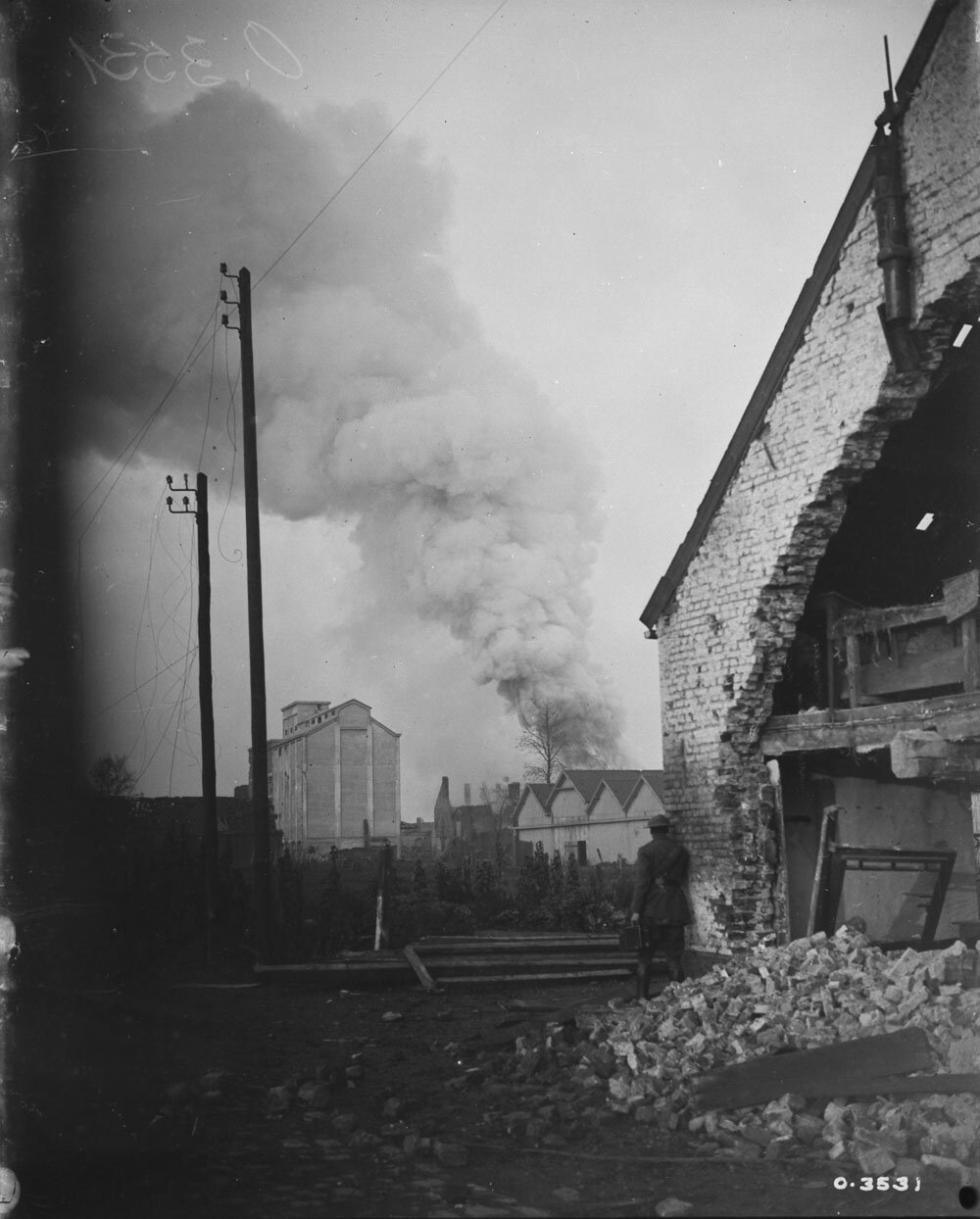
1/11/1918 o.3531
"One of the many fires started by the enemy before the Canadians drove him from Valenciennes."
Un des nombreux incendies allumés par l'ennemi avant que les Canadiens ne le chassent de Valenciennes.
Cette photo complète les précédentes, que l'on peut relier grâce aux pignons du bâtiment incendié au centre. A gauche ce qui ressemble à un silo à grain situe le lieu le long de l'escaut, c'est le Moulin Gillard, qui sera détruit (et incendié) lors des assauts ; la rue du Faubourg de Paris passe sous la passerelle couverte :

C'est la partie droite (claire) du bâtiment dont on voit le pignon sur la photo canadienne, prise donc d'une certaine distance, probablement dans le quartier dénommé "Petit Bruxelles", sur la rive droite de l'Escaut, le canal et le Vieil Escaut sur lequel se trouve l'écluse du moulin se côtoyant. La maison qui brûle est au début de ce quartier en venant du moulin, mais la zone est maintenant portuaire et a subi de profondes modifications.
Noter l'officier qui s'abrite au premier plan : il semble porteur d'une chambre photo : serait-ce l'auteur qui est sur l'une de ses prises de vue, l'appareil -sur pied- déclenchant avec retard ?

dans l'axe un bâtiment blanc aux toits multiples, que l'on retrouve sur cette reconnaissance aérienne de 1918 :

1/11/1918 o.3532
"One of the many fires started by the enemy before the Canadians drove him from Valenciennes."
Un des nombreux incendies allumés par l'ennemi avant que les Canadiens ne le chassent de Valenciennes.
Une nouvelle fois, il s'agit du Moulin Gillard, dont on reconnaît la passerelle couverte qui relie les bâtiments de chaque coté de la rue :
Une autre photo prise sous le même angle :
Ayant pris position sur la rive droite de l'Escaut, il leur reste à rejoindre le centre ville tel que décrit au début de cette page pour la journée du 2 Novembre 1918.
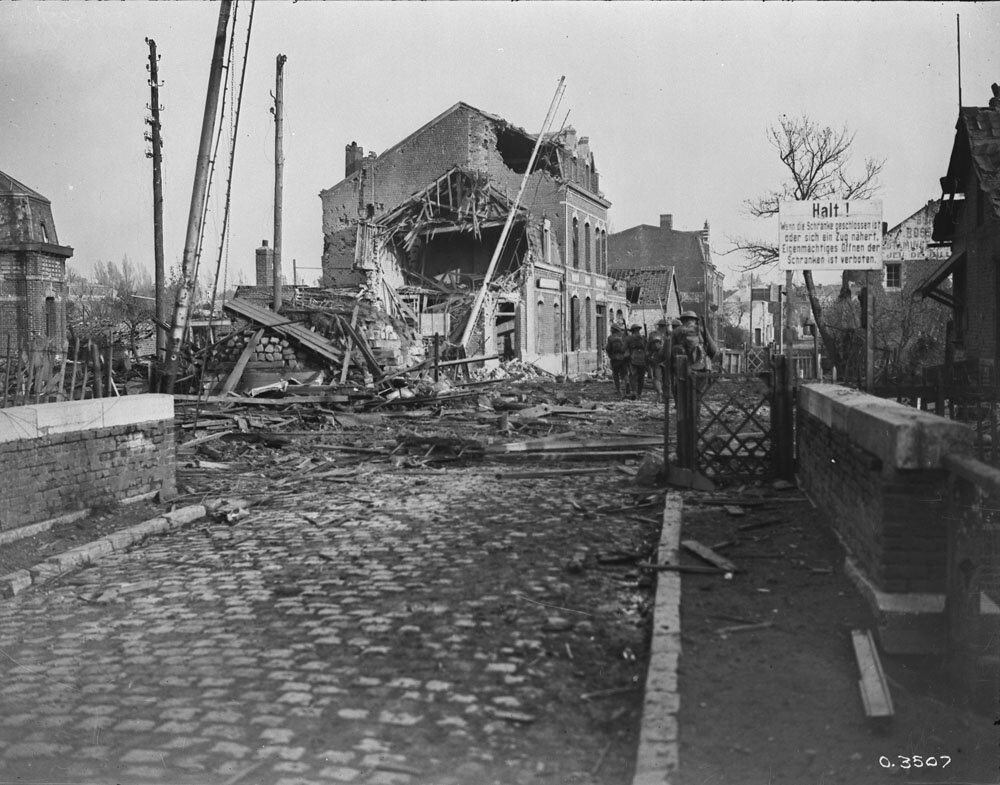
/11/1918 0.3507
"Canadian Patrol crossing the railway in Valenciennes under heavy machine gun fire".
Patrouille Canadienne traversant la voie ferrée à Valenciennes sous un feu nourri de mitrailleuses.
A droite un panneau -non bilingue- rédigé en allemand :
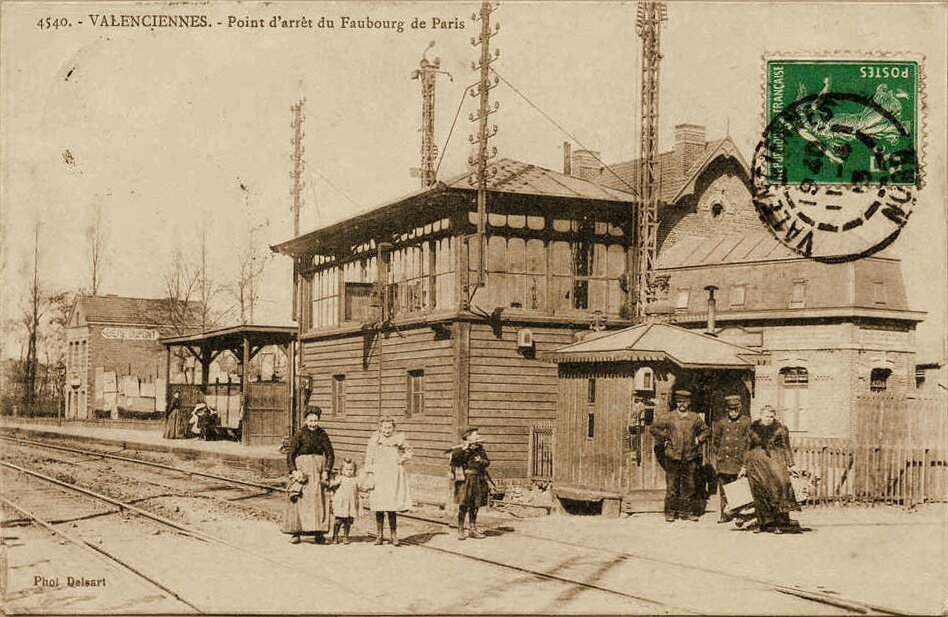
On distingue derrière celui-ci une réclame pour l'Estaminet BOSSUT, "Jeu de billard". L'établissement se situait après guerre au 2 Avenue Désandrouins. Les soldats Canadiens viennent de traverser au niveau de la halte du Faubourg de Paris, Ils emprunt la "Rue du chemin des planches", nous sommes le 2 novembre 1918 au matin, la journée de libération du centre de Valenciennes commence.
Vues du passage à niveau avant et après la guerre. Celui-ci a disparu, au profit d'un passage supérieur près de la nouvelle gare du faubourg, maintenant désaffectée, et de la modification du tracé de la rue dans sa partie basse.
Les premières maisons après le passage, donc celle en partie détruite, ont disparu après guerre : plan d'urbanisation oblige.
/11/1918 o.3495
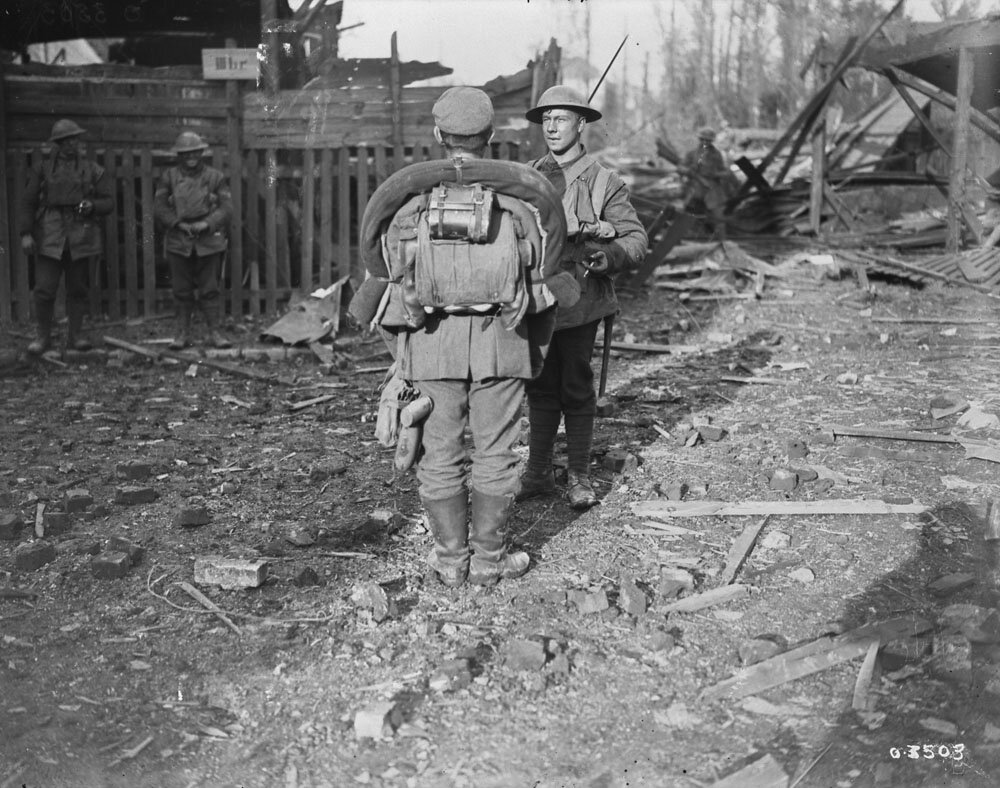
"A Russian Pole made to fight by the Germans walking into the Canadian Lines."
Un Polonais de Russie enrôlé par les Allemands se rend vers les lignes Canadiennes.
De nombreux sujets Russes dont des Polonais annexés avaient été capturés par les Allemands et envoyés sur le front de l'Ouest. Le traitement réservés à ces prisonniers venus de l'Est, quelque soit leur nationalité était inhumain, il n'est donc pas étonnant de retrouver des Russes enrôlés dans l'armée pour ne pas mourir de faim. Celui-ci a dû croiser la patrouille qui vient de partir et se dirige tranquillement vers les lignes Canadiennes. Il porte son équipement au complet, moins les armes .
Le photographe dont on aperçoit l'ombre en bas à droite, preuve qu'il a fait vite, s'est retourné pour le voir aborder la sentinelle dont la baïonnette fixée au canon du fusil est visible. Restés sur les positions que la patrouille vient de quitter, les soldats l'acueillent avec plus de curiosité que d'hostilité..
Le 3 novembre la progression derrière l'ennemi se poursuit, le bataillon prend position 800 yards au sud de la route vers Mons (ligne bleue), alors que le Commandement s'installe à "White Chateau" (château blanc) parfaitement localisé le long de la Nationale menant à Onnaing, coté droit un peu avant cette localité (cercle bleu).
Vue du sud, la position occupée par le bataillon, White Chateau est dans le bosquet à gauche :
Le château est désormais une ferme, gardant l'allure qu'il avait en 1918 : (photos de l'auteur, juillet 2014)

De nombreuses unités Canadiennes ont cantonné à Valenciennes ou dans les environs immédiats lors de la délivrance de la ville ; voici les unités médicales pour lesquelles l'endroit a pu être localisé :

Officiers de la 4° CCCS, Valenciennes, novembre 1918
(source : Bibliothèque et Archives du Canada)

Le lycée avant la guerre. Il n'a pas changé depuis :
(La ville abrite déjà le centre de soins n°6 britannique.)
Le Directeur-adjoint visite le 6/11 la 13e Ambulance de campagne, et parmi d'autres, le Centre Principal de Soins (Main Dressing Station) de la 3° Division Canadienne, situé à St. Saulve, dans un grand immeuble autrefois [grand] séminaire, devenu couvent des Ursulines, évacué en 1916 pour en faire un hopital allemand, et qui "sera un excellent endroit pour un centre de soins" (sic).

Main Dressing Station (croix rouge)

Le grand séminaire tel qu'il le restera
jusqu'à un incendie le 8/2/1973.
Il visite le 7 la 4°CCCS de St. Saulve, ainsi que les Centres Principaux de Soins des 2de et 3° Divisons, situés sur la route St. Saulve - Mons. Le 10, veille de l'armistice, le Quartier Général Canadien s'installe à Valenciennes. Le rédacteur note le 10/11 dans le journal de marche : "Participation à la remise officielle de la ville de Valenciennes au Président de la République par le Général Commandant la Première Armée Britannique."
Directeur Adjoint des Services Médicaux, (A.D.M.S), 1ère Division Canadienne
Reste stationné à Masny, à mi-chemin entre Douai et Valenciennes, jusqu'au 14 novembre où il se déplace à Jemappes, près de Mons. Le journal de marche du 12/11 signale les positions à prendre le lendemain, dont celle de la 3e Division Canadienne dans un secteur qu'il faut lire "AUBRY - PETITE Foret - HERIN - LA SENTINELLE" :

12, Rue Duchesnois, Saint-Saulve
Hugh CAIRNS est né le 4 décembre 1896 à Ashington, Northumberland (NBL), Grande-Bretagne.
Le recensement britannique du 2 avril 1911 situe la famille CAIRNS dans une maison particulière (Private house) au 48 Third Row (3° rangée), Ashington. 3rd row est située dans Linton qui est une cité minière, au plan de ville "carré", de la compagnie des houillères Linton, qui donne son nom à ce hameau situé 2 miles au nord de la paroisse du Saint-Sépulcre d'Ashington. 15 personnes résident dans cette maison de 5 pièces : les parents, mariés depuis 18 ans, le frère du mari, leurs 11 enfants, et une servante.
| Prénom (CAIRNS ou ..) |
Qualité | Date de naissance |
Age (ans) |
Métier | Lieu de naissance |
| George Henry | Chef de famille |
ca. 1864 | 47 | Chef d'équipe adjoint à la mine de charbon. |
Rennington, NBL |
| Elizabeth (DORES) | Épouse | ca. 1869 | 42 | Whickham, Durham | |
| Thomas | Frère | ca. 1869 | 42 | Aide boucher | Bransford Bambro, NBL |
| Henry | Fils | ca. 1893 | 18 | Apprenti boulanger | Morpeth, NBL |
| Albert | Fils | ca. 1895 | 16 | Mineur, haveur | Ashington, NBL |
| Norman | Fils | ca. 1897 | 14 | Apprenti épicier | Ashington, NBL |
| Hugh | Fils | ca. 1897 | 14 | Trieur de charbon | Ashington, NBL |
| Lawrence Wilfred | Fils | ca. 1899 | 12 | Écolier | Ashington, NBL |
| Ruby Blanche Evelyn | Fille | ca. 1901 | 10 | Écolier | Ashington, NBL |
| Winifred May | Fille | ca. 1903 | 8 | Écolier | Ashington, NBL |
| Edwin Donkin | Fils | ca. 1906 | 5 | Écolier | Ashington, NBL |
| George Leslie | Fils | ca. 1908 | 3 | Écolier | Ashington, NBL |
| Eva Rebecca | Fille | ca. 1909 | 2 | Écolier | Ashington, NBL |
| Thomas Cyril | Fils | ca. 1910 | 7 mois | Écolier (sic) | Ashington, NBL |
| Mary Jane (LORD) | 1890 | 21 | Domestique | Cornwall, England |
Le 6 Mai 1911, la famille (dont l'oncle Thomas) s'embarquent à Liverpool sur SS Laurentic de la White Star Company. Les 1592 âmes à bord arrivent le 13 Mai à 19h30 Québec-Grosse Isle, où se trouve le centre de quarantaine ; cette année-là près de 150.000 immigrants passeront par ce centre dans lequel nos passagers débarquent le 14 à 6h.
La destination indiquée par les deux hommes est Edmonton (Alberta), pour y être fermier. Il semble qu'ils s'arrêtent en chemin des quelques 4000km à parcourir, puisque le recensement canadien de 1911, qui - par chance pour nous- débute le 1er Juin 1911, les localise à Saskatoon (Saskatchewan).
Ils résident sans le quartier (ward) n°5, 29e rue Ouest, semble-t-il au n°713 [Rod Filan], et l'enquête nous apprend en plus le mois de naissance, rectifiant parfois l'année, confirmant que Hugh et Norman sont jumeaux. Leurs métiers se sont adaptés aux exigences de leur ville d'accueil :
| Prénom |
Qualité | Date de naissance |
Age (ans) |
Métier | |
| George Henry | Chef de famille |
Mars 1864 | 47 | Charpentier | |
| Elizabeth (DORES) | Epouse | Novembre 1869 | 41 | -/- | |
| Thomas | Frère | Mars 1869 | 42 | Couturier | |
| Henry | Fils | Mars 1893 | 18 | Boulanger | |
| Albert | Fils | Janvier 1895 | 16 | Ajusteur | |
| Norman | Fils | Décembre 1897 | 14 | Livreur | |
| Hugh | Fils | Décembre 1897 | 14 | Coursier | |
| Lawrence Wilfred | Fils | Octobre 1898 |
12 | Coursier | |
| Ruby Blanche Evelyn | Fille | Juillet 1900 |
10 | -/- | |
| Winifred May | Fille | Mai 1903 | 8 | -/- | |
| Edward | Fils | Juillet 1905 |
5 | -/- | |
| George Leslie | Fils | Juillet 1907 |
3 | -/- | |
| Eva Rebecca | Fille | Décembre 1909 | 2 | -/- | |
| Thomas Cyril | Fils | Septembre 1910 | 9 mois | -/- | |
Ils déménagent 2 ans après, pour une maison non loin de là : 832 Avenue G North, où les retrouve le recensement de 1916. Le changement important dans leur situation est la mention qui figure sur les lignes de Henry, Albert et Hugh : "65th Battalion" nous informant que 3 des fils (sur les 4 en âge de le faire) se sont engagés :
Henry, l'aîné, né le 6 Mars 1893, qui a épousé le 26 septembre 1914 Elizabeth Davina STOBIE, alors boulanger, s'engage le 8 avril 1916. Il sera affecté au "8th Stationary Hospital" du CAMC (Canadian Army Medical Corps), unité non combattante, eu égard probablement au fait qu'il est père de famille (un garçon prénommé George Henry né en 1915).
Son nom apparaît dans la liste établie à Saskatoon le 10 Mai 1916, n° matricule 534199 :
Créé justement à Saskatoon le 27 mars 1916, l'hôpital canadien permanent n°8 embarque à Halifax le 19 mai 1916 à bord du transport de troupe "Adriatic" de la White Star (dont il était l'un des Big Four, reconverti) qui lève l'ancre le 22 et arrive à Liverpool le 29 Mai où ils débarquent le 30 à destination de Shorncliffe (Kent), (ce qui confirme la remarque du recensement de 1916) où se situe le camp d'entrainement, plus précisément à Dibgate camp, un mile à l'ouest, où se trouve l'école de formation du corps médical, actuellement centre d'entraînement des Cadets :
L'Hôpital n°8 sera situé successivement :
Sans autres renseignement sur Henry, démobilisé le 8 juin 1919 au Canada, dont je sais qu'il aura notamment une fille, Shirlie, vivant maintenant à Saskatoon, et dont il sera question dans une prochaine page puisqu'elle est venue 2 fois à Valenciennes.
Albert est né le 28 Janvier 1895, il déclare être épicier lorsqu'il s'enrole le 11 Août 1915, matricule 472262. On y apprend qu'il a déjà servi 1 ans dans les 105e Fusiliers (de Saskatoon) créé en 1914. Il sera versé dans le 65e bataillon (Saskatchewan du nord). Il bénéficiera -comme Hugh- d'une permission pour aller moissonner du 15 Août au 16 Septembre 1915, avec prolongation juqu'au 15 octobre. Il sera versé ensuite dans le 46e bataillon.
On ne possède pas de photo d'Albert, mais ses documents indiquent qu'il a un tatouage représentant une jeune fille sur l'avant-bras droit !
Son parcours ressemble à celui de son frère au sein du 46e bataillon (voir ci-dessous), avec bien entendu des variantes : il est nommé lance-corporal le 6 juin 1917, et promu caporal le 22 septembre, blessé par éclat d'obus à l'avant-bras droit le 26 octobre 1917 près d'Ypres. Évacue vers une Casualty Clearing Station (numéro non signalé, mais les 2e & 3e CCCS étaient alors à "Remy Siding" près Lijssenthoek, à 12km au SO d'Ypres), dirigé vers le 6th Canadian General Hospital situé à Troyes (Aube) où il sera soigné pour une fracture du cubitus, il restera en convalescence au dépôt régimentaire à Bramshott via Epsom jusqu'au 7 avril 1918.
Blessé de nouveau par balle à la tête le 2 septembre 1918 sur la ligne Drocourt-Quéant alors que le bataillon, partant du village d'Haucourt en ruines tente d'atteindre Dury en suivant un barrage roulant qui précède les 47e et 50e bataillon, il est admis dans un centre de soin "rapproché" (Casualty Clearing Station) dont le n° n'est pas rapporté, mais seules les 1ère et 4e CCCS était "dans le secteur" à Agnès-les-Duisans, à 25km de Haucourt, derrière Arras (12 miles était la distance prévue entre front et CCS).
Soigné au 3e HG de Boulogne où il a été transporté le 4 puis au 83e Hopital Général situé à Terlincthun à l'ouest de Boulogne le 8, il y décède le 10 septembre 1918.
Il est inhumé au cimetière britannique voisin de Terlincthun, tombe III. E. 8. dont l'inscription est
"PEACE PERFECT PEACE IN THIS DARK WORLD OF SIN".

Du cimetière on aperçoit non loin la colonne de la grande armée surmontée de la statue de Napoléon 1er.
Hugh a déclaré être plombier lorsqu'il s'est enrôlé le 2 Août 1915, matricule 472168. Lui aussi est affecté au 65th Bataillon. Il bénéficiera d'une permission pour aller moissonner du 15 Août au 16 Septembre 1915, avec prolongation juqu'au 15 octobre.

Les seuls renseignements concordants de sa vie civile indiquent qu'il a été joueur de foot-ball (soccer). Il apparaît dans une photo prise à Saskatoon en 1913, 2° joueur au premier rang, depuis la gauche. Sa ville d'adoption s'en souviendra après la guerre avec un monument le représentant.
On ne dispose que d'une seule photo du Caporal Hugh Cairns :
Désormais les destins des deux frères qui figurent ensemble dans le nominal roll du 65e vont être liés :
Le 65e embarque à Halifax le 20 juin 1916 à bord de l'EMPRESS of BRITAIN. Ce paquebot et son jumeau l'Empress of Ireland qui appartiennent à la Canadian Pacific Steamship Company, faisaient avant la guerre la traversée régulière de l'Atlantique, amenant au Canada les immigrants de Grande-Bretagne. Il arrive à Liverpool le 28 juin.
Le bataillon cesse d'exister en Septembre 1916, après que les 33 officiers et les 1040 hommes et sous-officiers aient été répartis dans les 44e, 46e, 54e, 72e et 73e bataillons en Juillet.
Le 46e bataillon a été créé en Février 1915 sous le commandement du Lieutenant-Colonel Hubert SNELL, et mobilisé à Moose Jaw. Il avait embarqué à Halifax le 23 Octobre 1915 à bord du SS LAPLAND de la Red Star Line et débarqué à Liverpool le 30 Octobre.
Hugh et Albert seront affectés au 46e le 30 juin. Hugh appartient à la 3°Section, Compagnie "A".
Le bataillon intègre la 10° brigade, 4° Division Canadienne, et est désormais sous les ordres du Lieutenant-Colonel DAWSON Herbert John, le Lieutenant-Colonel SNELL grièvement blessé le 5 juillet alors qu'il tentait d'éloigner une grenade mal jetée lors d'un exercice de lancer des nouvelles grenades Mills, étant encore en convalescence .
A noter qu'entre le 2 Juillet 1915 et le 23 Juillet 1916, 14 soldats perdront la vie, 11 sont inhumés en Grande-Bretagne, 3 au Canada.
Arrivés à Bramshott où se trouve le dépot régimental le 8 Août 1916 les troupes traversent le Channel sur le "Princesse Clémentine", vapeur à aubes belge, et débarquent au Havre (noté Harve) le 11 pour participer à la guerre et n'être démobilisé que le 9 Juin 1919, ce que ni Albert ni Hugh ne verront.
Le 'Princesse Clémentine' au Havre
Les Flandres
La suite sera basée sur les déplacements du bataillon qui à peine débarqué est conduit en train jusque Godewaersvelde, d'où les hommes marchent jusque Steenvoorde puis Reningelst en Belgique qu'ils atteignent le 15 Août pour relever le 18° Bat., et s'avancent jusque Vierstraat le 22 et La Clytte le 29.
Il existe au Canada une sommet (2910m), nommé La Clytte, entourée de Lens Moutain, et Kemmel Mountain. Arras, Cambrai, Valenciennes (3150m), St Julien, Zillebeke Mountains commémorent un peu plus à l'Est les batailles de même nom.
Le premier contact avec le front des Flandres a été brutal : le premier jour, le 15, la compagnie "B", qui rejoignait des positions de réserves déplore quatre blessés par balle, 3 soldats et un sous-officier, qui seront, c'est à signaler, cités dans le journal de marche qui habituellement réserve ses lignes aux seuls officiers, se contentant de noter le nombre des "O.R.", soldats et sous-officiers :
De même : un blessé le 16, 3 autres le 17, dont le soldat #437026 Harrison W., de la compagnie "D", qui recevra une balle dans la tête en étant au poste d'écoute. On apprendra le 20 que le soldat Harrison, décédé le 19, est le premier mort au combat du 46° et qu'il a été inhumé avec les honneurs par le 18° Bataillon à Ridgewood Cemetery où il repose toujours (CWGC) ; bien que certains auteurs annoncent davantage, 979 noms de soldats du 46° figurent actuellement dans les listes de la Commonwealth War Graves Commission qui contiennent ceux de quelques 6480 Canadiens décédés dans cette guerre.
Les postes d'écoute ont vu leur sécurité renforcée, car dans la nuit du 23 au 24, un soldat des Welsh Fusiliers qui courait vers celui du bataillon reçut un léger coup de baïonnette.....
Le 8 septembre 1916 Hugh est affecté à une section de mitrailleurs Lewis pour lequel il a reçu une formation d'une journée.
Le 46e restera dans la région d'Ypres jusqu'au 11 septembre, pour rejoindre St Omer via Hazebrouck -à pied, près de 60Km, en 3 jours malgré son état de fatique, musique en tête en traversant les villes- et atteindre Bayenghem-lès-Éperlecques pour entraînement, mais surtout être pour un temps à l'arrière du front, où ils échangèrent le fusil Ross, excellente arme de tir à culasse rectiligne, réglementaire au Canada, mais peu adapté aux conditions des tranchées et à la qualité des munitions de guerre,
pour le SMLE (Short Magazine Lee-Enfield), à verrou rotatif qui équipe toutes les troupes de l'Empire,
avant de partir pour la Somme pour laquelle ils reçurent un entraînement aux méthodes d'attaques qui y étaient utilisées.
On dénombre 10 décès durant cette première période d'action :
| HARRISON | W | 437026 | 19/08/1916 |
| THORP | TM | 472560 | 24/08/1916 |
| WILLIAMS | AJ | 474141 | 24/08/1916 |
| BERRY | A | 126953 | 25/08/1916 |
| MORRISON | G | 437875 | 31/08/1916 |
| PHILBRICK | BR | (Captain) | 09/09/1916 |
| FORBES | JAMCG | 472856 | 11/09/1916 |
| TALLIS | EA | 472918 | 11/09/1916 |
| FAULDS | GM | 472189 | 17/09/1916 |
| IRELAND | DW | 219354 | 17/09/1916 |
9 reposent à Ridgewood Cemetery, TALLIS Edgard Alfred est inhumé au BAILLEUL COMMUNAL CEMETERY EXTENSION.
6 membres de la famille TALLIS sont enrôlés au 65° et intègrent le 46° : Les 3 frères Edgar, Victor et William, musiciens bien connus de Borden (Saskatchewan) et descendants du compositeur du XVI° siècle, Sir Thomas Tallis, le fils de William, Arnold, et deux neveux Sidney et Harold. (Accès à leurs dossiers)
Outre Edgar, Victor sera tué le 19/02/1917 non loin de Vimy, Arnold, déjà blessé (gazé) lors de l'affaire du "Pimple" près de Vimy, sera tué sur la ligne Drocourt-Quéant le 2/9/1918 (le jour où Albert Cairns est mortellement blessé), Harold sera tué à Valenciennes le 1/11/1918 (le jour où Hugh Cairns est mortellement blessé). William (blessé le 3/11/1916) et Sidney rentreront au pays avec une santé précaire.
La Somme
Les Alliés espéraient que l'offensive de la Somme attirerait les forces allemandes loin de la lutte acharnée à Verdun. Le premier jour de la bataille a coûté la britanniques 57450 victimes, le plus lourd tribut qu'ils aient eu à supporter en une seule journée de combat, le Régiment de Terre-Neuve a été pratiquement anéanti moins d'une demi-heure - 710 tués, blessés ou portés disparus sur 801 hommes. La bataille a dégénéré en une guerre d'usure. Quand elle a prit fin, les Alliés avaient gagné quelques 300km² de territoire. Les pertes allemandes furent d'environ 650.000 ; 420.000 pour les Britanniques -près de 128.000 tués- (dont 24.029 Victimes Canadiennes), et 195.000 Français. Les batailles de l'Ancre font partie de cette grande bataille.
Le 46e bataillon est arrivé sur le champ de bataille de la Somme le 8 Octobre et y est resté jusqu'au 25 Novembre, jouant un rôle important dans les batailles dites de l'Ancre. En outre, le bataillon a fait des rotations dans les tranchées de première ligne, et a fourni des équipes de travail qui ont creusé et réparé des tranchées sous le feu de l'ennemi. Mais même quand ils étaient en retrait, les aires de bivouac dans les crayères étaient à portée de l'artillerie allemande.
Il occupera successivement et plusieurs fois les positions-clefs suivantes, entrecoupés de pause à Albert et à proximité :
Il rejoint ensuite une zone de repos par Albert, Varennes, Herissart, Terramesnil où il cantonne le 30/11.
Le nombre de décès répertoriés sur cette période s'élève à 92, dont 21 pour le 25 octobre et 20 pour le 11 novembre.
La liste des noms apparaissant dans le war diary du 46th est en cours d'élaboration ICI
Le 1er Décembre 1916 commence une marche de 70 km qui les amène le 4 à Bruay-en-Artois (maintenant Bruay-Labuissière) pour une période de 15 jours ; 77 hommes viennent combler les vides. Cette période est faite d'entrainement et d'exercice des compagnies, notamment une instruction poussée de bombardiers.
Ils gagnent Camblain-l'Abbé le 18 Décembre et doivent se tenir prêts à gagner la ligne de front le lendemain : ils rejoignent alors Carency via Villers-au-bois.
Ils sont - sans le savoir encore- à 6km de Vimy. Le mois se termine en de nombreuses opérations, que n'interrompt pas la Fête de Noël :
Le journal de marche du bataillon raconte "Christmas Day" :
Le 31 le bataillon reçoit l'ordre d'aller relever le 44e, ce qui se fait dans l'après-midi et la soirée, malgré un fort retard dû à des tranchées écroulées. Ils passeront le réveillon dans GABRIEL, COBURG & ARRAS ALLEYs (carte ci-dessus). La journée du 1er janvier 1917 sera à peu près calme, mais le bataillon déplore un mort : #437575, soldat W.J. GOOD, posté en sentinelle avancée.
A suivre.........
La Victoria Cross, (Croix de Victoria), la plus haute distinction accordée aux soldats de l'Empire Britannique a été attribuée 70 fois à un soldat Canadien entre le 23 Avril 1915 et le 1er Novembre 1918, dont 35 pour la seule année 1918 et 30 pour la période des derniers 100 jours, ce qui nous donne idée de l'ardeur des combats de cette dernière période.
La dernière attribution a été à titre posthume au Sergent Hugh CAIRNS, du 46e Bataillon (10e Brigade, 4e Division du Corps expéditionnaire Canadien) : en voici la citation parue dans la London Gazette.
|
No. 472168 Serjt. Hugh Cairns, D.C.M., late 46th Bn., |
Sergent Hugh Cairns, du 46e Bataillon, Mle 472168, Régiment du Saskatchewan, Médaille de Conduite Distinguée. |
|
|
For most conspicuous bravery before Valenciennes on 1st November, 1918, when a machine gun opened on his platoon. Without a moment's hesitation Serjt. Cairns seized a Lewis gun and single handed, in the face of direct fire, rushed the post, killed the crew of five, and captured the gun.
Later, when the line was held up by machine-gun fire, he again rushed forward, killing 12 enemy and capturing 18 and two guns. Subsequently, when the advance was held up by machine guns and field guns, although wounded, he led a small party to outflank them, killing many, forcing about 50 to surrender, and capturing all the guns.
After consolidation he went with a battle patrol to exploit Marly and forced 60 enemy to surrender. Whilst disarming this party he was severely wounded. Nevertheless, he opened fire and inflicted heavy losses. Finally he was rushed by about 20 enemy and collapsed from weakness and loss of blood.
Throughout the operation he showed the highest degree of valour, and his leadership greatly contributed to the success of the attack. He died on the 2nd November from wounds.
|
Pour sa bravoure exceptionnelle devant Valenciennes, le 1er Novembre 1918, quand une mitrailleuse a ouvert le feu sur son peloton. Sans aucune hésitation le Sergent Cairns a saisi une mitrailleuse Lewis et seul, face à des tirs directs, s'est précipité le poste ennemi, a tué les 5 hommes du détachement, et a capturé la mitrailleuse.
Plus tard, quand nos troupes ont été contenues par le feu d'autres mitrailleuses, il s'élança de nouveau, tuant 12 ennemis, en capturant 18 et deux mitrailleuses. Par la suite, lorsque l'avance a été arrêtée par le feu de mitrailleuses et de canons de campagne, bien que blessé, il a emmené un petit détachement pour déborder l'ennemi, tuant de nombreux soldats, forçant environ 50 à se rendre, et capturant tous les canons.
Une fois la position consolidée, il est allé avec une patrouille jusqu'à Marly où il a forcé 60 ennemis à se rendre. Lors de cette opération, il a été grièvement blessé. Néanmoins, il a ouvert le feu et infligé de lourdes pertes à l'ennemi. Finalement attaqué par 20 assaillants il s'est effondré de faiblesse due à la perte de son sang.
Tout au long de l'opération, il a montré la plus grande bravoure, et son esprit d'initiative a grandement contribué à la réussite de l'attaque. Il est décédé de ses blessures le 2 Novembre.
London Gazette n°31155 du 31 Janvier 1919. |
Cette même citation qui apparait dans les documents relatifs au Sergent CAIRNS, au verso de sa Medal Card :
Au recto figure la citation pour la Distinguished Conduct Medal (D.C.M.) attribuée le 17 Juillet 1917 par le Général Currie, et parue dans la London Gazette n°30251 du 25 Aout 1917, alors qu'il était encore simple soldat :
Extrait du War Diary du 46e Bataillon :
Extrait de la London Gazette :
|
472168 Pte. H. Cairns, Infy. |
Soldat H. Cairns, Mle 472168, Infanterie |
|
|
For conspicuous gallantry and devotion to duty in leading a party forward at a critical moment and supplying covering fire to the flank of an attacking battalion. With great initiative he recovered two guns which had been left behind, and posted them, repelling three enemy attacks, and successfully covering our subsequent withdrawal.
Though wounded, he held on until all his ammunition was expended, when he made his way back to our line, having done invaluable service, and set a very fine example.
(LG #30251, August 24th, 1917)
|
Pour sa bravoure et son dévouement à la tête d'un détachement qui s'est porté en avant à un moment critique, assurant un tir de couverture sur le flanc d'un bataillon lors d'une attaque. Avec une grande initiative il a récupéré deux mitrailleuses qui avaient été laissées en arrière et les a mises en action, repoussant trois attaques ennemies, et couvrant avec succès la retraite qui suivit.
Bien que blessé, il a tenu jusqu'à ce que toutes ses munitions aient été épuisées, puis il est revenu vers nos lignes, après avoir rendu un inestimable service, montrant un très bel exemple. (London Gazette n° 30251 du 24 Aout 1917)
|
Le Musée Canadien de la Guerre possède l'ensemble de ses médailles (medal set) après qu'elles aient été détenues dans la famille du sergent, puis remises aux archives du 46e bataillon qui les y a transmises.
Victoria Cross,
Distinguished Conduct Medal,
British War Medal, Victory Medal et Croix de Chevalier de la Légion d'Honneur.
La citation pour la Victoria Cross situe parfaitement l'action lors de la prise de Valenciennes et à Marly pour la seconde partie, c'est par contre moins clair en ce qui concerne la DCM attribuée le 24 Août 1917. Le dossier personnel du Sergent Cairns précise qu'il a été blessé le 3 juin 1917, ce qui ne situe pas l'action à Vimy-même comme on le voit parfois écrit, mais 2 mois plus tard, non loin de là malgré tout, dans les durs combats menés autour de La Coulotte, dans leur difficile progression de Vimy à Lens face à un adversaire toujours aussi déterminé.
Le journal de marche du 46e Bataillon nous déroule l'action du 3 juin 1917.
(Le caporal Ernest Brownridge Mle 157503, recevra effectivement la MM, son nom figure dans la London Gazette n°30234 du 14 Aout 1917)
Les 44e et 50e Bataillons composent la 10e Brigade avec le 46e et le 47e, ainsi que que la 10° compagnie de mitrailleuses (CMGC) et la 10° batterie de mortiers de tranchée (TMB)
Parmi les annexes se trouve un carte, plus exactement un partie de la carte 36c, recopiée pour être emportée. On peut superposer cette carte à l'original, pour situer précisément l'emplacement de la mitrailleuse (rond vert) et celui où se sont installés les Canadiens (rond orange), au sud de la rivière la Souchez en 30.d.
Les ordres de la Brigade sont clairs, notamment en ce qui concerne les 2 compagnies du 46° mises à disposition du 50° :
Les ordres du Bataillon reprennent ceux de la Brigade en précisant les rôles des 4 compagnies, une fois de plus il est spécifié que les 2 compagnies mises à disposition ne participent pas à l'attaque.
|
SECRET Appendice n°2
46e Bataillon d'Infanterie Canadienne
ORDRE D'OPÉRATION No.70
Carte de référence : France, Feuille 36c.SW 1/20.000.
1. Informations.
Dans la nuit du 2 au 3 Juin la 10e Brigade d'Infanterie Canadienne va attaquer LA COULOTTE (N.31 central), la STATION CENTRALE DE PRODUCTION D'ELECTRICITE (M.36.b) et les tranchées ennemies à proximité. L'attaque sera menée par le 44e Bataillon à droite et le 50e Bataillon sur la gauche. Les 46e et 47e bataillons tiendront l'actuelle ligne de front. 2. Les compagnies "B" et "D" du 46e Bataillon seront retirés du front pour une position d'appui indiquée par l'officier commandant le 50e Bataillon, trois heures avant ZERO la nuit de l'opération.
Le front tenu par la compagnie "B" sera pris en charge par la Cie "A" du 46e. Le front tenu par la compagnie "D" sera pris en charge par la compagnie "C" du 50e bataillon, le 46e bataillon assisté par les fusils-mitrailleurs de la compagnie "D" tiendra sa présente ligne de front.
La compagnie "A du 46e Bataillon, assisté par les fusils-mitrailleurs de la compagnie "B" tiendra sa présente ligne de front, de même que ceux de la compagnie "B" sauf aux endroits prévus pour le rassemblement du 44e bataillon.
3. En retrait pour soutien, les compagnies "B" et "D" du 46e bataillon viendront sous les ordres de l'officier commandant le 50e Bataillon pour la réalisation et la consolidation après l'attaque, elles ne pourront en aucun cas être employées lors de l'attaque.
4. Les officiers commandant les compagnies "A" et "C" du 46e bataillon vont faire tous les préparatifs pour aider à l'attaque. Leurs compagnies seront prêtes à aller de l'avant dès la réception des ordres du Q.G. du bataillon.
Chaque homme transportera 4 grenades Mills. Chaque Grenadier emportera 10 grenades à fusil. Pelles et des pioches seront distribuées en proportion de 4 pelles pour une pioche. Les bouteilles d'eau seront remplies.
5. Un officier de signalisation se chargera des communication si les compagnies "A" et "C" progressent. ZERO sera 12h de minuit du 2 au 3 juin. S'il y a une modification ce sera signalé. Les compagnies "A" et "C" devront être prêtes à ZERO.
Le Lieutenant-Colonel
Commandant le 46e Bataillon d'Infanterie Canadienne. Distribué à 19h00 le 1er juin par courrier.
|
Les ordres du Lieutenant-Colonel DAWSON prévoient également qu'une section de la compagnie "D" avec un fusil-mitrailleur, sous les ordres du lieutenant REID, occupera l'emplacement bétonné de mitrailleuse situé à M.30.d.20.35. (voir ci-dessus) et établira un point de blocage de la tranchée ennemie conduisant vers le nord depuis ce point, et un poste de défense dans "CALLOUS TRENCH" près de l'endroit où elle croise le remblai [de chemin de fer] M.30.d.30.40. Un sapeur accompagnera le lieutenant REID pour faire sauter l'emplacement de mitrailleuse si c'est ordonné.
Un barrage d'artillerie pilonnera l'objectif de ZERO à ZERO et 4 minutes
Enfin, la 3° annexe livre le compte-rendu du Lt-Colonel Dawson :
|
Appendice n°3 3 Juin 1917
De: Officier Commandant le 46e Bataillon d'Infanterie Canadienne.
Pour: Officier General Commandant la 10e Brigade d'Infanterie Canadienne.
Je vous prie de trouver ci-après le rapport sur la petite opération de la nuit du 2 au 3 juin.
1. Objectif - Se saisir d'un emplacement bétonné de mitrailleuses situé dans un passage sous la voie de chemin de fer à M.30.d.20.30, bloquer les tranchées ennemies allant au nord depuis ce point et placer un obstacle dans CALLOUS TRENCH à M.30.d.30.30.
2. Composition de la formation d'attaque - Un peloton de la compagnie "D" du 46e Bataillon sous les ordres du Lieutenant REID avec 1 sapeur du 10e Génie Canadien et 2 fusils mitrailleurs - l'avance pourra être épaulée par le feu des F.M. depuis le poste vers le remblai de chemin de fer.
3. Progression - Le barrage débute à minuit pile accompagné par deux émissions de gaz visant ELEU-DIT-LEAUWETTE. À zéro plus quatre minutes le barrage est levé et la formation d'attaque avance depuis l'embranchement de chemin de fer en M.36.a.85.85. La formation a été répartie en bombardiers, fusiliers, grenadiers à fusil, et section de F.M. La route suivie était au long du remblai de chemin de fer et au Nord des usines à gaz. Quelques mitrailleuse ennemies et un mortier de tranchée ont rapidement ouvert le feu sur ces points, mais le calme de la formation lui a permis d'atteindre son objectif avec seulement deux victimes - 2 tués.
L'excavation ou emplacement a été trouvé entièrement occupé par l'ennemi. Il a été grenadé et dès que l'entrée a été atteinte les occupants se sont rendus. Vingt-quatre prisonniers ont été faits dont deux ont été tués. Les obstacles ont été immédiatement placés dans les deux tranchées de communication conduisant vers le nord à M.30.d.20.35 et M.30.d.2.3 avec grenadiers surplombant la route. Les officiers mitrailleur et éclaireur ont été envoyés au P.C. afin de rendre compte de la situation et leur rapport concernant de violents tirs de mitrailleuses balayant toutes les approches de CALLOUS TRENCH m'a fait prendre la décision de ne pas tenter de tenir un emplacement dans cette tranchée, d'autant qu'aucun avantage particulier serait ainsi acquis. Les représailles de l'ennemi étaient très fortes de la part de son artillerie et des mortiers de tranchées à proximité du remblai de chemin de fer en M.36.a. Ces représailles ont commencé dans les sept minutes et ont été très sévères jusqu'à environ 3 heures. Les mitrailleuses ennemies ont été actives depuis FOSSE 3 et un terril en M.30.c. L'ennemi s'est avancé deux fois contre l'obstacle mais n'a fait aucune tentative sérieuse. Prisonniers : 24. 2 par la suite tués, 3 blessés, du 88e Régiment Prussien.
Obstacle - situé avec une bonne maîtrise des approches venant du Nord et surplomb de la chaussée. L'emplacement de mitrailleuse est grand avec trois pièces et commande la route du Nord et du Sud. Deux entrées.
Barbelé - barricade de barbelés, c'est un obstacle mais passer à travers reste possible.
Fournitures - nos gens de la barricade ont été approvisionnés par la formation de transport avec abondance en nourriture, eau, munitions pour armes légères, bombes, grenades à fusil, périscope, fusées de secours, chargeurs de F.M.
Communication - La communication téléphonique a été établie vers 14:00. Une tranchée devrait être creusée ce soir pour connecter l'ancienne ligne de front au P.C. Le câblage n'est pas terminé. Ce sera fait ce soir.
(signé) H.J. DAWSON. Lieutenant-Colonel, 46e Bataillon.
|
DAWSON Herbert John, CMG, DSO & Bar.
Né le 21 Novembre 1876 à Birkenhead (Angleterre) - Décédé le 18 Septembre 1926 à Montréal (Canada)
On trouvera sur l'extrait de carte ci-dessous les lieux évoquées : Fosse 3 et Eleu-dit-Lauwette, ainsi que les positions cerclées de bleu. Vert : le point de départ, jaune : "Callous trench" dont le nom apparait un peu plus au sud, et bleu : la position des obstacles. La brasserie (brewery) est en bas à droite, et la station électrique au-dessus du grand "M".
|
|
|
Capitaine Harold Albert Reid, 46e Bataillon Canadien,
Régiment du Saskatchewan. Pour sa bravoure et son initiative lors d'une attaque. Lorsque la première ligne de sa compagnie a été arrêtée par un intense tir de mitrailleuses, il a couru vers l'avant et a les a emmené. Il a dirigé le tank de tête sur le point de résistance ennemie, et plus généralement a conduit le nettoyage de la position jusqu'à ce qu'il soit blessé à la jambe par balles de mitrailleuse. A fait preuve de courage affirmé et d'un habile sens du commandement. |
Harold Albert REID décède en Ontario en 1957.
| Nom | Mle |
| ARMSTRONG FE | 437762 |
| CHAMBERS JH | 291545 |
| CONOLLY GJB | 487487 |
| GREENWOOD A | 472809 |
| HALLIDAY J | 887412 |
| JOHNSON J | 886173 |
| LANDMAN LG | 888087 |
| MCIVER NG | 887432 |
| MCKILLOP P | 781740 |
| PETERS GI | 910939 |
L'un est McIVER Norman George dont la fiche de décès porte la mention :
"Killed in Action".
While on a raiding party consolidating a strong point on the night of the 3rd June 1917, he was instantly killed by an enemy "whiz-bang" shell.
Le second est très probablement CONOLLY George Joseph Benedict, de la compagnie "D"
"Killed in Action".
When going "over the top" to capture a machine gun emplacement, he was hit in the head by shrapnel and instantly killed.
Tous sont inhumés au cimetière militaire de Villers Station, sauf CHAMBERS dont le corps n'a pas été retrouvé et dont le nom est inscrit sur le mémorial de Vimy.
Revenons au soldat Hugh Cairns : dans leur livre sur le 46° Bataillon, surnommé le Bataillon Suicide eu égard aux fortes pertes de celui-ci (1.433 tués et 3.484 blessés soit un taux de perte de 91,5 % selon les auteurs) : J.L. McWilliams & R.J. Steel décrivent l'acte qui lui vaudra sa première médaille:
Au cours du retrait, le soldat Hugh Cairns fut une figure marquante. Il avait emmené son équipe de mitrailleurs Lewis à un moment critique pour fournir un tir de couverture pour un bataillon sur le flanc de la 46e. Il en a récupéré deux de de cette unité qu'il a posté en action. Bien qu'il ait été blessé à ce moment, il a continué un feu nourri. "Cairns a vu quelques-uns des Allemands qui sortaient de leur tranchée pour essayer de couper nos hommes de leur flanc», écrit Bill Musgrove, le Néo-Brunswickois. "Il a pointé son arme sur eux et les repousse. Ses deux assistants mitrailleurs étaient blessés. Il a attrapé deux hommes du bataillon en retraite pour les mettre au chargement des munitions. Tandis qu'il avait le dos tourné ces deux-là l'ont abandonné. Hughie était comme fou."
"Le lendemain matin, Hughie Cairns décrit leur comportement à sa manière colorée à leur adjudant. En conséquence, Cairns a été recommandé pour une cour martiale, mais le colonel Dawson, après lui avoir donné une leçon sur le respect des supérieurs, l'a plutôt recommandé pour la Médaille de Conduite Distinguée.
La renommée de Hugh CAIRNS commence : évacué pour sa blessure le 3 juin, il sera de retour dans son unité le 9.
Il obtient le chevron de Bonne Conduite le 4 Août 1917, qu'il portera, peut-être avec une bande verticale pour blessure,
jusqu'à ce qu'il soit nommé Lance/Corporal le 11/11/1917, puis promu Caporal le 1/7/1918, enfin Sergent le 15/8/1918.
En attendant un endoit plus approprié, je dresse la liste des noms rencontrés
lors de la lecture du War Diary du 46e Battaillon :
(clic)
"Ils étaient là", les Canadiens, partie intégrante du Corps Expéditionnaire Britannique. Durant la période des Derniers 100 Jours (Canad's Last Hundred Days), 8 Aout 1918-11 Novembre 1918, depuis Amiens jusque Mons, un certain nombre d'entre eux ont reçu la Victoria Cross (V.C.), la plus haute distinction accordée aux soldats de l'Empire Britannique.
Elle a été remise 70 fois à un soldat Canadien entre le 23 Avril 1915 et le 1er Novembre 1918, dont 35 pour la seule année 1918 et 30 pour la période des derniers 100 jours, ce qui nous donne idée de l'ardeur des combats de cette dernière période.
Comme toujours la remise de la Victoria Cross s'accompagne d'une citation qui parait dans la London Gazette, dans un délai moyen d'un à quatre mois après les faits qui l'ont motivée .
Voici dans l'ordre chronologique les noms des 30 récipiendaires, suivent -dans le même ordre- les citations parues dans la London Gazette :
| NOM | Prénoms | Date d'obtention | Lieu d'obtention | |
| 1 | CROAK | John Bernard | 08/08/1918 | Amiens |
| 2 | GOOD | Herman James | 08/08/1918 | Hangard Wood |
| 3 | MINER | Harry Garnet Bedford | 08/08/1918 | Demuin |
| 4 | BRERETON | Alexander Picton | 09/08/1918 | Warvillers |
| 5 | BRILLANT | Jean | 09/08/1918 | Meharicourt |
| 6 | COPPINS | Frederick George | 09/08/1918 | Amiens |
| 7 | ZENGEL | Raphael Louis | 09/08/1918 | Amiens |
| 8 | TAIT | James Edward | 11/08/1918 | Beaucourt Wood |
| 9 | DINESEN | Thomas Fasti | 12/08/1918 | Parvillers |
| 10 | SPALL | Robert | 13/08/1918 | Parvillers |
| 11 | RUTHERFORD | Charles Smith | 26/08/1918 | Monchy-le-Preux |
| 12 | CLARK-KENNEDY | William Hew | 27/08/1918 | Wancourt |
| 13 | HUTCHESON | Bellenden Seymour | 02/09/1918 | Cagnicourt |
| 14 | KNIGHT | Arthur George | 02/09/1918 | Cagnicourt |
| 15 | METCALF | William Henry | 02/09/1918 | Cagnicourt |
| 16 | NUNNEY | Claude Joseph Patrick | 02/09/1918 | Vis-en-Artois |
| 17 | PECK | Cyrus Wesley | 02/09/1918 | Cagnicourt |
| 18 | YOUNG | John Francis | 02/09/1918 | Dury |
| 19 | RAYFIELD | Walter Leigh | 04/09/1918 | Cagnicourt |
| 20 | KERR | George Fraser | 27/09/1918 | Bourlon Wood |
| 21 | LYALL | Graham Thomson | 27/09/1918 | Bourlon Wood |
| 22 | HONEY | Samuel Lewis | 30/09/1918 | Bourlon Wood |
| 23 | GREGG | Milton Fowler | 01/10/1918 | Cambrai |
| 24 | MERRIFIELD | William | 01/10/1918 | Abancourt |
| 25 | MACGREGOR | John | 03/10/1918 | Cambrai |
| 26 | MITCHELL | Coulson Norman | 09/10/1918 | Cambrai |
| 27 | ALGIE | Wallace Lloyd | 11/10/1918 | Cambrai |
| 28 | RICKETTS | Thomas | 14/10/1918 | Ledeghem |
| 29 | BARKER | William George | 27/10/1918 | Forêt de Mormal |
| 30 | CAIRNS | Hugh | 01/11/1918 | Valenciennes |
Suivre le "chemin des Victoria Cross" permet de se rendre compte de la progression du Corps Expéditionnaire Canadien depuis Amiens (un même lieu ne figurant qu'une fois) :
His Majesty the KING has been graciously
pleased to approve of the award of the Victoria
Cross to the undermentioned Officers, N.C.O.'s
and Man:
(à suivre)
Abstract from "The Story of the Great War" :
Between August 8 and November 11, 1918, the following had been captured:
| Prisoners | 31,537 |
| Guns (heavy and field) | 623 |
| Machine guns | 2,842 |
| Trench mortars (heavy and light) | 336 |
Over 500 square miles of territory and 228 cities, towns, and villages had been liberated, including the cities of Cambrai, Denain, Valenciennes, and Mons.
La LONDON GAZETTE #31680 du 9 décembre 1919 publie un certain nombre de citations d'attribution de la Military Cross à des soldats Canadiens : parmi ceux-ci le lieutenant Fred. Lawrence Moore, d'Economy Point en Nouvelle Ecosse, dont la citation est ainsi libellée :
|
Lt. Fred. Lawrence Moore, 85th Bn., Can. Infy., Nova Scotia R. |
Lieutenant Fred. Lawrence Moore, 85e Bataillon, Infanterie Canadienne, Régiment de Nouvelle-Écosse. | |
| For conspicuous gallantry and devotion in front of Valenciennes, on 6th November, 1918, in charge of the right flank of his battalion in the attack. It was impossible to make the canal crossing at the point where it had been planned. He immediately made a daring reconnaissance to secure a crossing, engaging the enemy with his revolver, and being severely wounded. With great courage and devotion he remained on duty until he had established his platoon on the far side of the canal, and issued all instructions regarding the holding of the positions. | Pour sa bravoure et son dévouement face à Valenciennes, le 6 Novembre 1918, alors qu'il était en charge du flanc droit de son bataillon durant l'attaque. Il était impossible de traverser le canal à l'endroit qui avait été prévu. Il a immédiatement fait une reconnaissance audacieuse pour assurer un passage, engageant l'ennemi avec son revolver, avant d'être gravement blessé. Avec beaucoup de courage et de dévouement, il est resté en service jusqu'à ce qu'il ait établi son peloton de l'autre côté du canal, et émis toutes les instructions concernant la tenue des positions. |
Mais....... car il y a un "mais", que faut-il comprendre de cette traversée d'un canal en face de Valenciennes. La ville a été investie par les troupes alliées, essentiellement Canadiennes -et Britanniques-, le 2 Novembre 1918, puis sécurisée au fur et à mesure de l'avancée des troupes vers Mons atteint le jour de l'armistice, le 11, au point que le Président de la République, Raymond Poincaré, rend visite à Valenciennes le 10. Donc le 6, le 85e bataillon s'était déjà éloigné vers la Belgique, repoussant les troupes allemandes.
En effet, si le war diary du 85e situe celui-ci
Il signale cependant que les troupes cantonnent :
En effet le 85e relève le 38e Bataillon qui vient d'avoir une journée "chaude" au Sud d'Onnaing : lire la page consacrée sur ce blog à la 1st Canadian Motor Machine Gun Brigade .
Ces 4 compagnies sont donc sur les lignes suivantes :
(Je reviendrais sur cette journée).
C'est sur la rivière Aunelle -coulant du sud vers le nord- que les soldats du 85e bataillon vont se heurter au problème du franchissement, même si la rivière n'est pas très large, alors que la rive opposée est fortement défendue. Une fois passée, en fin de journée, les éléments avancés seront surpris par une montée soudaine de la grande Honnelle, les obligeant à nager pour rejoindre la rive.
Ces deux derniers jours auront été particulièrement difficiles, et le bataillon se replie au repos à Anzin, le QG dans les locaux de l'usine "Escaut et Meuse", peut-être les "grands bureaux", toujours debouts, ou une des belles maisons avoisinantes :
les bataillons, eux, arrivent séparément du front entre minuit et tôt le matin du 7 Novembre. Suivant le war diary :
"La ville (Anzin) est très peu endommagée par les bombardements et est pratiquement comme les habitants l'ont laissée [NDR : les occupants avaient forcé la population à quitter l'agglomération devant l'avance alliée] lorsque la bataille s'est déroulée les derniers jours du mois précédent. Les cantonnements (the billets) sont confortables et le plus "comme chez soi" que le bataillon aît eu depuis de nombreux jours ."
Il est vrai qu'on le leur devait bien ! ........
Pourtant Anzin était notablement détruite, Mairie, Eglise, quartiers et usines pillées et sabotées du fait de l'occupant avant son départ.
Probablement en avaient-ils vu d'autres !!!!!
Le journal du bataillon se termine par un décompte des pertes :
5 Novembre : 2 tués et 15 blessés (dont 1 reste au bataillon)
6 Novembre : 16 tués et 31 blessés (dont 2 restent au bataillon). Le Lieutenant Moore est parmi les blessés.
auxquels il faut ajouter 8 blessés des 2 et 4 Novembre, soit un total de 72.
Ils auront la chance de rester en cantonnement jusqu'à l'armistice avant de partir pour la Belgique et l'occupation de l'Allemagne ; le 10/11 le bataillon défilera, probablement pour la venue du Président Poincaré ; le 11 Novembre il recevra message suivant à 9h00 alors qu'il défilait:
"Ils étaient là", les Canadiens, partie intégrante du Corps Expéditionnaire Britannique. Durant la période des Derniers 100 Jours (Canad's Last Hundred Days), 8 Aout 1918-11 Novembre 1918, depuis Amiens jusque Mons, un certain nombre d'entre eux ont reçu une citation pour la Military Cross (M.C.), parue dans la LONDON GAZETTE #31680 du 9 décembre 1919 :
Certains noms de lieux ont été mal orthographiés : pour en faciliter la recherche, j'ai opté pour la version correcte, avec un commentaire qui apparait en survolant le nom souligné. D'autres, plus précis ont permis de retrouver l'endroit exact, sur une carte actuelle et/ou sur une carte d'époque (lien sur le toponyme ou minimagettes). Valenciennes apparait 70 fois, pour nous rappeler qu'elle figure parmi les "Battles of Honour" de 1918.
Les premiers cités le sont pour une seconde ou une première barrette, la Gazette rappelle alors la date de parution de la précédente citation, que l'on peut faire apparaitre en survolant une référence soulignée lorsque la date est dans les 100 jours.
Parmi eux, 8 appartiennent au 47e bataillon, 7 au 44e bataillon, 7 au 46e bataillon et 6 au 87e bataillon
Suivent les citations de :
|
ALLEN, Norman Burke, Lt., (20th Bn.) |
(dernières corrections le 08/08/2021)
AWARDED A SECOND BAR TO THE MILITARY CROSS
| Capt. Keith Campbell MacGowan, M.C., 47th Bn., Can. Infy., W. Ont. R. |
|
|
For conspicuous gallantry and fine leadership in front of Valenciennes from 17th to 21st October, 1918. Throughout the operation he led his own company with the greatest skill and daring, and when communications were temporarily cut off he co-ordinated the work of all the companies of the battalion. On two occasions of street fighting he led the battalion, and the tactical ability he displayed and his personal example did much to ensure the ultimate success of the operations.
(M.C. gazetted 18th January, 1918.) (1st Bar gazetted 1st February, 1919.) |
|
| Capt. Frederick James O'Leary, M.C., 1st Bde., Can. Engrs. |
|
|
For conspicuous gallantry and devotion to duty during the operations on the Sensée Canal from the 16th to 22nd October, 1918, when, by his untiring efforts and daring reconnaissances, he enabled the bridging work to be successfully carried out, and made it possible for the Field Artillery to cross the canal in time to support the advancing infantry. The whole success of the advance was due to his total disregard of personal danger, bold initiative and prompt action.
(M.C. gazetted 4th June, 1917.) (1st Bar gazetted 8th March, 1919.) |
|
| Lt. Evans Ross, M.C., 28th Bn., Can. Inf. Sask. R. |
|
|
For conspicuous gallantry and devotion to duty at Havre on 11th November, 1918. During the advance through the village his company was held up by an enemy post. Leading a small party of men to the assault, he killed one and captured three, enabling the company to advance.
(MC gazetted 11th January, 1919.)
(1st Bar gazetted 8th March, 1919.) |
|
AWARDED A BAR TO THE MILITARY CROSS
| Lt. George Baldwin, M.C., 47th Bn., Can. Infy., W. Ont. R. |
|
|
For conspicuous gallantry and fine leadership in operations before Valenciennes on 1st November, 1918, when in charge of a half company. He led his men to the attack in face of very heavy shell and machine-gun fire with splendid courage, and on more than one occasion, when the enemy resistance was particularly severe, he rushed forward with an utter disregard of personal danger, and, by force of his example, got his men forward and overcame all resistance. His dash, and leadership were of the highest order.
(M.C. gazetted in this Gazette.) |
|
| Lt. Frederick Horace Barnes, M.C., 38th Bn., Can. Infy., E. Ont. R. |
|
|
For conspicuous gallantry and devotion to duty as battalion Intelligence Officer in operations at Valenciennes from 1st to 5th November, 1918. It was due to his personal reconnaissance, in face of heavy fire, that the battalion was enabled to cross the Canal de L'Escaut on the 1st November. Later on, when the battalion was held up and one company became partially demoralised by shell fire, he assisted in its reorganisation and led it forward to its final objective. He made frequent reconnaissances, both by day and night, and his efforts throughout were untiring, and to all ranks he set a wonderful example of daring and conscientious devotion to duty.
(M.C. gazetted 15th February, 1919.) |
|
| Lt. (A./Capt.) Adolf Berner, M.C., 47th Bn., Can. Infy., W. Ont. R. |
|
|
For conspicuous gallantry and devotion to duty during the action in front of Valenciennes on 1st November, 1918, in command of a company. When other companies became disorganised. through loss of officers and N.C.Os., he at once assumed command and personally rushed two machine-gun nests which were holding up the advance, in spite of the fact that they were firing at them at short range. His determination and great courage were a powerful factor in maintaining the moral of the whole unit under very heavy fire and trying circumstances.
(M.C. gazetted 15th. February, 1919.) |
|
| Capt. (A./Maj.) (now Maj.) Edmund Hooper Birkett, M.C., 2nd Bn., Can. Engrs. |
|
|
For conspicuous gallantry and devotion to duty during the crossing, of the Canal de la Sensée on 16th October, 1918. He was in charge of all the forward bridging, consisting of four cork bridges for infantry crossings, four pontoon bridges for guns, and two heavy bridges for heavy traffic. Due to his personal example, organisation and energy, the infantry, guns ambulances and wheel transport were able to cross the canal in almost record time.
(M.C. gazetted 19th August, 1916.) |
|
| Lt. Melvin Colebrook Buchanan, M.C., 26th Bn., Can. Inf., N. Brunswick R. |
|
|
For conspicuous gallantry and devotion to duty in the advance on Mons, 8th November, 1918. The initiative and judgment with which he controlled his company in the attack were most marked. He several times went ahead to reconnoitre, and so rapid was the advance, that the enemy had no time to set off a single mine on the railways or bridges, while three officers, seventeen prisoners, twelve machine guns, and nine bicycles were captured.
(M.C. gazetted 8th March, 1919.) |
|
| T./Capt. Kenneth Charles Burness, M.C., P.P.C.L.I., E. Ontario R. |
|
|
For conspicuous gallantry and tenacity during three days'critical operations in front of Mons, 7th to 10th November, 1918. While employed in street fighting from Avesnes through the outskirts of Mons, he with a small patrol, encountered an enemy post in a house. This he rushed without hesitation, killing two himself and taking four prisoners. Throughout the fighting he was always in advance with the foremost troops, setting a fine example of leadership.
(M.C. gazetted 11th January, 1919.) |
|
| Lt. James H. Carvosso, M.C., P.P.C.L.I., E. Ontario R. |
|
|
For conspicuous gallantry and leadership during the operations before Mons from 7th to 10th November, 1918. On one occasion meeting with determined resistance from enemy machine guns, he went forward with two Lewis-gun teams and personally directed their fire to cover a forward section of artillery coming into action at a range of less than 400 yards. He made two personal reconnaissances at critical periods which contributed materially to the success of the whole operation.
(M.C. gazetted 26th July, 1917.) |
|
| Lt. Jordayne Wyamarus Cave, M.C., 42nd Bn., Can. Infy., Quebec R. |
|
|
For conspicuous gallantry and initiative on 22nd October, 1918, as battalion scout officer in charge of the screen during an advance of over 7,000 yards through the Foret de Raismes. His skill and determination in pressing through the thick undergrowth, and forcing the enemy rearguard of machine guns and snipers, was directly responsible for the success of the operation. During the following days he did fine work in locating and driving in enemy outposts across the flooded area of the L'Escaut Canal.
(M.C. gazetted 8th March, 1919.) |
|
| Lt. William Gordon Ernst, M.C., 86th Bn., Can. Infy., Nova Scotia JR. |
|
|
For conspicuous gallantry and devotion to duty throughout the Valenciennes operations from 1st to 6th November, 1918, during which he made an extremely dangerous and difficult reconnaissance, which required the utmost skill and daring, and resulted in information which ensured the complete success of th. attack by the battalion on Quarouble on the 5th November.
(M.C. gazetted 16th September, 1918.) |
|
| Lt. Reginald Leake Gale, M.C., 102nd Bn., Can. Infy., 2nd Cent. Ont. R. |
|
|
For conspicuous gallantry and devotion to duty during operations east of Valenciennes on 6th November, 1918, when, with three other ranks, he made a daring reconnaissance, wading across the Grand Honnelle river under heavy machine-gun fire, and, gaining the opposite side, he at once attacked and captured a house. He then sent back for a machine gun and team, and, advancing himself with the remaining two men, he drove details of the enemy from their refuges. On arrival of the gun, it was placed in a position commanding both flanks and the front, and the last elements of the enemy were driven out with many casualties. The town thus captured was held till the arrival of a forward company, when the position was consolidated.
(M.C. gazetted 15th October, 1918.) |
|
| Capt. William Arthur Grafftey, M.C., 42nd Bn., Can. Infy., Quebec R. |
|
|
For conspicuous gallantry and devotion to duty at Mons on 10th/11th November, 1918. This officer led his company (the first to penetrate Mons) with dash and initiative, personally reconnoitring, ahead under heavy shell fire. He succeeded in surrounding two machine-gun posts, and, working his way through the city, cut off three other posts which were holding up the advance on the right.
(M.C. gazetted 1st January, 1919.) |
|
| Capt. (now Maj.) James Hamilton, M.C., 72nd Bn., Can. Infy., Brit. Col. R. |
|
|
For conspicuous gallantry during the capture of Valenciennes and subsequent operations from 1st to 4th November, 1918, when in charge of the battalion. It was largely due to his thorough organisation, courage, and energy that the Canal de L'Escaut was successfully crossed in the face of a strongly held enemy position. Throughout the operations he was indefatigable in his efforts to get his troops forward with a minimum of casualties, and his success was greatly due to his appreciation of the situation, untiring energy, and resourcefulness.
(M.C. gazetted 4th February, 1918.) |
|
| Lt. Claude Leighton Hart, M.C., 2nd Can. Mtd. Rifle Bn., B. Columbia R., attd. 1st C. Ontario R. |
|
|
For conspicuous gallantry and devotion to duty in the operations against Quievrain on 6th November, 1918. In command of a platoon on the battalion's left flank, when the company was held up and suffering heavily from machine-gun fire, he worked his men forward to a position from which they enfiladed the enemy, and the company was enabled to advance.
(M.C. gazetted 8th March, 1919.) |
|
| Lt. Robert Angus Hay, M.C., 11th Bn., Can. Engrs. |
|
|
For conspicuous gallantry and initiative south of Valenciennes on 1st November, 1918, when in charge of a small party reconnoitring for water supply. Although continually subject to the enemy's shell and machine-gun fire, he worked his way along the front repairing the wells and pumps. On one occasion, being forced to take cover during an intense gas-shell barrage, he captured three German officers, and twenty-three men who had taken refuge in a cellar. Though suffering from gas fumes and severe casualties, he persevered in his work, and by his self-devotion produced for the attacking troops a well organised water supply.
(M.C. gazetted 18th January, 1918.) |
|
| Lt. William Lawson Jenkins, M.C., 2nd Siege Bty., Can. Garr. Arty. |
|
|
On 28th September, 1918, he was sent forward from the battery position near Bois de Cocret to establish communication with the infantry front line system. Although coming under heavy shell fire, he held on with great determination, and reached the headquarters of an infantry battalion. He then made a full reconnaissance of our front line in full view of the enemy and obtained very valuable information.
(M.C. gazetted 27th October, 1917.) |
|
| Capt. William Walker Kennedy, M.C., 46th Bn., Can. Infy., Saskatchewan R. |
|
|
For conspicuous gallantry during the advance from Fressies to Faubourg de Paris between 17th and 22nd October, 1918. When the advance was held up by heavy shelling and intense machine-gun fire, he was ordered to assist the unit on his flank. He reorganised his company in face of the enemy fire, and when this move did not succeed, remade his plans, carried out the task, and made further advance possible. At a later date it was due to his courage and splendid example that the enemy were again driven back and valuable ground gained.
(M.C. gazetted 18th February, 1918.) |
|
| Lt. George Henry Goff Lash, M.C., 47th Bn., Can. Infy., W. Ont. R. |
|
|
For conspicuous gallantry and devotion to duty at Valenciennes on 1st November, 1918, when in command of a company. In the attack he displayed the greatest courage and skill in leading his command, and when there was a tendency to halt some hundreds of yards from the objective, he rushed forward, in spite of extremely heavy machine-gun fire, and by his magnificent example caused his company to follow him, successfully capturing the objective.
(M.C. gazetted 1st February, 1919.) |
|
| Capt. Gerald Bristol Latimer, M.C., 8th Bn., Can. Engrs. |
|
|
For conspicuous gallantry and initiative near Haucourt on the night of 26th/27th August, 1918. The bridge over the Cojeul River on the main Cambrai road had been demolished by the enemy, leaving a large gap which effectually stopped traffic. He was ordered to make an engineer reconnaissance of this bridge. After several attempts, during the whole of which he was under heavy shell and rifle fire, he reached the bridge, found it mined for demolition, and cut the lead wires. He returned to the outpost line, and, securing an infantry patrol, led them forward, saved the bridge, and secured the bridgehead. He rendered very valuable service.
(M.C. gazetted 1st January, 1918.) |
|
| Lt. John George Leighton, M.C., 44th Bn., Can. Infy., New Brunswick R. |
|
|
For conspicuous gallantry and devotion at Famars and Mont Houy from 30th October to 1st November, 1918. Previous to the attack it was found that no touch had been obtained with the enemy for some hours. Lt. Leighton was given the task of gaining touch, and carried out his task with great daring and skill. As a result the exact hostile outposts were located and taken on by the artillery, materially contributing to the success of the attack.
(M.C. gazetted 16th September, 1918.) |
|
| Lt. Walter James MacDonald, M.C., M.M., 44th Bn., Can. Infy., New Brunswick R. |
|
|
For conspicuous gallantry and fine leadership at Denain on 20th October, 1918. When the brigade was held up on the outskirts of the town, Lt. MacDonald, who commanded a company, organised a minor enterprise, using medium trench-mortar and Lewis-gun fire in lieu of barrage. Leading his company forward with the greatest courage and determination, he cleared a farm, captured four machine guns and over fifty prisoners, and thus enabled the whole battalion to advance, breaking the enemy's hold on the village of Wavrechain.
(M.C. gazetted 1st February, 1919.) |
|
| T./Capt. John MacGregor, M.C., D.C.M., 2nd Can. Mtd. Rif. Bn., B. Columbia R. attd. 1st C. Ontario R. |
|
|
For conspicuous gallantry and leadership from 5th to 8th November, 1918, at Quievrain and Quievrechain. Through his initiative the bridges over the Honnelle River were secured. His personal reconnaissances and the information he derived from them were of great use to his commanding officer. His prompt action in seizing the crossings over the river did much towards the final rout of the enemy.
(M.C. gazetted 4th. March, 1918.) |
|
| Capt. Vivian Stewart Cass McClenaghan, M.C., 4th Bn., Can. Engrs. |
|
|
For conspicuous gallantry and devotion to duty on the night of the l0th/11th October, 1918, when in charge of a bridge-construction party on the River Erclin. The situation immediately in front was uncertain, and his party worked under the protection of guns of the Canadian Motor Machine Gun Brigade. In spite of darkness and constant heavy machine-gun and shell fire, he displayed the greatest courage and skill in handling his party, and his untiring energy and contempt of danger during the whole night were responsible for the completion of the work, which enabled the infantry to advance at daylight.
(M.C. gazetted 4th February, 1918.) |
|
| Lt. James Baird Thorneycroft Montgomerie, M.C., M.M., 42nd Bn., Can. Inf., Quebec R. |
|
|
For conspicuous gallantry and devotion to duty during the attack and capture of Mons on the 10th/11th November, 1918. In command of the right company, which was held up by enemy posts from the eastern side of the canal, he, with a small party of scouts, made repeated reconnaissances under intense fire, and at night drove the enemy from the bridgeheads, constructed a footbridge across the canal, and at daybreak forced an entrance into the southern portion of the town.
(M.C. gazetted 1st February, 1919.) |
|
| Capt. Allan Brooks Morkill. M.C., 7th Bn., Can. Infy., Brit. Col. R. |
|
|
For conspicuous gallantry and good leadership of his company during operations northeast of Lecluse, 10th, 11th and 12th October, 1918. On 11th October he forced a crossing of the Sensee River, capturing the village of Tortequenne and 26 prisoners. On 12th October, during our attack on the Sensee Canal, he succeeded in reaching the canal and establishing a line along the bank with very slight casualties.
(M.C. gazetted 11th January, 1919.) |
|
| Lt. Frederick Pye, M.C., 2nd Can. Mtd. Rif. Bn., B. Columbia R., attd. 1st C. Ontario R. |
|
|
For conspicuous gallantry and leadership at the Grande Honnelle River on 6th and 7th November, 1918. He led his men with such dash that both crossings over the river were secured and the mine wires cut before the enemy had time to blow up the bridges. In addition, his platoon captured three officers and 80 prisoners.
(M.C. gazetted 1st February, 1919.) |
|
| Lt. Benjamin Skinner, 10th Bn., Can. Infy., Alberta R. |
|
|
For great gallantry and good leadership of his company during the attack on the enemy positions west of the Canal de la Sensee on the 12th October, 1918. He led his men in the attack on Arleux and drove the enemy from their strongly held positions, thus clearing up the right flank of the advance.
(M.C. gazetted 8th March, 1919.) |
|
| Capt. George Alexander Smith, M.C., 13th Fld. Amb., Can. A.M.C. |
|
|
For conspicuous gallantry and devotion to duty in the operations south of Valenciennes on 1st and 2nd November, 1918. Through heavy gas-shell and machine-gun fire he supervised the clearing of the battlefield, and much of the success of the rapid evacuation of the wounded was directly due to him. He showed a total disregard of personal danger and splendid energy, and was a magnificent example to all men under him.
(M.C. gazetted 15th February, 1919.) |
|
| Lt. Harry Gardiner Brough Templeman, M.C., M.M., 10th Bn., Can. Infy., Alberta R. |
|
|
For conspicuous leadership and gallantry during the operations of 17th/18th October, 1918, when the 10th Battalion advanced from the Canal de la Sensee to the town of Ecaillon, he was placed in charge of a party of scouts and instructed to reconnoitre the Canal de la Sensee with a view to effect a crossing, and, if possible, to seize the high ground across the canal. He showed great ability and energy in carrying out the duty, and killed several enemy.
(M.C. gazetted 7th November, 1918.) |
|
| Lt. Edward Wallace Waits Watling, M.C., 10th Bn., Can. Infy., Alberta R. |
|
|
For marked gallantry and dash during the attack on Arleux on 12th October, 1918. He was advancing with a Lewis-gun section through the town, when an enemy machine-gun post was pointed out to him which was stopping the advance. He made his way to the enemy position and personally shot the gunner, and, rushing forward, captured the crew. While making a second attempt to put the enemy guns out of position, he was severely wounded by an enemy sniper.
(M.C. gazetted 7th November, 1918.) |
|
| Capt. Richard Chapman Weldon, M.C., Can. A.M.C., attd. 2nd Motor Bde., Can. M.G. Corps. |
|
|
While in action at Naves, on 10th October, 1918, he had command of the R.A.P. established just west of the village. When a motor-cycle scout had his legs blown off and was wounded in the chest on the road east of Naves, he went forward under heavy fire, dressed his wounds, and had him taken back in his car, thus undoubtedly saving his life. He has consistently shown marked devotion to duty.
(M.C. gazetted 15th February, 1919.) |
|
| Lt. (A./Capt.) Frederic Frank Worthington, M.C., M.M., 1st Motor Bde., Can. M.G. Corps. |
|
|
For conspicuous gallantry and leadership north of Valenciennes on 22nd October, 1918. With a battery of motor machine guns and a section of armoured cars he pushed forward to the Canal de l'Escaut in front of the infantry. Here he found the enemy attempting to blow up the bridge. After an intense duel lasting half an hour, during which the enemy three times attempted to rush his guns, he secured superiority of force and drove the enemy from the bridgehead, enabling the infantry to cross unmolested.
(M.C. gazetted 1st February, 1919.) |
|
AWARDED THE MILITARY CROSS
| Lt. Norman Burke Allen, 20th Bn., Can. Inf., 1st C. Ontario R. |
|
|
For conspicuous gallantry, south-east of Mons, 10th November, 1918, when he led his company with great skill to the capture of Saint Symphorien, after which he established outposts beyond. Later, he successfully attacked an enemy patrol of 25 men, killing five and capturing four. He himself personally captured the N.C.O. in charge.
|
|
| Lt. Ralph Fleton Allen, 4th Div'l Sig. Coy., Can. Engrs., attd. Hdqrs.,11th Can. Infy. Bde. |
|
|
For conspicuous gallantry and devotion to duty as brigade signalling officer, during the advance from the Canal de l'Escaut during the end of October and first week of November, 1918. He organised a chain system of communications, which never failed, and by means of it brigade headquarters was in continuous touch with all battalions throughout the operations. He carried out his duties with the greatest courage and success, staying on duty day and night, even under the heaviest fire. Without his assistance it would not have been possible to forcethe passage of the Grand Honnelle river.
|
|
| Lt. Cyril Edward Armbrister, M.M., 47th Bn., Can. Infy., W. Ont. R. |
|
|
For conspicuous gallantry and devotion to duty in operations near Valenciennes, on 1st November, 1918, when in charge of the left half of his company. During the advance the company was held up by a series of strong enemy machine-gun posts in some large buildings. He thereupon despatched a section to the right of the enemy posts, and, with the greatest courage, rushed across the front in full view of the enemy guns, gained a small bank from which he bombed the enemy's only means of escape from the building, and paved the way to their eventual extermination. Later, on finding some snipers were causing casualties, he advanced, and at great personal risk, succeeded in killing five, driving the remainder away. His conduct throughout was of the very highest order.
|
|
| Lt. Leonard Frank Askwith, Can. L. Horse. |
|
|
For conspicuous gallantry and devotion to duty at Frameries, on 9th November, 1918, when he personally led a reconnaissance and two liaison patrols under very heavy shell and machine-gun fire. By his skill, courage and determination valuable information was received, which materially assisted the infantry in their advance.
|
|
| Lt. Charles H. Atkinson, 25th Bn. Can. Infy., Nova Scotia R. |
|
|
For conspicuous gallantry and fine leadership during the attack on the Canal de l'Escaut, on 10th October, 1918. Although the darkness was very intense, he successfully reached the canal in face of heavy shell fire, and was the first to cross. His personal courage and judgment in his choice of positions, and distribution of his force at the final objective, undoubtedly assisted in the success of the whole operation.
|
|
| Lt. George Baldwin, 47th Bn., Can. Infy., W. Ont. R. |
|
|
For conspicuous gallantry and fine leadership in front of Valenciennes, from 18th/21st October, 1918. Throughout he displayed the greatest courage and tactical ability, leading his men to the assault in face of intense machine-gun, artillery and trench fire with fine determination. Through his action several machine-gun nests, which had been holding up the advance, were put out of action, and the crews killed; while his personal example had great influence in urging the men forward in spite of severe opposition.
|
|
| Capt. William James Baxter, 2nd Cent. Ont. R., attd. 18th Bn., Can. Infy. |
|
|
For conspicuous gallantry and devotion to duty in front of Iwuy on llth October, 1918, when in command of a support company. The enemy, having counter-attacked with tanks, brought our attack to a standstill. He pushed forward with his company, and by use of all his Lewis guns and three captured machine guns, was able to force the tanks to retire, thereby enabling the position to be held, and the advance to continue later. His courage and determination were worthy of high praise.
|
|
| Lt. Alfred Bean, 4th Can. Mdt. Rif. Bn., 1st C. Ont. R. |
|
|
For conspicuous gallantry and devotion to duty, November 2nd, 1918, near Valenciennes. As officer in charge of a covering party to the Engineers, trying to bridge L'Escaut Canal, he gained superiority of fire over enemy machine gun nests situated across the canal, enabling, by means of his own machine guns and rifle bombers, the whole party to withdraw.
|
|
| Lt. Harry Chandler Beatty, 20th By., 5th Bde Can. F.A. |
|
|
For great gallantry and devotion to duty on the night of October 29th, 1918, near Maing. As officer in charge of an ammunition convoy he successfully got forward his ammunition to battle positions despite heavy shelling, causing casualties to men and horses. He showed great coolness and ability.
|
|
| Lt. Archibald Henry Black, 4th Can. Mtd. Rif. Bn., 1st C. Ont. R. |
|
|
For great gallantry and devotion to duty during operations 5th November, 1918, near Vicq. He made a daring reconnaissance before the assault, gaining valuable information, greatly assisting the success of the operations. Later, during the assault, he personally supervised the establishing of a defensive flank under heavy rifle and machine gun fire.
|
|
| Lt. Govan Blake, 2nd Can. Mtd. Rif. Bn., 1st C. Ont. R. |
|
|
For great endurance, pluck and devotion to duty during operations against Quiévrechain, November 6th, 1918. When the left of his company was held up by trench mortar and machine-gun fire he worked forward with a Lewis gun section and engaged several enemy machine-gun posts, forcing them to withdraw. Later, when his company commander was killed, he assumed command and though wounded handled the company most ably throughout the operation.
|
|
| Capt. John Patrick Bonfield, Can. A.M.C., attd. 20th Bn., Can. Inf., 1st C. Ont. R. |
|
|
For conspicuous gallantry and devotion to duty. He established a regimental aid-post in
|
|
| Lt. Charles Herbert Brook, M.M., 72nd Bn., Can. Infy., Brit. Col. R. |
|
|
For conspicuous gallantry and devotion to duty at Valenciennes from 1st to 4th November, 1918, in charge of a platoon. When effecting the passage of the Canal de l'Escaut, he personally paddled the first section across in a collapsible boat, and superintended the conveying of succeeding sections, until two platoons were across, when he cleared the surrounding area, and established a bridgehead, inflicting casualties on the enemy. On other occasions it was undoubtedly due to his courage and leadership that the enemy were driven out of their positions before they had time to blow up the bridges across the canal. Throughout the operations, he displayed the greatest courage, and offered a fine example to all ranks with him.
|
|
| Lt. Frank Brown, 44th Bn., Can. Infy., New Brunswick R. |
|
|
For exceptional gallantry at Denain, 20th October, 1918. He led'his platoon against a strongly held enemy post, which was finally surrounded and captured by his determined leadership. He continued to lead his platoon over open ground against enemy posts until severely wounded. He showed marked courage and devotion to duty.
|
|
| Lt. Albert Ernest Burnham, 54th Bn. Can. Infy., 2nd C. Ont. R. |
|
|
For conspicuous gallantry and devotion to duty from 3rd to 5th November, 1918, near Valenciennes. He led his company through heavy street fighting, which resulted in the capture of Marly with many prisoners and much material, with the greatest courage and skill. Although wounded in the early part of the operations he refused to retire, being the only officer left in his company, and notwith-standing this, he organised battalions and carried out his duties with remarkable courage and thoroughness.
|
|
| Lt. Arthur Francis Cagney, M.M., D./22nd By., 6th Bde., Can. F.A. |
|
|
For conspicuous gallantry and devotion to duty near Mont Eribus, south of Mons, on 10th November, 1918. He was on patrol charged with the duty of reconnoitring the front and flanks of the advance. Throughout the day he was continually traversing stretches of country dominated by enemy observation and swept by machine-gun fire, performing what at times seemed an impossible task with the greatest disregard to danger, and enabling the artillery to advance boldly, and take up fresh positions.
|
|
| Lt. William Henry Cain, 2nd Bn., Can. Engrs. |
|
|
For conspicuous gallantry and devotion to duty during preparations for crossing the Canal de la Sensee on 13th October, 1918. As the enemy constantly kept the area under machine-gun and shell fire, the situation was most trying but, by his fearless courage and energy, he so inspired his men that he was able to place the bridging material in readiness for the work. He also made several daring reconnaissances for mines and traps, and the information he sent back was of the greatest value.
|
|
| Lt. George William Cavey, M.M., 87th Bn., Can. Infy., Quebec R. |
|
|
For conspicuous gallantry and initiative in the Douai sector, from 15th/24th October, 1918. Throughout this period he displayed the greatest courage and skill in handling his patrol and four tanks, which he led across a the Canal du Nord, disposing of several hostile machine-gun posts and capturing prisoners and guns. During all these operations, carried out under heavy machine-gun fire, he showed utter disregard for his own personal safety, and by his boldness and initiative was a great factor in the advance of his battalion to its objective.
|
|
| Capt. Francis Joseph Guy Chadwick, Can. Corps. Cyc, Bn., attd. 1st Mot. Bde., Can. M.G. Corps. |
|
|
On the night of 9tb October, 1918, near Cambrai, he, with his company exploited far in advance of the infantry and with great skill in face of heavy fire established and held a line of resistance against stubborn opposition until the following morning, when his line was passed through by our attacking infantry. His gallantry and good work securely held and made the left flank secure.
|
|
| Lt. Lloyd Poole Chapman, 10th By., 3rd Bde., Can. Fid. Arty. |
|
|
For conspicuous gallantry and devotion to duty in the attack on Valenciennes. On the morning of 1st November, 1918, while the battery was subjected to heavy shelling in an exposed position, he walked backwards and forwards supervising the firing. When a direct hit was secured on one of his guns, killing and wounding all the detachment, he assisted in dressing the wounded, and removing the dead. It was through his magnificent example that the men remained steady throughout.
|
|
| Lt. Arthur Edgar Chatwin, 58th (How.) By., 14th Bde., Can. Fid. Arty. |
|
|
For conspicuous gallantry and devotion to duty at Valenciennes, on 2nd November, 1918, when in command of a forward section of his battery. He entered the city with the infantry scouts, crossing the canal under fire, bringing his battery into action in close support of the infantry, who were advancing. His courage, energy and initiative in keeping down hostile machine-gun fire made possible the advance of the line later on.
|
|
| Lt. Joseph Gordon Chutter, H.Q., 3rd Bde., Can. G.A |
|
|
For conspicuous gallantry and devotion to duty on the night of 5th November, 1918, at Valenciennes. He started out from brigade headquarters with a party of signallers, four lorries and wire, to establish forward communication, en route all four lorries had to be left, three being ditched and one being shelled. He then proceeded on foot under heavy fire four kilometres and gave the forward sections of two batteries and two heavy batteries their operation orders for the morning. Through his initiative the four units were able to support the infantry in the morning attack.
|
|
| Lt. Joseph Badenoch Clearihue, 51st By., 13th Bde., Can. Fid. Arty. |
|
|
For conspicuous gallantry and devotion to duty at Valenciennes on 1st November, 1918, as liaison officer with the attacking battalion. Throughout the operations and the succeeding days he directed the firing on many strong points and machine-gun posts, which were holding up the infantry, sent back reports of great tactical value, and, although frequently under very heavy fire, showed the greatest courage and determination in carrying out his duties.
|
|
| Lt. (A./Capt.) Robert Benjamin Code, M.M., 44th Bn., Can. Infy., New Brunswick R. |
|
|
For conspicuous gallantry and fine leadership east of Famars on 1st November, 1918. Although outnumbered by the enemy, he pressed the attack on Mont Houy with such vigour that the garrison surrendered. Later, he reorganised his company, and led repeated attacks on the enemy, inflicting heavy casualties, and again capturing a large number of prisoners. His exceptional courage and determination greatly inspired the men under his command.
|
|
| Lt. George Howard Phillip Coneybeare, 24th Bn., Can. Infy., Quebec R. |
|
|
For conspicuous gallantry and devotion to duty on 2nd October, 1918, during a hostile attack on our outpost line. When some of the enemy succeeded in capturing two men in an advanced post, he rushed forward, and alone attacked the enemy patrol, killing two, and capturing an officer and one man, thereby releasing his own men. Later, seeing a large party, numbering about 150, formed up for an attack, he went from post to post directing his Lewis guns and men, with the result that the attack was entirely repulsed. He was wounded, but refused to leave his platoon. His example of coolness and daring was very fine.
|
|
| Lt. Alexandre Couillard, 22nd Bn., Can. Inf., Quebec R. |
|
|
For conspicuous gallantry and exceptional leadership in the operations in and around Quievrain on 7th November, 1918. When his company was left without a commanding officer or second in command, he took charge, and led it through Quievrain and on towards Elouges, until held up in the afternoon. He then consolidated, and made a thorough reconnaissance, resuming the advance in absolute darkness until he gained his objective. His work throughout was an inspiration to his men.
|
|
| Capt. Thomas MacWhirter Cowan, 15th Bn., Can. Infy., 1st Cent. Ont. R. |
|
|
During the operations of 11th and 12th October, 1918, in the Hamblain-Biache sector, north of Cambrai, he led his company most skilfully to their objective, showing utter disregard for personal safety. When the left flank of his company became exposed to heavy machine-gun fire, he at once altered his dispositions in such a masterly manner as to quickly dispose of the enemy resistance from that point.
|
|
| Lt. (A./Capt.) Howard Alexander Creighton, 2nd Bn., Can. M.G. Corps. |
|
|
For conspicuous gallantry and devotion to duty during a night attack at the Canal De L'Escaut, near Cambrai, on 8/9th October, 1918. He moved his battery forward in the dark over difficult country, closely supporting the infantry, and personally capturing three prisoners, single-handed. When the attempt was checked by hostile machine-gun fire, he successfully covered the advance with direct overhead fire, which allowed the troops to proceed. His coolness and disregard for danger under shell fire was a splendid example to his battery.
|
|
| Lt. Vincent Robert Alexander Crombie, 19th Bn., Can. Infy., 1st C. Ont. R. |
|
|
North-east of Cambrai, for marked gallantry and initiative. On the morning of 11th October, 1918, the troops on our right were continuing the advance when they met with hostile tanks and were thrown back in confusion. He rushed up his platoon, opened fire on the advancing tanks ; he himself with a captured anti-tank rifle caused one tank to withdraw. He continued to encourage all the troops about him and greatly assisted in reorganising them to continue their advance. Later, he was badly wounded, but continued at duty. He did fine work.
|
|
| Lt. (A./Capt.) Reginald Herbert Curren, 5th Can. Mtd. Rif. Bn., Quebec R. |
|
|
For conspicuous gallantry and devotion to duty from 5th to 9th November, 1918, especially during the attacks on Hensies, Montroeul-sur- Haine and Noyelle. The advance of his company was impeded by swamps and deep water, but he overcame all obstacles, forcing a field gun to withdraw, and getting patrols across the canal, which brought back useful information. He showed great deter- mination and initiative.
|
|
| Lt. John Doughty Cutting, 87th Bn., Can. Infy., Quebec R. |
|
|
For conspicuous gallantry and devotion to duty on 4/5th November, 1918, in the Valenciennes sector. He made a most daring reconnaissance in the face of heavy machine-gun fire, and the information he obtained enabled his company to be deployed successfully for the attack. Later, he led his men with the greatest courage and skill, and
succeeded in reaching a point within 100 yards of a sunken road strongly held by the enemy. He was then severely wounded. |
|
| Lt. Donald Darling, 7th Bn., Can. Engrs. |
|
|
For conspicuous gallantry and determination on the night of 25th October, 1918, in reconnoitring the crossing of L'Escaut Canal at the old bridge site near
|
|
| Lt. Charles Gordon Scott Dixson, 78th Bn., Can. Infy., Manitoba R. |
|
|
For conspicuous gallantry and devotion to duty in front of Valenciennes, on 5/6th November, 1918. He led forward a patrol to locate river crossings, under the most intense barrage, and when he found that two bridges were mined, he at once proceeded to cut the leads, which enabled his half company to make the crossing in safety. His resourcefulness and initiative were to a great extent responsible for the success of the operations.
|
|
| Capt. John Alexander Dougan, Can. A.M.C., attd. 58th Bn., 2nd Cent. Ont. R. |
|
|
For gallantry and devotion to duty during the attacks on the Marcoing line and Pont d'Aire on 28th September and 1st October, 1918. Throughout both of the above actions, he worked under heavy fire, dressing the wounded and superintending their evacuation. He, at all times, showed great coolness, and several times assisted in the carrying of the wounded. His untiring energy was the means of saving many lives.
|
|
| Lt. Edward Francis Dougherty, 38th Bn., Can. Infy., E. Ont. R. |
|
|
For conspicuous gallantry and devotion to duty during operations near Valenciennes, from 1st to 6th November, 1918. He led forward a fighting patrol to clear the enemy from the south of the city. On his way he captured two machine-gun posts, killing the garrison, in the face of heavy fire. During the advance on several occasions he led his platoon forward in the most gallant manner, and, at one time, when the left flank was left open, he crossed a heavily shelled area to establish touch with the flanking battalion. His work throughout was of the highest character, and the example he set his men cannot be overestimated.
|
|
| Lt. Clair Glendon Dunham, 5th Can. Mtd. Rif. Bn., Quebec R. |
|
|
For conspicuous gallantry and devotion to duty from 5th to 9th November, 1918, near Pommeroeul. In spite of machine-gun fire he led his platoon to the Conde Canal, and put a footbridge across the first stretch of water, he then found a boat and crossed with his platoon to the other bank, establishing a post there. While crossing, the enemy artillery fired at the party over open sights, but undeterred he drove them back about 1,000 yards, and held on under heavy machine-gun fire. At daybreak he again pushed on until he occupied Pommeroeul.
|
|
| Lt. Walter Earl Dunning, 13th Bn., Can., Infy., Quebec R. |
|
|
On 10th October, 1918, he was ordered to attack the village of Sailly-en-Ostrevent, with one platoon. The village was garrisoned by several machine-gun posts and two trench mortars. Though suffering from gas he twice rallied his party and led them to the attack again. With one other man he himself crawled through two belts of wire, and coming up in rear of the most advanced post rushed it, killing the occupants and capturing their gun. Thanks greatly to his fine courage and leadership the village was gained.
|
|
| Lt. Leslie Gordon Eastman, M.T. Coy., Can. A.S.C. |
|
|
For conspicuous gallantry and devotion to duty on the night of 1st/2nd November, 1918, at thez crossing of the Canal de L'Escaut. In charge of a convoy of lorries with heavy bridging material he brought them up under heavy gas, high explosive shell fire, and direct machine-gun fire. He personally brought each lorry down to the site selected, assisted in the unloading, and returned with it to the convoy This he repeated six times, and only one lorry was not fired at. He set a fine example of coolness to the drivers.
|
|
| Lt. Edward Wesley Edwards, 21st Bn., Can. Inf., E. Ontario R. |
|
|
For conspicuous gallantry and devotion to duty. After overcoming and disposing of numerous machine-gun nests, the advance of his company was held up by the fire of a field gun over open sights. He first got his men under cover, and then leading forward a party of Lewis gunners, skilfully manoeuvred into a commanding position and brought such fire to bear that the gunners retreated, carrying away two wounded. The advance was then resumed.
|
|
| Lt. (A./Capt.) Lorne St. Clair Eiler, M.M., 44th Bn., Can. Infy., New Brunswick R. |
|
|
For conspicuous gallantry and fine leadership at Aulnoy, on 1st November, 1918. A number of enemy machine guns had escaped the barrage, and were holding up the advance of his company. He led a forward attack on these guns, and succeeded in clearing them out, personally inflicting casualties. Later, when the objective had been gained, he again led parties forward, under heavy fire, and silenced machine guns, which had not been mopped up. Throughout the day he showed high courage and sound tactical ability.
|
|
| Lt. Robert Wright Fenton, D.C.M., 26th Bn., Can. Inf., N. Brunswick R. |
|
|
For conspicuous gallantry and devotion to duty in the advance west of Mons, on 8th November, 1918. He showed great initiative in pushing his posts forward, and silencing enemy machine guns. Later on, he got his platoon into the village and established posts on the eastern edge, keeping in touch with the company on his left. He then pushed on and surprised eight of the enemy in the act of blowing up a railway bridge, and captured them, cutting the wires attached to the explosives, and thereby saving the bridge.
|
|
| Lt. James Robert Ferguson, 13th Bn., Can. Infy., Quebec R. |
|
|
At Sailly-en-Ostrevent on 8th October, 1918, he led a platoon with great skill, establishing posts close up to the enemy's position under very heavy fire. This position he held against several counter-attacks, and in the face of very heavy gas shelling. On 10th October he took forward a battle patrol, and inflicted heavy casualties on the enemy, and held his position against enemy bombing attacks until told to withdraw. He did fine work.
|
|
| Lt. John Alexander Ferguson, 1st Bn., Can. Engrs. |
|
|
For conspicuous gallantry and energy on 1st November, 1918, in charge of the construction of two heavy bridges over the Canal de L'Escaut, near Valenciennes. Early in the afternoon he went forward under heavy shell and machine-gun fire and made a careful reconnaissance of the two destroyed bridges. Although severely shelled throughout the day he handled his men admirably, getting the bridges constructed in very rapid time.
|
|
| Lt. John Kennedy Finlayson, 38th Bn., Can. Infy., East Ont. R. |
|
|
For great courage and devotion to duty during the operations in the vicinity of Bourlon, on 29th September, 1918. He handled his platoon in a most skilful manner in the attack on enemy positions in the vicinity of the Douai-Cambrai road, carrying on after being wounded in the neck. Later, when his company commander was wounded he crawled out thirty yards under heavy machine-gun fire, and, with assistance, succeeded in bringing him in. He refused to leave his post until he was relieved by another officer three hours later.
|
|
| Lt. William Henry Fisher, Jnr., 6th Siege Bty., Can. Garr. Arty. |
|
|
He has repeatedly distinguished himself in forward reconnaissance work during the operations leading to the capture of Cambrai and afterwards. On 27th September, 1918, he went forward with the infantry and though several times held up by machine-gun fire, selected battery position east of the Canal du Nord. A few days later he went forward into Sancourt, Blecourt, Raillencourt and St. Olle, under fire, and brought back valuable information. He has throughout shown fearless initiative.
|
|
| Lt. Joseph Howard Fitzpatrick, 54th Bn., Can. Infy., 2nd Cent. Ont. R. |
|
|
In the battle of Cambrai, on the 27th September, 1918, and succeeding days, for great courage and devotion to duty. He led his platoon to the attack and formed a defensive flank, encountering a heavy enemy counter-attack in so doing. In the attack on the 30th September, 1918, after being somewhat badly wounded, he kept on and led his platoon to the attack, only going out when ordered by his superior officer.
|
|
| T./Lt. William Eric Foxen, 50th Bn. Can. Infy., Alberta R. |
|
|
For conspicuous gallantry and devotion to duty in front of Valenciennes, on 1st November, 1918. He was in charge of a platoon whose task was to clear up a difficult area. Although wounded early in the operation, he remained in charge, directing his men, and setting a magnificent example of courage. When the officers commanding the platoon became casualties, he took charge, led the men forward to their companies, and, returning, successfully accom- plished his own task in spite of intense suffering from his wounds, and heavy resistance.
|
|
| Capt. Arthur Charles Futcher, 15th Bn., Can. Infy., 1st Cent. Ont. R. |
|
|
During operations of llth and 12th October, 1918, in the Hamblain-Biache sector, north of Cambrai, he handled his company with great judgment and gallantry. On nearing the Sensee Canal his company met heavy machinegun fire, but he dealt with the enemy machinegun posts and gained his objective.
|
|
| Capt. Ralph Charles Geddes, 38th Bn., Can. Infy., E. Ont. R. |
|
|
For conspicuous gallantry and devotion to duty in operations around Valenciennes, from 1st to 5th November, 1918. For four days he commanded his company continuously in the front line, and it was due to his fine leadership, in face of heavy machine-gun fire, that his company gained their objective with few casualties. Later, when held up, he made a daring personal reconnaissance to locate hostile machine guns. His work throughout was of the highest character, and the success of the battalion was in no small measure due to his wonderful example of courage and energy.
|
|
| Lt. George Harry Gilbert, M.M., 46th Bn., Can. Infy., Saskatchewan R. |
|
|
For conspicuous gallantry and devotion to duty on 1st November, 1918, before Valenciennes, when he voluntarily took charge of the delivery of supplies in an attack. The advance was made in face of strong resistance, and his party came under heavy machinegun and artillery fire, but by his courage and fine leadership, he took his men forward and established his dump in the front line objective. His work was of the greatest value at a time when it was especially necessary to replace depleted supplies of guns; ammunition and bombs.
|
|
| Lt. Robert James Grill, 21st Bn., Can. Inf. E. Ontario R. |
|
|
For conspicuous gallantry and devotion to duty south of Mons, on 9th November, 1918. By skilful leading he kept his company continually on the advance, maintaining pressure on the enemy rear guards. On arriving at the outskirts of the village, where the opposition was very determined, he made a personal reconnaissance, and bringing up a platoon with a Lewis gun, drove the enemy back hurriedly.
|
|
| 623095 C.S.M. Thomas George Goodall, D.C.M., 44th Bn., Can. Infy., New Brunswick R. |
|
|
For conspicuous gallantry and devotion to duty at Aulnoy, on 1st November, 1918. On account of the low strength of the battalion, he took charge of a party composed of battalion headquarters, signallers, runners, orderly-room clerks, and batmen, leading them successfully forward, and clearing up several nests of machine guns. By his courage and fine leadership the village was secured, 200 prisoners captured, and the river bridgehead, before the enemy could explode the charges.
|
|
| Lt. Bruce Gordon Gray, 75th Bn., Can. Infy., 1st Cent. Ont. R. |
|
|
For conspicuous gallantry and devotion from 3rd to 5th November, 1918, near Valenciennes. As company commander he handled his company with the greatest skill and tactical ability. On one occasion, owing to shortage of officers and N.C.O.'s, he personally led sections, and successfully dealt with hostile machine guns opposing the advance. On another occasion he made a personal reconnaissance of the whole line, under most difficult conditions, and then led his company a distance of over 3,000 yards to its objective. Throughout he displayed the greatest courage and determination.
|
|
| Lt. Robert Murray McCheyne Gray, 46th Bn., Can. Infy., Saskatchewan R. |
|
|
For conspicuous gallantry between 27th and 28th September, 1918, before Cambrai. In the advance on the Canal du Nord, he handled his assault company with great skill and ability. In the advance seven machinegun nests were encountered and it was mainly due to his fearless leadership that these were disposed of. Several machine guns were captured by his company in the two days.
|
|
| Lt. William Walter Haddock, 52nd Bn., Can. Infy., Manitoba R. |
|
|
On 28th September, 1918, west of Cambrai, he behaved with great skill and gallantry in the attack on the Marcoing line, west of Cambrai. When his company commander was killed, besides those of two other companies, he took command and made a reorganisation of three companies under very heavy fire. While leading the attack he received a serious wound. His conduct throughout was a fine example to those with him.
|
|
| Lt. Marcus Leslie Hancock, P.P.C.L.I., E. Ont. R. |
|
|
For conspicuous gallantry, and resource during the operations from 7th to 10th November, 1918. On the night of 9/10th November, on the outskirts of Mons, he reconnoitred enemy posts, deliberately drawing machinegun fire in order to locate them. Later, he successfully dealt with them with smoke bombs and rifle grenades. In the early morning of November 10th, he, with four men got within 150 yards of Mons Station, and taking cover in a house drove back a party of thirty.
|
|
| Lt. Edward Arthur Hanley, 2nd Bn., Can. Engrs. |
|
|
For gallantry and devotion to duty on the night of the 13th October, 1918, in bridging the Canal de la Sensee, west of Ferin, for the passage of infantry. He had the bridge very quickly finished, in spite of the fact that the enemy were on the opposite bank, shooting bursts of machine-gun fire up the canal.
|
|
| Lt. (A./Capt.) Percy Seecombe Downe Harding, 4th Bn., Can. Infy., 1st Cent. Ont. R. |
|
|
For great initiative and determination during the pursuit of the enemy to the Foret de Raismes. On the night of 20th/21st October, 1918, immediately after our troops had gained the eastern outskirts of Hasnon, he, under a very heavy fire, brought up the cookers to all the companies and thus provided the troops with a hot meal after a very strenuous day's fighting. It was necessary on more than one occasion to man-handle the convoy through large mine craters and across ditches.
|
|
| Lt. Joseph James Harold, 5th Can. Mtd. Rif. Bn., Quebec R. |
|
|
For conspicuous gallantry and devotion to duty from 5th to 9th November, 1918, near St. Aybert and Thivencelle. He showed initiative and daring throughout the operations, especially in penetrating and clearing the two villages, at the head of a patrol. This assisted the advance of the troops on the left. His leadership inspired his men.
|
|
| Capt. John Archibald Harstone, 19th Bn., Can. Inf., 1st C. Ont. R. |
|
|
For conspicuous gallantly and devotion to duty south of Mons, on 10th November, 1918. When the left flank was held up by heavy machine-gun fire, he rushed forward and established a series of machine-gun posts in the neighbouring houses. He then made his way to the right flank, under continuous fire, and the two companies were able to co-operate in alternate rushes, resulting in the capture of two enemy posts, which were holding up the attack.
|
|
| Capt. Robert Erle Heaslip, 13th Bn., Can. Infy., Quebec R. | |
|
At Sailly-en-Ostrevent, on 8th October, 1918, he was given the undertaking of getting his company across the river Trinquis, to form a bridgehead for use in later operations He got his men across a narrow plank bridge, and then moved them into assembly positions. At dawn he made a surprise attack, gallantly leading his men forward in face of heavy fire, and succeeded in capturing 25 of the enemy and three machine guns. He established a bridgehead in the face of the enemy, and held it against three heavy enemy counter-attacks.
|
|
| T./Lt. William Hedges, 10th Bn., Can. Inf., Alberta R. |
|
|
For conspicuous gallantry and initiative east and south-east of Epinoy, on 27/28th September, 1918. When the advance had been checked owing to darkness and strong opposition, he arranged his platoon to protect the left flank, which was exposed owing to the unit on the left not having come up. Later, he aided this unit when it did come up to establish posts. The same night, in charge of a fighting patrol, he captured a hostile party of eight men and one machine gun. He also drove back about sixty of the enemy, being wounded in the shoulder by an officer, whom he then shot. The next morning he was severely wounded in the attack, and died as a result of his wounds.
|
|
| Capt. Roy Massey Henning, 1st Bn., Can. Engrs. |
|
|
For conspicuous gallantry and devotion to duty, especially during the operations resulting in the capture of Valenciennes. He was in charge of the company detailed to build two bridges over the canal. To gain the necessary information about the site, etc., he first of all went up in an aeroplane, and flew at a low altitude over the enemy lines. He next went forward under very heavy fire, and examined the abutments of the broken bridges, securing useful information, and during the construction of the bridges he frequently visited them and gave valuable advice.
|
|
| Lt. William Reynolds Hepburn, 46th Bn., Can. Inf., Saskatchewan R. |
|
|
For conspicuous gallantry and devotion to duty during the advance from Fressies to Faubourg de Paris, from 17th/22nd October, 1918, as battalion signalling officer. He was directed to establish a series of report centres, moving forward with each advance. To insure the quick execution of these orders, he went forward himself, and by his courage and resource was able to maintain communications during the advance of 17 miles, extending over five days. His unfailing courage and devotion to duty under heavy hostile shelling and intense machine-gun fire, proved of the greatest value to his battalion commander in directing the movements of companies.
|
|
| 102046/C.S.M. James Hillerby, 54th Bn., Can. Infy. |
|
|
Near Valenciennes, 3rd to 5th November, 1918, during the operations of 2nd November, 1918, and the subsequent advance, for marked gallantry and initiative. Accompanied by a runner he made a daring reconnaissance of part of a village which was still in the hands of the enemy. When his runner was wounded by machine-gun fire, he carried him to shelter, and then rushed these machine-gun posts single-handed and killed or captured the crews. Throughout the operations he did fine work.
|
|
| Lt. Reginald Duncan Hinch, 78th Bn., Can. Infy., Manitoba R. |
|
|
For conspicuous gallantry and devotion in front of Valenciennes, on 23rd October, 1918. During the advance on the Canal de l'Escaut, he displayed the greatest skill and courage in handling his half company. Although exposed to machine-gun fire from both flanks, he established a post beyond a road swept by fire, and between two hostile positions. He then proceeded to push the enemy out of position after position, and finally established a post at cross roads, which enabled him to connect with the right half company.
|
|
| Lt. Ronald Joseph Holmes, 46th Bn., Can. Infy., Saskatchewan R. |
|
|
For conspicuous gallantry and devotion to duty before Valenciennes, on 1st November, 1918. When the troops that were intended for the first wave became involved in heavy, fighting on the flanks, he displayed great courage and initiative in leading his platoon forward to the front of the attack, and his promptness in doing this proved of great value in maintaining a well-connected front. Later, when a company had lost all its officers and all but twenty-four of its men, and was responsible for a difficult front of 500 yards, he took the command, and by his successful disposition made the front secure. Throughout he gave a fine display of courage and disregard of danger.
|
|
| Lt. James McGivern Humphrey, 87th Bn., Can. Infy., Quebec R. |
|
|
During operations at Marchipont on the 5th November, 1918, he displayed conspicuous gallantry and resource. When his battalion was held up by heavy frontal and flanking machine-gun fire he organised his position and succeeded in bringing an effective counter fire on the enemy with good results. He then made a daring reconnaissance in the face of heavy machine-gun fire and obtained valuable information. Later, in command of three platoons, he organised and carried out a successful attack on the village. Throughout the operation he set a fine example of cool courage and determination.
|
|
| Lt. John Cavendish Jones, 46th Bn., Can. Infy., Saskatchewan R. |
|
|
For conspicuous gallantry and devotion to duty before Valenciennes on 1st November, 1918, when in command of a company in the attack. He led it with great skill and courage in dealing with vastly superior numbers of the enemy. When the right flank of the attack was endangered owing to severe casualties, he quickly grasped the situation, and leading a platoon, dealt with the enemy active gun posts, which were hampering the advance, capturing the guns with the survivors of their crews.
|
|
| Capt. Henry Kew Jordan, 1st Bn., Can. M.G. Corps. |
|
|
During the advance on Hasnon on 21st October, 1918, he displayed great courage and determination. When our line was held up near Hasnon, he led a section of machineguns forward under heavy fire, and had them mounted on the top of the windmill
|
|
| Lt. Carleton Joseph Ketchum, 4th Can. T.M. By., Can. Fld. Arty. |
|
|
For conspicuous gallantry and devotion to duty in operations from 1st to 4th November, 1918, near Valenciennes, when in charge of three 6-inch mobile trench mortars. He brought his guns to the front line on the canal, and for thirty minutes fired so deadly a barrage on hostile posts and machine-guns across the water, that the infantry were able to cross the canal successfully. Later, he advanced his guns quickly into action under direct machine-gun fire, and although his entire crew were wiped out, he calmly went on laying the mortar himself, and completed his task, firing forty rounds on enemy machine guns, which he destroyed. His great courage and remarkable ability in keeping his mortars at all times with the forward companies were worthy of the highest praise.
|
|
| Lt. John Wallace Kilpatrick, 47th Bn., Can. Infy., W. Ont. R. |
|
|
For conspicuous gallantry and devotion to duty near Valenciennes, on 1st November, 1918, when he successfully led his men to the final objective, under extremely heavy fire, after having lost all his officers. He was of invaluable assistance to his company commander at all times, and his courage and determination were an inspiration to all ranks with him.
|
|
| Lt. Thomas Kirkwood, 25th Bn., Can. Infy., Nova Scotia R. |
|
|
For conspicuous gallantry and devotion to duty during the attack on Elouges on 7th November, 1918. Coming unexpectedly upon a concealed enemy machine-gun, which wounded several of his men, he quickly and coolly dealt with it, saving his platoon from further casualties. On reaching the objective with only nine men he held at least fifty of the enemy at bay, who were endeavouring to attack his right flank. His conduct was worthy of high praise.
|
|
| Lt. James Archibald Knight, 11th Bn., Can. Engrs. |
|
|
For conspicuous gallantry and devotion to duty during the attack on Valenciennes, on 1st November, 1918. In order to bring up guns and ammunition, it was necessary to repair a main road along an exposed ridge, which was under direct observation and heavy enemy fire. At great personal risk he reconnoitred the road, led forward the working party, and, by his personal example of courage and energy, effected the necessary repairs, in spite of heavy shell and machine-gun fire. It was entirely due to his disregard of danger and determination that this work of the greatest necessity was carried through.
|
|
| Lt Orrin Lincoln Lantz, 85th Bn., Can. Infy., Nova Scotia R. |
|
|
For conspicuous gallantry and devotion to duty on the night of 25th October, 1918, near Valenciennes. He led his platoon in an attempt to force a crossing of the Canal de l'Escaut in face of severe machine-gun and artillery fire, reaching the bridge only to have it blown up as he attempted the crossing. Although he lost half his platoon, he made another attempt further up the canal, only to be met with extremely heavy trench mortar and machine-gun fire. He led his party back, bringing all the dead and wounded from the area through a heavy barrage. It was mainly owing to his skill and untiring efforts that so many of the men returned safely.
|
|
| Lt. Lawrence Lansdowne Lawler, 40th By., 10th Bde., Can. F.A. |
|
|
For conspicuous gallantry and devotion to duty on 10th November, 1918, before Mons. He acted as forward observation officer for his battery which was in close support of the infantry, and covered the machine-gun swept outpost area many times in gaining information, which enabled his battery to engage and silence enemy field and machine-guns.
|
|
| Lt. Charles Holland Locke. 61st By., 14th Bde., Can. Fid. Arty. |
|
|
For conspicuous gallantry and initiative on the night of 5/6th November, 1918, at Onnaing, when in charge of an ammunition convoy. On nearing the battery position, the convoy was subjected to an intense burst of shell fire, and it was due to his coolness and courage that only slight casualties were suffered. On the same night he directed the repair of a bridge, under heavy fire, and made several trips with ammunition along heavily harassed roads, delivering over 2,000 rounds to the battery.
|
|
| Lt. William Earle Longworthy, 60th By. 14th Bde., Can. Fid. Arty. |
|
|
For conspicuous gallantry and devotion to duty in operations on 9th October, 1918, at Blecourt, when in charge of a convoy of ammunition for the battery. When the battery position was subjected to very heavy shell fire and many horses stampeded, he rallied and collected the train, with the greatest courage and determination, and delivered the ammunition to the battery at a time when it was most urgently needed. Subsequently, during the same night, he made three more trips to the position with ammunition, through a very heavy harassing fire.
|
|
| Lt. Douglas Alanson Loomis, 4th Bn., Can. Infy., 1st Cent. Ont. R. |
|
|
For most conspicuous gallantry and enterprise during the pursuit of the enemy to the Foret de Raismes. On 20th October, 1918, when his platoon was checked by machine-gun fire, he went forward, and with his revolver, shot three of the first crew, the remainder of which ran. He then advanced towards the second gun and killed three of its crew, the rest of which, and also the crew of the third gun he drove from their position. He did splendid work.
|
|
| Lt. Herbert Lowe, 19th Bn., Can. Infy., 1st C. Ont. R. |
|
|
For conspicuous gallantry and devotion on 11th October, 1918, in the advance north-east of Cambrai. After the first objective had been gained, he went forward with his platoon and four Lewis guns, and established a position well forward, which led to further advance. When the second objective was reached, he went forward, establishing two more posts, which again enabled the advance to be continued. Throughout, his courage and grasp of the situation set a fine example of encouragement to his men.
|
|
| Lt. Gladstone MacDonald, 85th Bn., Can,. Infy., Nova Scotia R. |
|
|
For conspicuous gallantry and devotion to duty in front of Valenciennes, on 6th November, 1918. A very strong enemy machine-gun garrison held up the company on his right flank. He at once manoeuvred his platoon round the left flank of the enemy, and was able to advance into such a position that, owing to heavy casualties, they had to retire. Later in the day, he led an attack resulting in the capture of three machine-guns and nineteen prisoners. His personal courage was a splendid inspiration to all ranks with him.
|
|
| Lt. Chalmers Jack Mackenzie, 54th Bn., Can. Infy.,2nd C. Ont. R., attd. Can. Corps Survey Sect. |
|
|
For conspicuous gallantry and devotion to duty when in charge of a forward observation post at La Sentinelle on 1st November, 1918. For thirty-six hours he was constantly on observation duty, three times having to move his post owing to enemy shell fire. He also made a forward reconnaissance of the west and south outskirts of Valenciennes, the information thereby gained being of great assistance to the attacking troops.
|
|
| Lt. Albert Wallace MacKinnon, 52nd Bn., Can. Infy., Manitoba R. |
|
|
For conspicuous gallantry and initiative in command of the leading company in the advance from Raismes to the canal in Bruay, on 22nd/23rd October, 1918. By careful reconnaissance he ascertained the enemy's dispositions, and then moved his company forward several miles at great speed, capturing three villages, although his flank was exposed. That night he again reconnoitred ahead, and took up a position which at daybreak resulted in the capture of Bruay and at the same time cut off the enemy's retreat over the canal.
|
|
| Capt. Hugh John MacLaren, 31st Bty., 9th Bde., Can. Fld. Arty. |
|
|
For conspicuous gallantry and devotion to duty at the battery position near Hem-Lenglet on 18th October, 1918. Enemy shelling having ignited a large dump of ammunition, causing two casualties, he rushed to the spot, and after several attempts, succeeded in extinguishing the fire. His gallant act and presence of mind saved two guns and many rounds of ammunition and prevented further casualties.
|
|
| Lt. James Harper MacNeill, M.M., 85th Bn., Can. Infy., Nova Scotia R. |
|
|
For conspicuous gallantry and devotion to duty in front of Valenciennes, on 6th November, 1918. When the company commander and all other officers became casualties, he took charge, and led the attack against heavy machine-gun fire. When all around him became casualties, he advanced alone, and accounted for the enemy post. Through the whole operations his fearless conduct and fine leadership were an inspiration to his men.
|
|
| Lt. Bruce Murray MacPherson, 1st Can. Mtd. Rif. Bn., Sask. R. |
|
|
For conspicuous gallantry and devotion to duty on 4th November, 1918,at
|
|
| Lt. Ralph Stewart MacPherson, P.P.C.L.I., E. Ont. R. |
|
|
For conspicuous gallantry and initiative from 7th to 10th November, 1918, near Mons. On 9th November, in front of Mons, he reconnoitred the enemy line under severe machine-gun fire, locating an enemy post which was giving his platoon considerable trouble, and rushing it, killed two and captured the gun, He was wounded in the leg, but refused to give in, and carried on until the platoon was relieved.
|
|
| Lt. Alma Burchill Manning, 36th By., 9th Bde., Can. F.A. |
|
|
For conspicuous gallantry and energy in the vicinity of Ghlin, on 9th and 10th November, 1918. As forward observation officer he established a post from which he successfully engaged with observation several machine-gun nests, which were holding up the infantry. While observing he was continuously under heavy fire, but supplied information with judgment and coolness.
|
|
| Qrmr. and Hon. Capt. Reginald Clegg Maples, 52nd Bn., Can. Inf., Manitoba R. |
|
|
For conspicuous gallantry and initiative during the advance to the canal at Valenciennes, on 22nd/23rd October, 1918. He took personal charge of the transport, and by untiring efforts kept it up with the advance, thus permitting rapid progress and the complete outflanking of the enemy. Mined roads and heavy shelling, causing casualties to men and animals, were overcome by his judgment and energy.
|
|
| Capt. George Marr, 20th Bn., Can. Infy., 1st C. Ont. R. |
|
|
For conspicuous gallantry and devotion to duty, north-east of Cambrai, on 11th October, 1918. During the attack the hostile barrage fell among the leading companies, causing confusion. He moved forward and materially assisted in re-forming the advance, despite heavy fire and a severe wound whilst performing this self-appointed task. His courage and self-sacrifice were an inspiration to all about him.
|
|
| Lt. Frederick Alexander Matheson, Can. Light Horse. |
|
|
For conspicuous gallantry and devotion to duty near Iwuy, on 10th October, 1918. He led his squadron to an objective in front of the infantry, occupied and held it till dark, when he was relieved. The success of the enterprise was largely due to his dash, whereby a large number of machine guns were silenced.
|
|
| Lt. Robert Charles McBirnie, 54th Bn., Can. Infy., 2nd C. Ont. R. |
|
|
For conspicuous gallantry and fine leadership from 1st to 3rd November, 1918, near Valenciennes. He led a patrol under heavy fire into a village, and captured the garrison, making a further advance possible. He also made a personal reconnaissance for road mines, locating several and at great personal risk disconnecting them, thereby saving many casualties to the troops following, as well as preserving the road for traffic. His daring leadership was without doubt responsible for the rapid advance at this point.
|
|
| Lt. James Edward Mclnnes, D.C.M., M.M., 47th Bn., Can. Infy., W. Ont. R. |
|
|
For conspicuous gallantry and devotion in front of Valenciennes, on 1st November, 1918. Although enemy machine-gun and rifle fire was extremely heavy, he led his men forward over very open ground with the greatest courage. Encountering a trench manned by a large number of the enemy, which threatened to hold up the advance, he pushed forward, and, single-handed, succeeded in capturing the whole garrison. Finally, when a neighbouring company had lost all its officers, he added it to his own command, and successfully led both companies to the final objective. Throughout, he showed the highest courage, and his splendid example contributed largely to the success of the operations.
|
|
| Rev. Samuel Ephraim McKegney, Can. Chaplains' Serv., attd. 58th Bn., 2nd C.Ont.R. |
|
|
For conspicuous gallantry and devotion to duty during the attacks near Cambrai on 28th September and 1st October, 1918. Throughout he was continuously present on the battlefield, dressing the wounded and assisting in their evacuation amidst very heavy fire. He had no rest for two days, during which time he was indefatigable in carrying out his duties and relieving the suffering.
|
|
| Lt. Donald Alexander McKillop, 2nd Hy. By., Can. G.A. |
|
|
For conspicuous gallantry and devotion to duty in charge of the guns which were being put in action at Onnaing, on the night of 5th November, 1918. The position and approaches were being constantly shelled, but he got the guns into position and ready for the morning's operations.
|
|
| Lt. Matthew McLaren, 42nd Bn., Can. Inf., Quebec R. |
|
|
For conspicuous gallantry and devotion to duty near Mons, on 10/11th November, 1918. In command of the leading platoon of the left company, when the advance was held up by an enemy machine-gun post, he went forward to reconnoitre. After going about 200 yards he was severely wounded by a sniper, but continued to direct his platoon until dusk. He set a fine example of coolness and endurance.
|
|
| Lt. (A./Capt.) Hector N. McNeil, 85th Bn., Can. Infy., Nova Scotia R. |
|
|
For conspicuous gallantry and devotion to duty during the Bourlon Wood operations in front of Cambrai. On the 29th September, 1918, in the course of a daylight operation by two companies to establish an outpost line round an important village, four out of five of the officers engaged were casualties, including both company commanders. He took charge of the whole line, held it intact, and succeeded in driving in some of the enemy posts. He did excellent work throughout.
|
|
| Lt. John William Miller, M.M., Royal Can. R., Nova Scotia R. |
|
|
For conspicuous gallantry and skilful handling of his company during the operations at Mons, on 10th and 11h November, 1918. He conducted a rapid advance with a minimum of casualties, dealing with enemy machine guns, and securing the crossings of the roads west of Mons.
|
|
| Capt. William Henry Miller, 8th Bn., Can. Engrs. |
|
|
For conspicuous gallantry and leadership between 4th and 8th November, 1918, during the advance from the Canal D'Escaut. Under heavy fire he organised reconnaissance of the roads for traps and mines, and later was in charge of the construction of a bridge over the canal at Jemappes, completing the task during the hours of darkness.
|
|
| Lt. Frederick Brenton Millett, Royal Can. R., Nova Scotia R. |
|
|
For conspicuous gallantry and able leadership near Mons, on 10th November, 1918. When his platoon was held up by machine-gun fire, he made a personal reconnaissance locating the post. Leading a section to the flank he rushed the post, capturing the gun and seven prisoners, and killing three others. Although severely wounded in the thigh he remained with his platoon until the objective was reached, encouraging his men by his endurance and determination.
|
|
| Lt. Reginald Mitchell, 4th Bn., Can. Mtd. Rif., 1st Cent. Ont. R. |
|
|
For conspicuous gallantry and devotion to duty on 26th August, 1918, near Monchy. Shortly after jumping off, an enemy trench mortar opened rapid fire on the advancing troops. Leading a section down the Scarpe Valley, he overcame the infantry opposition and captured the mortar, killing the crew. Later, after twice leading a section against a machine- gun post, and being repulsed with loss, he crept up alone, killing the crew with his revolver, and capturing the gun.
|
|
| Lt. Arthur Reginald Montgomery, M.M., Y./5c. By., 5th Can. Div., T.M. Bde., Can. Fld. Arty. |
|
|
For conspicuous gallantry and devotion to duty in action from 1st/6th November, 1918, at La Sentinelle. He fought his mortars with the greatest skill and determination, in spite of heavy enemy barrages, and materially assisted in the capture of three towns. His energy and cheerfulness never failed, and were the greatest inspiration and example to the men of his command.
|
|
| Lt. Fred. Lawrence Moore, 85th Bn., Can. Infy., Nova Scotia R. | |
| See this page of the blog |
For conspicuous gallantry and devotion in front of Valenciennes, on 6th November, 1918, in charge of the right flank of his battalion in the attack. It was impossible to make the canal crossing at the point where it had been planned. He immediately made a daring reconnaissance to secure a crossing, engaging the enemy with his revolver, and being severely wounded. With great courage and devotion he remained on duty until he had established his platoon on the far side of the canal, and issued all instructions regarding the holding of the positions.
|
| Lt. John Morgan, 18th Bn., Can. Inf., W. Ontario R. |
|
|
For conspicuous gallantry and initiative in front of Noirchain, on 9th November, 1918. Throughout the day he kept assaulting the enemy rear-guards with energy and dash. At one point, where the enemy were preparing to make a stand against the battalion on his right, he led platoon against the enemy posts several hundred yards on this flank, and overcoming the obstacles facilitated the advance of the rest.
|
|
| Capt. Walter Corneil Morgan, Can. A.M.C., attd. 46th Bn., Saskatchewan R. |
|
|
For conspicuous gallantry and initiative on 27th/29th September, 1918, before Cambrai. On the 27th September when the battalion attacked, he went forward under heavy fire and attended to the wounded in the field, and later establishing regimental aid post in the battalion objective he organised stretcher parties and personally supervised the clearing of all wounded. On 28th September he carried on his work in the face of great danger until he was wounded severely.
|
|
| Lt. Allan Morrison, 52nd Bn., Can. Infy. Manitoba R. |
|
|
On the 28th September, 1918, he went forward to the attack of the Marcoing line with his company. The attack was held up owing to heavy machine-gun fire. All the officers in the four companies, except himself, became casualties. He immediately assumed control of all the men of his battalion that he could find, and, under heavy fire, reorganised them. On 1st October he led his company with splendid dash to the attack of enemy machine-gun nests, securing the capture of some 150 prisoners and twenty machine guns. He did fine work.
|
|
| Lt. Orland Forest Moses, M.M., 38th Bn., Can. Infy., E. Ont. R. |
|
|
For conspicuous gallantry and devotion to duty in operations around Valenciennes, from 1st to 5th November, 1918. He was the first of his company to cross the bridge, remaining in the face of very heavy hostile machine-gun fire until he had got the whole force safely across. Later, he led a fighting patrol through the city on his own initiative, silencing four machine guns and killing and taking many prisoners. On one occasion, although wounded in the head and leg, he continued leading his men forward, under very heavy fire until their objective was gained. His courage and coolness throughout were worthy of high praise.
|
|
| Capt. William Campbell Murdie, 9th Bn., Can. Engrs. |
|
|
For conspicuous gallantry and devotion to duty on 2nd November, 1918, in reconnaissance of L'Escaut and Decharge Canals, near Bruay and Valenciennes, in front of our line. He ascertained the condition of the canal banks, under heavy fire, and from the information acquired, made plans for the repair of the breaks in the banks, which were flooding the neighbouring area.
|
|
| Lt. Thomas Georges Murphy, 22nd Bn., Can. Inf., Quebec R. |
|
|
For conspicuous gallantry and devotion to duty in the operations in and around Quievrain, on 7th November, 1918. After quickly advancing through the village towards Elouges, he was held up in the afternoon by machine-gun fire. He organised the position then reached, and made several reconnaissances, finally continuing the advance in the dark after most difficult conditions, and successfully reaching his objective. He showed great disregard of danger throughout, and set a fine example.
|
|
| Lt. John Thomas Mutch, 72nd Bn., Can. Infy., Brit. Col. R. |
|
|
For conspicuous gallantry and devotion to duty, near Valenciennes, from 1st to 4th November, 1918. During the crossing of the Canal de l'Escaut, the boats in use by his platoon were swamped owing to enemy machine-gun fire. He immediately took his men to another crossing, and got them safely across. In subsequent operations he led his platoon forward, under heavy machine-gun fire, to his objective, being severely wounded when within fifty yards of it. Throughout, he proved himself a skilful and fearless leader.
|
|
| Lt. Samuel Jackson Nasmith, 72nd Bn., Can. Infy., Brit. Col. R. |
|
|
For conspicuous gallantry and devotion to duty near Valenciennes, from 1st to 4th November, 1918, when in charge of a support company covering a crossing of the Canal de l'Escaut. A difficult situation arose owing to strong hostile opposition from an enemy strong point. He led two platoons forward, and succeeded in establishing himself in the strong point, inflicting heavy casualties on the enemy. Later, he led his platoon on another enemy strong point, capturing two complete machine-gun crews with the guns. Throughout the whole operations his personal example was the greatest inspiration to his men.
|
|
| Lt. Warren Davidson Nelson, 4th Can. Divl., T.M. By., Can. Fid. Arty. |
|
|
This officer had charge of a battery of 6-inch mobile Newton trench mortars
|
|
| Lt. Alfred Joseph Nicholson, 87th Bn., Can. Infy. Quebec R. |
|
|
For conspicuous gallantry and devotion to duty on 21st/22nd October, 1918, in the Valenciennes sector. As battalion signalling officer he displayed the greatest courage and disregard of personal risk, and maintained perfect communication under heavy shell and machine-gun fire. He was inde- fatigable, working twenty-four hours at a stretch until ordered to take rest. His coolness and courage greatly contributed to the success of the battalion operations.
|
|
| Lt. Norman Nicholson, 87th Bn., Can. Infy., Quebec R. |
|
|
For conspicuous gallantry and devotion to duty on 5th November, 1918, in the Valenciennes sector. In command of a company, he showed extraordinary skill in making his dispositions to overcome very heavy machine-gun fire from his front and both flanks, and he personally directed a successful attack on established posts along a sunken road, gaining most valuable information for the attack, which took place the following morning. His magnificent example was an inspiration to all ranks with him.
|
|
| Lt. Albert Victor Noble, 3rd Bn., Can. Infy. 1st Cent. Ont. R. |
|
|
For very gallant leadership of the leading platoon on the night of 13th/14th October, 1918, when his battalion crossed the Canal de la Sensee and raided the enemy south-east of Corbehem, securing prisoners. On reaching the eastern side of the canal, a machine-gun nest was encountered in a brick house. He personally put this crew out of action, captured the two guns, and finally took the final objective. His platoon killed many of the enemy, and he handled them with great ability throughout.
|
|
| Lt. James Moncur Ogilvie, 102nd Bn., Can. Infy., 2nd C. Ont. R. |
|
|
For conspicuous gallantry and devotion to duty south and east of Valenciennes, from 3rd to 6th November, 1918. He went out with one man to establish the exact location of the unit on the brigade right flank, which, at great personal risk, he succeeded in doing, thus rendering invaluable assistance in effecting the necessary connection. Later, he showed magnificent qualities of courage and leadership as platoon commander in action, when over forty prisoners and a large number of machine guns were captured, and very heavy casualties in killed and wounded inflicted on the enemy.
|
|
| Lt. Ole Olsen, 75th Bn., Can. Infy., 1st C. Ont. R. |
|
|
For conspicuous gallantry and devotion to duty from 3rd to 5th November, 1918, near Valenciennes. Acting as intelligence officer, accompanied by one N.C.O., he made a daring patrol into the area occupied by the enemy, under heavy machine-gun fire, and afterwards, on his own initiative, led and established an outpost line forward a distance of 800 yards. Although incessantly shelled by hostile artillery, he maintained the post throughout the day, making valuable observations, and in the evening made a reconnaissance of the whole front. The information he obtained was of the utmost value.
|
|
| Rev. Thomas O'Sullivan, Can. Chaplains' Service, attd. 1st Bde. H.Q., Can. Engrs. |
|
|
For conspicuous gallantry and devotion to duty during the Valenciennes operations on 1st November, 1918. He went forward and attended wounded under very heavy high explosive and gas-shell fire, attending during the whole night to sappers who became casualties while at work. He has always done the greatest amount of good work during the operations.
|
|
| Capt. Joseph Armand Pare, 11th Fld. Amb., Can. A.M.C |
|
|
For conspicuous gallantry and devotion south-east of Valenciennes, on 2nd November, 1918. Whilst working as bearer officer he made repeated trips into the village of Marly to evacuate wounded. This was done under intense gas and shell fire, the village being practically the front line all day. During subsequent operations he kept in close touch with advancing troops, and was responsible for the splendid work of clearing the battlefield.
|
|
| Lt. (A./Capt.) Charles William Pickard, 26th Bn., Can. Infy., N. Brunswick R. |
|
|
For conspicuous gallantry and devotion to duty in the advance on Mons on 8th November, 1918. In reaching his second objective in the face of machine-gun fire, he advanced his platoon sections by short rushes, capturing two machine-guns, and causing two others to withdraw. This allowed for a rapid advance by the remainder of the company, and the enemy had no time to blow up any of their mines which were all set. His work was of a very high order.
|
|
| Lt. John Keith Potter, 2nd Can. Mtd. Rif. Bn., 1st C. Ont. R. |
|
|
For conspicuous gallantry and devotion to duty in the operations against Quievrechain and Quievrain on 6th November, 1918. As soon as he reached the bridges, which were mined, he cut the wires, and following them up to a house some 300 yards away, captured by himself two officers and two men who were waiting to blow the bridges up. His prompt action saved any delay.
|
|
| Lt. Austin Craig Pratt, 2nd Bn., Can. Engrs. |
|
|
For conspicuous gallantry and devotion to duty, especially in connection with the crossing of the Canal de la Sensee and the Canal de l'Escaut on 1st November, 1918. In charge of the transport of pontoon and trestle bridging materials he traversed eight miles and arrived to time, and got his pontoons hauled over a most difficult road which was being heavily shelled to the banks of the canal. He then got his sixty horses back and awaited further orders, having been on duty thirty hours. He also did excellent work in charge of a large bridging transport train at the Canal de la Sensee, his organisation avoiding any confusion at the canal.
|
|
| Lt. Reginald Vigars Prenter, 72nd Can. Infy., Brit. Col. R. |
|
|
For conspicuous gallantry and devotion to duty at Valenciennes on 1st to 4th November, 1918. During the attack his company had to cross the canal by a cork float bridge. When putting this bridge into position, one of the rope guides broke. He immediately went on to the float in a very exposed position under machine-gun fire, and retied the rope. When the float was half way across the canal, it could not be got to go in the required direction. He then dived into the water, and by swimming and paddling managed to get the float into position. Later, he led patrols with great courage and skill, until severely wounded.
|
|
| Lt. Peter Price, 54th Bn., Can. Infy., 2nd C. Ont. R. |
|
|
For conspicuous gallantry and devotion to duty from 3rd to 5th November, 1918, near Valenciennes, while in charge of an advance patrol and six men. Finding that the advance was being held up by a strong enemy post at cross roads, he rushed forward at the head of his patrol, in broad daylight and under terrific machine-gun fire, captured the position, and in addition inflicted many casualties, captured twenty-eight prisoners, two trench mortars, and two machine-guns. The clearing up of this post enabled the battalion to continue its advance.
|
|
| Lt. Willard James Price, 4th Bde., Can. Fld. Arty. |
|
|
He acted as forward observation officer in charge of officers' patrol throughout the operations in front of Cambrai. He was continuously employed on this duty for the five days, which commenced with our advance over the Canal du Nord, 27th to 31st September, 1918. During the fighting in front of Sancourt he was always in touch with the infantry, and sent back much valuable information, enabling one enemy counter-attack to be completely broken up. He showed great coolness under fire, and rendered good service.
|
|
| Lt. Eric Arbour Prime, 2nd Bde., Can. Garr. Arty. |
|
|
During the attack on 27th September, 1918, in the Marquion-Inchy sector, and Subsequently, as battery signalling officer, he displayed fearless initiative and determination in laying and maintaining communications in forward positions when wires were repeatedly cut by night by enemy shell fire. He worked without rest for four days, and carried out daring reconnaissances under fire on several occasions in the vicinity of Sancourt, Blecourt and St. Olle, selected observation posts and laid lines successfully over very long distances.
|
|
| Lt. Stanton Earl Prowse, 2nd Siege Bty., Can. Garr. Arty. |
|
|
For conspicuous gallantry and devotion to duty. During the afternoon of 28th September, 1918, he went forward from the battery position, near Bois de Cocret, to make a reconnaissance of wire which was holding up the advance of our infantry. This reconnaissance was made in full view of the enemy and under heavy fire. He returned to his battery with valuable information. At all times he has shown great zeal.
|
|
| Lt. Thomas Ranford, M.M., 25th Bn., Can. Infy., Nova Scotia R. |
|
|
For conspicuous gallantry and leadership during the attack on Elouges on 7th November, 1918. His work as company commander was admirable throughout. By a personal reconnaissance he enabled the company of his left, which was held up, to continue its advance. Later, he saved the battalion many casualties by mounting a Lewis gun on a commanding position, and keeping down the enemy's machine-gun fire.
|
|
| Capt. Edward Ernest Benson Rattray, W. Ont. R., attd. 87th Bn., Can. Infy., Quebec R. |
|
|
For conspicuous gallantry and skilful leadership of a company during operations at Bourlon-Blecourt, 29th and 30th September, 1918, Cambrai sector. After personal reconnaissance he gained his objective with slight loss under heavy fire. On 30th September, during the attack south of Blecourt after going forward and reconnoitring the ground, he led the company and captured and consolidated the new position with comparatively small losses.
|
|
| Lt. William Wright Reid, 43rd Bn., Can. Infy., Manitoba R. |
|
|
For conspicuous gallantry and devotion to duty at Raismes on 22nd October, 1918. He led his platoon four miles over difficult country, and on reaching his objective, overpowered the sentries single-handed, capturing one and wounding another. The garrison being taken by surprise, took to flight.
|
|
| Lt. Edward Alexander Ringer, 25th Bn., Can. Infy., Nova Scotia R. |
|
|
For conspicuous gallantry and devotion to duty during the attack on Elouges on 7th November, 1918. He led his platoon to its objective and then taking charge of a reconnaissance patrol, obtained valuable information. Later, when his company commander was wounded, he led the company with skill until he himself was wounded. He set a fine example throughout.
|
|
| T./Lt. William Edward Roberts, 50th Bn., Can. Infy., Alberta R. |
|
|
For conspicuous gallantry and devotion to duty in front of Valenciennes, on 1st November, 1918, in charge of a party clearing up a row of houses. Although confronted throughout with most determined opposition from hostile machine-gun posts and sniping posts cleverly concealed, he succeeded in clearing all his area. His successful handling of his men, and his wonderful example of courage in face of terrible machine-gun and rifle fire, were great factors in the final success of the day.
|
|
| Capt. Herbert Leslie Roblin, 5th Bn., Can. Engrs. |
|
|
For conspicuous gallantry and devotion to duty on 8th November, 1918, near Baisieux, in charge of a section of sappers erecting a traffic bridge across the Grande Honnelle River. The original bridge had been destroyed, and there was a heavy bombardment of high explosive and gas, but he set a fine example of coolness and ability, and got the work done in very quick time, enabling traffic to use this important route.
|
|
| Lt. (A./Capt.) Albert Robert Ross, 44th Bn., Can. Infy., New Brunswick R. |
|
|
For conspicuous gallantry and devotion to duty at Famars on the night of 31st October-1st November, 1918. In the absence of the transport officer, he undertook to bring up the pack-train, and when the intense shell fire stampeded the horses and inflicted a number of casualties, he, by his coolness and grasp of the situation, reorganised the party, and succeeded in getting supplies to the battalion, working for several hours under extremely heavy shell fire, and being wounded during the night.
|
|
| Lt. (A./Capt.) Colin Russel, 44th Bn., Can. Infy., New Brunswick R. |
|
|
For conspicuous gallant and fine leadership at Denain, and before Valenciennes, on 20th/21st October, 1918. On the first date he effected a difficult crossing over the Scheldt Canal, leading his company in face of heavy machine-gun fire, and driving back the enemy machine-gun positions. Later, he led with great courage and skill an advance against heavy enemy resistance, outflanking the town of St. Leger, and enabling the right company
to capture it. |
|
| Lt. Leonard Rider Salmon, 7th Bn., Can. Infy., Brit. Col. R. |
|
|
During operations north-east of Lecluse, 10th, 11th and 12th October, 1918, he displayed great skill and courage in leading a patrol into a strongly fortified enemy position to which the single avenue of approach was heavily wired and swept by machine-gun fire. He collected valuable information, drove off a strong enemy patrol and withdrew successfully under heavy machine-gun and rifle fire He has previously done good work.
|
|
| Lt. Frank Schissler, M.M., 75th Bn., Can. Infy., 1st Cent. Ont. R. |
|
|
For great gallantry and devotion to duty, during operations in and around Bourlon Wood and north of Cambrai, 27/30th September, 1918. His company commander being killed he assumed command and led his company excellently. On the 30th again he led his company with great dash. He was severely wounded.
|
|
| Lt. James Hastie Scott, 2nd Bn., Can. Engrs. |
|
|
For courage and devotion to duty during the bridging operations on 14th October, 1918, west of Ferin. On the 14th he constructed a cork pier bridge across the Canal de la Sensee under machine-gun fire, enabling an infantry battalion to cross without casualties, and to surprise the enemy a few yards from the head of the bridge. Later, he made a reconnaissance of a destroyed bridge over the canal, and his information enabled a heavy bridge to be constructed.
|
|
| Lt. Walter Hobkirk Scott, 87th Bn. Can. Infy., Quebec R. |
|
|
For conspicuous gallantry and devotion to duty near Marchipont, on 5th/6th November, 1918, when ordered to establish forward posts. He led his section of young soldiers forward with the greatest courage and skill, subduing all resistance, and carried out his allotted task. Later, he led a platoon through the village, but was surrounded by the enemy in strength, and cut off from his base. Inspired by his gallant daring, his party maintained their position, and finally charging the enemy, succeeded in cutting his way through, inflicting heavy casualties upon them. His plucky action was the means of saving his patrol and turned a critical situation to one of advantage to his side.
|
|
| Capt. George Everett Scroggie, Can. Corps, Cyc. Bn., attd. 1st Mot. Bde., Can. M.G. Corps. |
|
|
During the operations of the night of 10th/11th October, 1918, east of Naves, he cleverly organised and gallantly carried out a successful attack with two platoons of cyclists in the face of direct enemy machine-gun nests. He drove out the enemy and succeeded in establishing a strong post on the high ground which covered a gap between the Canadians and British, thereby enabling our infantry to advance 700 yards.
|
|
| Capt. Charles Hamilton Seaman, 54th Bn., Can. Infy., 2nd Cent. Ont. R. |
|
|
In the battle of Cambrai on 27th September, 1918, and succeeding days, for great courage and initiative. He led his company to the attack, and under heavy fire attained his objective, rushing enemy positions after being wounded. In the attack of the 30th September and 1st October he again did good work in forming a defensive flank with his company against enemy counter attacks.
|
|
| Lt. William Pringle Seath, 20th Bty., 5th Bde., Can. F.A. |
|
|
For conspicuous gallantry and devotion to duty in the operations of 1st November, 1918, culminating in the capture of Valenciennes. He was on patrol picking out advanced battery positions, and though early in the day his arm was broken, he continued under heavy fire staking out gun positions. After ascertaining the latest infantry progress he returned to report, and was ordered to the dressing station, but as soon as his arm was put in splints he came back and took charge of the teams until finally ordered away by his company officer.
|
|
| Lt. Alan Hewitt Davidson Sharp, Can. Light Horse. |
|
|
For conspicuous gallantry and devotion to duty near Iwuy on 10th October, 1918. Ordered to seize an objective in front of the infantry, he galloped his squadron about one and a-half miles through heavy machinegun fire, losing most of his horses, and occupied the position until the infantry came up. His horse was shot under him, and though injured by falling on the pave road, he continued to direct and encourage his men.
|
|
| Capt. Arthur Joseph Slade, D.S.O., 50th Bn., Can. Infy., Alberta R. |
|
|
For conspicuous gallantry and devotion to duty in front of Valenciennes on 1st November, 1918. He was in command of a company whose task was clearing streets on the left flank of the attacking battalion. Throughout his conduct was magnificent, and his leadership marvellous, and his utter disregard for personal safety was such an inspiration to all ranks that all opposition, which was heavy throughout, was brushed aside. It was due to his successful leadership and fearlessness that throughout the attack his company was able to take one field gun, four light trench mortars, forty machine guns and over 450 prisoners.
|
|
| Lt. Charles Denton Smith. 18th Bn., Can. Inf., W. Ontario R. |
|
|
For conspicuous gallantry and determination at Frameries on 9th November, 1918. He led his platoon forward wit. such, rapidity that he surprised a party of sappers, preparing to blow up a road mine. Hushing forward, he shot the man who was in the act of igniting the fuse. The same evening he personally captured a machine gun, disposing of the crew.
|
|
| Lt. Ernest Bradshaw Smith, D.C.M., 2nd Mot. Bde., Can. M.G. Corps. |
|
|
At Naves, on 10th October, 1918, he was in command of two armoured cars, and finding that the bridge across the creek had been blown up by the enemy, he went forward with his guns dismounted, and, together with a platoon of cyclists, put an enemy machine-gun nest out of action and occupied about 100 yards of road, which enabled machine guns to be brought up to command the road and vicinity. He was wounded, but held on until reinforcements arrived. He did fine work.
|
|
| Lt. Thomas Arthur Smith, 1st, attd. 2nd, Mot. Bde., Can. M.G. Corps. |
|
|
At Naves, on 10th October, 1918, he had command of four armoured cars. He went ahead with four dismounted guns under continuously heavy machine gun and shell fire, and established a strong post which enabled the infantry to advance. He displayed most conspicuous gallantry, courage and determination to rush forward, keeping his guns in action successfully.
|
|
| Lt. James Matthew Soy, 85th Bn. Can. Infy., Nova Scotia R. |
|
|
For conspicuous gallantry and devotion to duty near Valenciennes, on the night of 23rd October, 1918. He led his platoon forward and successfully captured a strongly, entrenched position at a canal bridgehead, in face of severe machine gun and trench mortar fire. A party of his men having become involved in a wire mass not destroyed by our gun fire, at great personal risk he extricated the men from their position, at a time when six machine guns were playing on the location from a distance of fifty yards. It was entirely owing to his disregard for his personal safety that the casualties were so light.
|
|
| Lt. Herbert Morrow Stairs, 3rd Siege Bty., Can.G.A. |
|
|
For conspicuous gallantry and devotion to duty on patrol during the attack on Aulnoy and Marly on 1st November, 1918. Though machine gun and shell fire were very heavy, he kept in touch with three battalions, sending in valuable information to his brigade. At one time two of the battalions lost touch, but through his close liaison with the two commanding officers they were able to regain connection.
|
|
| Lt. William Hugh Charles Stanley, 102nd Bn. Can. Infy., 2nd C. Ont. R. |
|
|
For conspicuous gallantry and fine leadership during the advance east of Valenciennes, on 6th November, 1918, when in charge of a company. His work was characterised by wonderful rapidity of movement, which completely demoralised the enemy, and resulted in the capture of a large number of machine guns and prisoners. He showed complete disregard of personal safety, and at one point, when his advance was checked by a machine gun, he personally organised and led a party which captured it, being the first man in the position, the occupants of which were all captured or killed, without any loss to his party. Throughout he set his men a magnificent example.
|
|
| Capt. (T./Maj.) William Edward Steacy, 19th Bty., 4th Bde., Can. Fid. Arty. |
|
|
He commanded a battery with great gallantry throughout operations in the attack on Cambrai, and advanced them to a very forward position on three occasions—28th September, 30th September, and 1st October, 1918. Twice the battery was heavily shelled while firing, but owing to his personal example his officers and men maintained their fire. On October 1st he made a daring reconnaissance, bringing back valuable information which prevented the batteries getting into a dangerous situation.
|
|
| Lt. Harold Gardner Stevens, Can. L. Horse. |
|
|
For conspicuous gallantry and devotion to duty at Rombies, on 6th November, 1918, while in charge of a troop, which was sent out to reconnoitre bridge crossings, and to remain in contact with the enemy. The information which he obtained proved of the greatest value and his coolness and fine leadership greatly inspired his men in their work.
|
|
| Lt. Samuel Gladstone Stokes, 18th Bn., Can. Inf., W. Ontario R. |
|
|
For conspicuous gallantry and initiative at Ciply on 10th November, 1918. He went forward as scout officer, through the enemy's line, entered the village which was occupied by the enemy, locating their positions and strength, and brought back information which enabled the battalion to attack and capture the village with slight casualties.
|
|
| Lt. Charles Stronach, M.M., 7th Bn., Can Infy., Brit. Col. R. |
|
|
For great gallantry and good work during operations north-east of Lecluse, 10th, 11th, and 12th October, 1918. On the night 9th/10th October he led a scout patrol, assisted by a battle patrol, to force a crossing of the Sensee river between Lecluse and Tortequenne, working past an enemy barricade and post that he forced to retire. On 11th October he went forward with a battle patrol, and rushed the crossing and secured the village of Tortequenne, going on with two scouts and securing fourteen prisoners.
|
|
| Lt. Norman Hope Sutcliffe, 25th Bn., Can. Inf., Nova Scotia R. |
|
|
For conspicuous gallantry and coolness during a heavy counter-attack on the outpost line, south-east of Inchy-en-Artois, on 24th September, 1918. He was in command of the outpost line when the enemy counterattacked, but they were unable to break through. Later, when he heard that they had broken through on his right, he made a personal reconnaissance, and finding a machine gun post had been established, rushed it, killing three of the crew himself and capturing the gun.
|
|
| Lt. Donald Angus Sutherland, 7th Bn., Can. Engrs. |
|
|
For conspicuous gallantry and devotion to duty on 10th November, 1918, in the erection of an infantry bridge over the La Haine river near Mons. He carried out this work in advance of the infantry under heavy machine gun and rifle fire. His energy and resource under trying circum-stances contributed largely to the success of the operations.
|
|
| Lt. John Ernest Sutton, 24th Bty., 8th Bde., Can. Fid. Arty. |
|
|
He was in command of a section of 18-pounder quick-firing guns on 9th October, 1918. During the operations which resulted in the capture of Cambrai, he displayed great, boldness and initiative in pushing forward on a reconnaissance through the town with the infantry patrols, and took his section of guns through Cambrai into a position on the southeastern edge of the town, as soon as the first bridge capable of carrying field guns was constructed.
|
|
| Lt. Frank Sweatman, 52nd Bty., 13th Bde., Can. Fid. Arty. |
|
|
For conspicuous gallantry and devotion to duty at Valenciennes, on 1st November, 1918, in charge of a forward gun. Observing from beside his gun, he engaged six hostile machine guns, one after the other, at a range of 125 yards, successfully knocking them all out, and enabling the infantry to cross the canal with little difficulty. After expending the whole of his ammunition, he directed the fire of the other five guns of his battery, and, with his crew, made loopholes in the houses, and continued to support the attack by sniping. He invariably displayed the utmost courage and coolness during the operations, under the severest fire.
|
|
| Lt. Percy Emanuel Sweatman, 4th Bn. Can. M.G. Co. |
|
|
For conspicuous gallantry and devotion to duty near Poirier Station, on 1st November, 1918. When his section was heavily shelled with high explosive and yellow cross gas shells, he displayed the greatest coolness and resource in leading his men forward. Though severely gassed, owing to the suddenness and weight of the bombardment, he continued in the attack, skilfully placing his guns and going into action in the most dangerous position, and remained on duty throughout the operations.
|
|
| Lt. Bernard James Tait, 15th Bn., Can. Infy., 1st Cent. Ont. R. |
|
|
During operations of 20th October, 1918, west of Bois de Wallers, he displayed great initiative in leading his men. During the period before the advance he made several reconnaissances, and brought back valuable information. On the 20th, when his company was held up by machine-gun fire and his company commander wounded he took command. He organised a patrol to ascertain the exact position of enemy guns, leading the patrol with great gallantry and overcoming the resistance of enemy machine-gun posts.
|
|
| Lt. Frank Whitham Taylor-Bailey, 3rd Bn. Can. Engrs. |
|
|
For gallantry and devotion to duty in throwing two pontoon bridges across the Escaut Canal and the Viel-Escaut, west of Valenciennes, 2nd November, 1918. Though forced by shell fire on three or four occasions to abandon work, the work was successfully completed in quick time. This was owing to his coolness and fine example of energy under fire.
|
|
| Capt. Harry Sydney Thain, 75th Bn., Can. Infy., 1st C. Ont. R. |
|
|
For conspicuous gallantry and devotion to duty from 22nd/28th October, 1918, before Valenciennes. As company commander he led his company with great tactical skill and courage, successfully dealing with hostile machine-gun nests, which opposed the battalion's advance. Throughout the operations he showed great dash and initiative, and made several daring reconnaissances of the enemy positions, under machine-gun fire and sniping.
|
|
| Lt. Charles Cameron Thompson, 26th Bn., Can. Inf., N. Brunswick R. |
|
|
For conspicuous gallantry and devotion to duty in the advance on Mons on 8th November, 1918. At a time when the whole attack was held up by heavy machine-gun fire, he worked his platoon forward about 2000 yards, completely surprising and capturing 200 of the enemy. This so disorganised the enemy, that they left a large number of mines unexploded. He held the area until the rest came up.
|
|
| Lt. (A./Capt.) Frederick William Thompson, M.M., 2nd Mot. Bde., Can. M.G. Corps. |
|
|
At Naves on the l0th/11th October, 1918, he was commanding " A" Battery and also took command of "B" Battery when the officers became casualties ; he reorganised the same under heavy fire, silenced several of the enemy machine guns, and with his fire protected the party building the bridge. Later, on 11th October, he handled his battery with great determination and skill in helping to repel an enemy counter-attack with tanks, while the bridgehead was being built.
|
|
| Lt. John William Townhill, 4th Can. Mtd. Rif. Bn., 1st C. Ontario R. |
|
|
For conspicuous gallantry and devotion to duty near Vicq, on 4th November, 1918. When the two officers detailed to secure the final objective, and many of their men became casualties, he went forward and reorganised the troops, bringing concentrated fire to bear on the enemy strong points. He succeeded in reaching the final position, which he consolidated, and evacuated the wounded.
|
|
| Lt. Alexander Turnbull, M.M., 72nd Bn., Can. Infy. Brit. Col. R. |
|
|
For conspicuous gallantry and devotion to duty at the capture of Valenciennes, on 1st to 4th November, 1918, when in charge of two platoons ordered to attempt the southern crossing of the canal. The party came under heavy machine-gun fire, and as the situation grew worse, he made a personal reconnaissance over open ground swept by niachine-gun and rifle fire, made his report, and, returning, withdrew his platoon under cover of a smoke barrage to a crossing elsewhere. Throughout the whole operations he handled his platoon with the utmost coolness and courage.
|
|
| Lt. Harry Van Norman, 46th Bn., Can. Infy, Saskatchewan R., attd. 10th Bn., Can. Infy. Bde. |
|
|
For conspicuous gallantry and devotion to duty in front of Valenciennes, on 31st October and 1st November, 1918. He was responsible for moving forward ammunition to the vicinity of the front line, and he accomplished this in the most daring manner, and under heavy shell and machine-gun fire. It was due to his initiative and energy that troops in the firing line were kept at all times plentifully supplied with ammunition.
|
|
| Capt. Harry Wilson Walker, 87th Bn., Can. Infy. Quebec R., attd. Hdqrs. 4th Can. Div. |
|
|
For conspicuous gallantry and devotion to duty during operations before Valenciennes on 1st/2nd November, 1918. He made several daring reconnaissances, under heavy shell and machine-gun fire, of the utmost value, and secured information, which enabled further dispositions to be made, resulting in the greatest success of the operations.
|
|
| Capt. Arthur Volkmann Yates, 1st Bn., Can. Infy., West Ont. R. |
|
|
During the pursuit of the enemy from Canal de la Sensee to Foret de Raismes, 17th to 21st October, 1918, he was continually in touch with and supervised the actions of companies and details. When outpost lines were established he visited them and conveyed invaluable information to battalion headquarters, obtaining dispositions and location of companies and their headquarters many times under heavy fire. He set a very fine example to all ranks.
|
|
| |
|
|
|
|
| |
|
|
|
|
| |
|
|
|
|
"Ils étaient là", les Canadiens, partie intégrante du Corps Expéditionnaire Britannique. Un certain nombre d'entre eux ont reçu une citation pour la D.S.O. (Distinguished Service Order Medal), parue dans la LONDON GAZETTE #31680 du 9 décembre 1919 :
Transcriptions en cours ..........
AWARDED A SECOND BAR TO THE DISTINGUISHED SERVICE ORDER.
| Lt.-Col. Reginald Danbury Davies, D.S.O., 44th Bn., Can. Infy., N. Brunswick R. | |
|
In front of Inchy-en-Artois, 27th September, 1918, for marked gallantry and determination. In command of the battalion, he led a most successful attack against the enemy positions. Again, on 28th September, near Raillencourt notwithstanding most severe casualties, he again led his battalion in the attack and reached his objective, later materially assisting in beating off a strong enemy counter-attack. His reports throughout the operations were most clear and invaluable in determining the situation forward.
(D.S.O. gazetted 17th April, 1917.) (1st Bar gazetted 2nd December, 1918.) |
|
| Lt.-Col. John Percival MacKenzie, D.S.O., 1st Bde., Can. Engrs. |
|
|
During the recent operations he has on several occasions under fire made daylight reconnaissances in order to get the required information for the selection of bridge crossings. During the advance on Cambrai and Douai, September and October, 1918, it was due to his quick grasp of the situation and determined action that the infantry, field and heavy artillery, ambulance and ammunition were able to cross all obstacles with the least possible delay.
(D.S.O. gazetted 1st January, 1917.) (1st Bar gazetted 26th July, 1917.)
|
|
AWARDED A BAR TO THE DISTINGUISHED SERVICE ORDER.
| Lt.-Col. Walter Richard Brown, D.S.O., 26th Bn., Can. Infy., New Brunswick R. |
|
|
For conspicuous gallantry and resource in operations north of Cambrai during the night 8th/9th October, 1918, when he led his battalion in an attack across the Canal d'Escaut with great skill and devotion in most trying conditions and under heavy artillery fire. His personal courage at the bridges while his men were crossing, and the manner in which he afterwards reorganised the battalion in the dark and led them to the capture of a village, displayed fine qualities of leadership and determination. (D.S.O. gazetted 18th October, 1917.) |
|
| Brig.-Gen. William Antrobus Griesbach, C.B., C.M.G., D.S.O., Alberta R, (G.O.C., 1st Can. Infy. Bde.). |
|
|
For brilliant leadership and great gallantry in the operations of 8th August, 1918, south-east of Amiens; 2nd and 3rd September, 1918, east of Arras; and 27th/28th September, 1918, west and north-west of Cambrai in the crossing of the Canal du Nord and attack on Bourlon Wood; and during operations 17th/21st October, He made several personal reconnaissances, and his presence amongst the attacking troops and his coolness under critical conditions were largely responsible for the success that attended the ope- rations.
(D.S.O. gazetted 24th June, 1916.) |
|
| Maj. Terence Percival Jones, D.S.O.,. 4th Bn., Can. Infy., 1st Cent. Ont. R. (Brig-Maj., 12th Can. Infy. Bde,.). |
|
|
For conspicuous gallantry and devotion in the operations near Valenciennes from the 1st to 6th November, 1918. His work as brigade major was of the highest order, and largely contributed to the success of the brigade in the capture of Valenciennes and towns further east. He also made several daring personal reconnaissances under severe fire, and secured exact information which enabled the enemy's disposition to be effectively dealt with and the advance to continue.
(D.S.O. gazetted 1st January, 1917.) |
|
| Maj.-Gen. Frederick Oscar Warren Loomis, C.B., C.M.G., D.S.O., Quebec R. (G.O.C., 2nd Can. Infy. Bde.). |
|
|
For great gallantry and brilliant leadership during the operations south-east of Amiens, 8th/9th August, 1918, and east of Arras, 2nd September, 1918. He made recon- naissances under heavy fire, personally superintending the disposition of troops and encouraging all by his coolness and ability. The results achieved by the brigade were of an outstanding nature.
(D.S.O. gazetted 23rd June, 1915.) |
|
AWARDED THE DISTINGUISHED SERVICE ORDER.
| Maj. John Freeman Blair, Can. Army Dental Corps, attd. 4th Fd. Amb. Can. A.M.C. |
|
|
For conspicuous gallantry and devotion to duty from 5th to 11th November, 1918, in the Valenciennes-Mons area, as liaison officer between R.A.P.'s and forward collecting posts. Keeping in close touch with the rapidly advancing infantry, he was continuously under fire, but ensured the rapid evacuation of the wounded. On several occasions he dressed the wounded in the open under fire, remaining to superintend their removal on the arrival of the stretcher-bearers.
|
|
| Capt. Richard Walter Gyles, M.C., 46th Bn., Can. Infy., Saskatchewan R. |
|
|
For conspicuous gallantry and devotion to duty in the attack on Mount Houy, on 1st November, 1918, when he successfully led his company, with magnificent courage and determination, against points of resistance held by the enemy in great strength. On reaching an objective, the company was reduced to 15 men, but meeting a party of 50 of the enemy, he at once attacked, killing many and taking the survivors prisoners. In the advance his company captured three field guns, many machine guns, and a trench mortar, besides about 300 prisoners.
|
|
| Maj. Burnet Elmer Kelly, 9th Fd. Amb., Can. A.M.C. |
|
|
For conspicuous gallantry and devotion to duty from 22nd to 30th October, 1918, between Raismes and Bruay. In charge of the evacuation of wounded of the 9th. Canadian Infantry Brigade, he personally went over the field, night and day, with his stretcher-bearers, collecting wounded, most of the time under machine-gun and shell fire. His energy was an outstanding example to all ranks.
|
|
| Lt. .(A./Capt.) Frederick Garfield Kemp, 4th Bn., Can. Infy., 1st C. Ont. R. |
|
|
For conspicuous gallantry and presence of mind at critical times. During the assault on the Canal du Nord, on 27th September, 1918, he did excellent work. Upon reaching the Canal du Nord line his men came under heavy machine-gun fire from the left. He rushed enemy posts in the trench with two men, killing and wounding three or four himself, and scattering the others with a bomb. In the advance he, by fearless leadership, captured two field guns and killed all of the enemy machine-gunners holding the empla-cements. Throughout these operations he did excellently.
|
|
| Lt. John Phee Gordon MacLeod, 46th Bn. Can. Infy., Saskatchewan R. |
|
|
For conspicuous gallantry and devotion in the attack before Valenciennes on 1st November, 1918. He led his platoon forward in face of heavy opposition, and, reaching his objective, he established an advanced post of eight men, taking four more forward. He encountered a large enemy party, and, attacking at once, forced them to surrender. But before they could be disarmed the Bosche officer, realising the weakness of his opponents, shot the N.C.O., and opened fire. With utter disregard of danger, and in face of enormous odds, Lieut. MacLeod and one man gallantly stood their ground, covering the withdrawal. Later, in face of direct, machine-gun fire, he made his way out, and succeeded in carrying the wounded N.C.O. to safety.
|
|
| Maj. Charles Henry McLean, 4th Can. Mtd. Rif. Bn., 1st. Ontario R. |
|
|
For conspicuous gallantry and devotion to duty near Valenciennes on 1st November, 1918. With a view to locating points for bridging the Escaut Canal, he and one man crossed it on an improvised bridge of a plank, raft and boat. Here he was immediately engaged by a machine gun, which he at once attacked, killing one man, and holding the remainder at bay until assistance arrived, when he captured the machine gun and ten men. A post was thus established, which enabled a crossing to be effected on the entire battalion frontage without a casualty.
|
|
| Maj. John Macintosh Millar, M.C., 85th Bn. Can. Infy., Nova Scotia R. |
|
|
For conspicuous gallantry and fine leadership in command of his battalion in the operations near Valenciennes from 24th October to 6th November, 1918. In the attempts to cross the Canal de L'Escaut on the 25th and 26th October, he displayed the greatest courage and perseverance under intense machine-gun fire, in securing information, which ultimately proved of the utmost value in the final crossing on 1st November. His work throughout that period was of the highest order, and his pluck and endurance were an inspiration to all ranks.
|
|
| Maj. Maurice Vernon Plummer, 51st (How.) By., 13th Bde., Can. Fid. Arty. |
|
|
For conspicuous gallantry and devotion to duty at Valenciennes on 2nd November, 1918, and preceding days, while acting in command of an artillery brigade in support of infantry, when his courage and untiring efforts materially assisted in the capture of the city. By a daring reconnaissance on 1st November he so placed his forward batteries that they were able to engage hostile machine guns so effectually as to enable the infantry to cross the canal with slight casualties.
|
|
| Maj. Edson Russell Purvis, 47th Bn. Can. Infy., W. Ont. R. |
|
|
For conspicuous gallantry and fine leadership during operations near Valenciennes from the 17th to 21st October, 1918, when acting as second in command and in charge of the advanced headquarters of the battalion.
Throughout that period he made several daring reconnaissances, and carried out most valuable liaison work, during much of which he was obliged to cross open ground swept by machine-gun fire and rifle fire from snipers. Later he assumed command of the battalion, and handled the attack with the greatest courage and ability. |
|
| Maj. George Willard Treleaven, M.C., 4th Fd. Amb., Can. A.M.C. |
|
|
For conspicuous gallantry and devotion to duty from 5th to 10th November, 1918, in the Valenciennes-Monsana, in charge of the evacuation of casualties from the forward area of the division. For five days he was continuously under fire in the open, selecting aid posts, and superintending the evacuation of the wounded. He frequently led stretcher parties forward across open ground fully exposed to enemy fire, and his disregard of danger was a splendid example to all ranks.
|
|
| |
|
|
|
|
| |
|
|
|
|
| |
|
|
|
|
| |
|
|
|
|
"Ils étaient là", les Canadiens, partie intégrante du Corps Expéditionnaire Britannique. Un certain nombre d'entre eux ont reçu une citation pour la D.C.M. (Distinguished Conduct Medal). Celle-ci est parue dans la London Gazette : 191 sont listés dans le supplément #31819 du 11 Mars 1920 :
AWARDED THE DISTINGUISHED CONDUCT MEDAL
| 6251 Sjt. W. F. Adams, R. Can. H.A. | |
|
On 10th October, 1918, near Le Cateau, he commanded his sub-section with great coolness under heavy shell fire of high explosive and gas. He has served continuously in France since July, 1915, in an exemplary manner, always showing the utmost devotion to duty under the most trying conditions.
|
|
| 2213 Tpr. W. G. Allen, Lord Strathcona's Horse. | |
|
At Moreuil Wood in March, 1918, the four horses he was holding were killed but he immediately took charge of all headquarters horses and moved them to another part of the wood. Whilst doing this he was wounded for the second time.
|
|
| 33221 Pte. L. F. Allingham, 2nd Fld. Amb., Can. A.M.C. | |
|
For devotion to duty as a stretcher-bearer. On several occasions during the Cambrai advance, 27th to 29th September, 1918, and the Canal du Nord in October, 1918, he organised and led stretcher parties under heavy fire to places where wounded were fully exposed.
|
|
| 216393 Sjt. J. S. Anderson, 1st Bn., Can. M.G.C. | |
|
For devotion to duty during the attack on Haynecourt on 27th September, 1918. When the advance was held up he pushed his gun forward and opened up on an. enemy machine-gun limber, and held it under fire until two of his men rushed out and captured it.
|
|
| 877691 Cpl. J. Andrews, 25th Bn., Can. Infy. |
|
|
For gallantry and devotion to duty from 17th September to 11th November, 1918. During the attack on Elouges on the morning of 7th November he was in command of a Lewis gun section, his company being held up by machine-gun fire, he led his section forward and succeeded in putting the gun out of action and killing the crew.
|
|
| 91273 Bdr. H. Annis, 8th Bde., Can. Fd. Arty. | |
|
He has rendered most valuable services since 1916. Particularly during this year's offensive, he has distinguished himself on many occasions by his coolness under heavy shell fire and in laying and keeping up battery communications, regardless of personal danger.
|
|
| 898042 Sjt. W. Antle, 1st Bn., Can. M.G.C. | |
|
For gallantry and devotion to duty between Blecourt and Bantigny on 1st October, 1918. During the operations on this date he was in charge of two machine guns and their crews. He had his guns in a commanding position under heavy shell fire and thereby covered the withdrawal of the infantry, inflicting heavy casualties on the enemy.
|
|
| 302476 Cpl. W. C. H. Atkinson, 10th Bde., Can. Fd. Arty. | |
|
For gallantry and devotion to duty. On the night of 27th September, 1918, when in charge of an ammunition column, he came under heavy fire, five out of six drivers were wounded and eleven horses hit. He at once went to the assistance of his men, carrying one wounded man 500 yards on his back to a place where assistance was given.
|
|
| 404957 C./S./M. F. W. Bailey, 3rd Bn., Can. M.G.C. | |
|
For gallantry and devotion to duty, September to November, 1918. During the advance from Arras to Mons he always set a splendid example to his men. In the fighting before Cambrai he repeatedly went through heavy shelling and machine-gun fire to ensure that the crews had an adequate supply of ammunition.
|
|
| 332866 Dvr. W. Baldwin, 13th Bde., Can. Fd. Arty. | |
|
For great gallantry and devotion to duty since August, 1917, especially on night 4th-5th November, near Onnaing, as lead driver of a wagon bringing ammunition to the battery position. On arrival he found the position being shelled. He drove up to his gun, had his wheel driver hold the horses, and himself unloaded his wagon and returned down the road to the wagon line.
|
|
| 415018 Sjt. J. Ball, 2nd Bn., Can. M.G.C. | |
|
On 27th September, 1918, during operations on the Canal du Nord crossing, he was in charge of a section of four guns. It was solely through his example and coolness under heavy fire that, in spite of severe casualties, his guns were kept in action. On 13th October, near Cambrai, he led his section through intense fire to the objective.
|
|
| A/34076 Sjt. A. J. Barlow, M.M., 10th Bn., Can, Infy. | |
|
For marked gallantry and initiative. At Hill 70, in March, 1918, during one tour, he entered the enemy trenches on five different occasions in daylight, inflicting casualties on the enemy each time.
|
|
| 300152 Cpl. G. Bedford, 6th Bde., Can. Fd. Arty. | |
|
During the period 17th September to 11th November, 1918, he, on numerous occasions when supplying ammunition to his battery, came under heavy shell fire. His sub-section sustained casualties to horses and men on a number of occasions, and at such times he set a fine example of courage and devotion to duty.
|
|
| 429104 L./Cpl. B. H. Benham, 7th Bn., Can. Infy. | |
|
As a battalion runner for three years, he has shown great courage and endurance in many actions, particularly during the operations at Passchendaele, November, 1917, when, after all other battalion runners had become casualties, he carried on alone, carrying messages, over a period of three days and nights under the heaviest fire.
|
|
| 105925 C./8./ M. C. Bernhardt, 52nd Bn., Can. Infy. (now M.H.D.). | |
|
Throughout his service in France, from 1916, he has shown marked gallantry and ability. On 27th September, 1918, during the Cambrai battle, owing to casualties, he assumed command of the company, and led them to their objectives under very heavy barrage. Next day, when the company was held up by a machine-gun post, he took command of one section and rushed the post, capturing thirty-five prisoners and twelve machine guns.
|
|
| 448258 Sjt. E. Bertrand, 22nd Bn., Can. Infy. | |
|
For conspicuous gallantry and ability north of Cambrai, from 1st to 14th October, 1918. He was placed in charge of the battalion scouts, and he took charge of patrols, and secured much valuable information. On the night 9th-10th October, he organised a small party and rushed an enemy machineguns post, personally killing two of the enemy crew and capturing the gun.
|
|
| 41739 Sjt. J. Bintliff, 2nd Bde., Can. Fd. Arty. | |
|
He has served continuously with his battery since February, 1915. On 2nd September, 1918, near Cagnicourt, he continued to keep his gun in action during heavy shelling, acting as gunner himself.
|
|
| 324893 Sjt. W. J. Bird, 14th Bde., Can. Fd. Arty. | |
|
During the operations of 2nd November, 1918, near St. Saulve, he showed great courage and devotion to duty in bringing the guns into action under heavy shell fire. Some of the teams were made casualties, and he got the remainder off the position at great personal danger.
|
|
| 457671 Sjt. R. Black, 1st Bn., Can. M.G. Corps. | |
|
For gallantry and devotion to duty near Crow's Nest and Cagnicourt on 1st and 2nd September, 1918. During these operations, while in charge of his battery transport, he used good judgment in bringing forward ammunition and rations under very heavy artillery and machine-gun fire.
|
|
| 150812 Pte. A. A. J. Blackwell, 1st Bn., Can. Mtd. Rif. | |
|
For gallantry and devotion to duty during operations at St. Olle on the 29th September, 1918. He was in charge of a company signal station during this action. When all the Bother men had been wounded he gathered up what signal equipment remained and carried on, rendering valuable service by establishing visual communication between his company and battalion headquarters.
|
|
| 922832 Spr. M. F. Blackwell, 1st Bn., Can. Engrs. | |
|
He was one of a party which captured an enemy machine gun and thirteen prisoners at the crossing of the Canal du Nord on 27th September, 1918. The success of this deed enabled a large number of wounded who were lying around to be attended to, where he displayed great devotion to duty in having the others removed to dressing stations.
|
|
| 670043 Cpl. T. Blanton, 75th Bn., Can. Infy. | |
|
For gallant leadership near Valenciennes on 20th October, 1918. When the battalion met with stubborn opposition at the Canal d'Escaut he took charge of a large patrol and pushed his way to the canal bank, where he established a post and inflicted heavy casualties on the enemy as they crossed over the canal.
|
|
| 500014 L./Cpl. C. Boucher, 2nd Bn., Can. Engrs. | |
|
For gallantry and devotion to duty as runner during the operations at Vimy, Fresnoy and Hill 70. He brought back important messages from consolidation parties under heavy fire, thus ensuring that inforrmation of the greatest value reached headquarters in record time.
|
|
| 409754 Sjt. G. Brand, 27th Bn., Can. Infy. | |
|
For gallantry and devotion to duty at Lens on 22nd August, 1917. He personally took charge of his platoon and led them to the capture of an enemy strong point. Previously he showed gallant conduct at Fresnoy on 3rd May, 1917.
|
|
| 46126 B./S./M. E. C. Brown, 1st Bn., Can. M.G. Corps. | |
|
For gallantry and devotion to duty at Hendecourt on 27th September, 1918. During the attack he assembled three machine-gun crews and took them forward to the village, placing them in positions to protect the flank under extremely heavy fire, setting a splendid example to the men under his command.
|
|
| 116449 Sjt. H. E. Brown, 2nd Bn., Can. M.G. Corps. | |
|
For conspicuous gallantry and initiative during operations at Drocourt-Queant line. When the advance was held up and his officer killed he took command and reorganised his section under heavy fire. He then continued the advance and gained the first objective.
|
|
| 628453 R./S./M. J. Calder, 47th Bn., Can. Infy. | |
|
For conspicuous gallantry and devotion to duty from 17th September to 31st December, 1918. During the operations in front of Valenciennes on 21st October and 1st November, 1918, he was in charge of all battalion dumps and was responsible for supplying same to the companies. Owing to his ability and skill in organising and directing carrying parties under heavy fire the necessary munitions were never lacking.
|
|
| 432975 A./C./S./M. C. Cameron, 49th Bn., Can. Infy. | |
|
For gallantry and devotion to duty. His work in the Ypres salient and on the Somme was worthy of the highest praise. Many times he has brought rations to his company under heavy shell and machine-gun fire, and on no occasion has he failed to deliver them safety.
|
|
| 85935 B./S./M. F. R. Camp, 8th Bde., Can. Fd. Arty. | |
|
During the period 17th September to 31st December, 1918, he has displayed cool courage and initiative. In the actions preceding the fall of Cambrai the horse lines were heavily shelled, an officer and several men and horses being killed. He got the horses moved to a flank, and the wounded evacuated to a dressing station.
|
|
| 830054 Sjt. M. A. Campbell, 1st Bn., Can. M.G.C. | |
|
For conspicuous gallantry and devotion to duty during the Amiens, Arras, and Cambrai operations. During these operations he was with the spare parts and repair lorry following the advance and showed great resource in getting through to batteries with guns, etc., to replace those deystroyed by fire.
|
|
| 446923 C./Q./M./S. T. Campbell, 31st Bn., Can. Infy. | |
|
For gallantry and devotion to duty from July to November, 1918, during the battles of the Somme, Vimy, and Lens. On numerous occasions he has personally delivered rations under heavy shell and machine-gun fire.
|
|
| 246768 Pte. K. J. Carl, 2nd Bn., Can. Infy. | |
|
For marked gallantry and devotion to duty during the successful attack north of Bourlon Wood, 27th September, 1918, when he carried messages through intense fire. Later, when a platoon had lost its officers and non-commissioned officers, he on his own initiative reorganised and led them forward with great skill and dash.
|
|
| 1003333 Sjt. E. Chambers, 2nd Bn., Can. M. G.C. | |
|
During operations at the Drocourt Queant line, when the attack was held up by heavy machine-gun fire, he reconnoitred and located the hostile guns under heavy fire. Returning he led the gun crew forward and silenced the hostile machine guns.
|
|
| 33640 Pte. M. H. Chaplain, Can. A.M.C. (Genl.), attd. 8th Bn., Can. Infy. | |
|
In October, 1918, he did continual good contre-espionage work in the forward shelled area, and by his efforts secured the arrest and trial of a large number of dangerous suspects. On one occasion he was thrown off his motor-bicycle by the concussion of a shell, but carried on.
|
|
| 2516 Pte. E. Z. Church, Lord Strathcona's Horse. | |
|
Near Le Cateau on 9th October, 1918, he displayed great gallantry and skill in dressing wounded horses during an attack under heavy artillery and machine-gun fire. He has on all occasions shown marked devotion to duty, never being discouraged, under the most adverse conditions.
|
|
| 2341302 B./Q./M./S. B. B. Claxton, 3rd Bde., Can. G. Arty. | |
|
For devotion to duty on all occasions, which served as an excellent example to the non-commissioned officers and men of the battery. Under shell fire he has executed his work with great coolness, and as acting serjeant-major has been very energetic and thorough.
|
|
| 150052 Sjt. A. Conly, 15th Bn., Can. Infy. | |
|
He distinguished himself especially during the fighting east of Amiens on 8th and 9th August, 1918. He led his platoon with great skill and daring against an enemy machine-gun nest, which was blocking the advance. Later, east of Arras, he again did excellent work until wounded.
|
|
| 457326 C./Q./M./S. J. Connor, 87th Bn., Can. Infy. | |
|
For devotion to duty. He served with his unit without a break, taking part in the battles of Sanctuary Wood in June, 1916, the battles of the Somme in September, 1916, and the attack on Vimy Ridge in April, 1917.
|
|
| 401713 Sjt. B. Cooper, 2nd Bn., Can. M.G.C. | |
|
For conspicuous gallantry and initiative in command of a section of four machine guns. During the operations on 1st October, 1918, near Bourlon, he rushed his guns to a position to cover a gap in the line, directing heavy fire on a hostile counter-attack that was developing, and causing many casualties.
|
|
| 504719 Sjt. W. M. Cradock, 12th Bn., Can. Engrs. | |
|
For consistent good work and devotion to duty during the period 27th September, 1918, to 11th November, 1918. He was on several occasions in charge of parties on important bridge-building work, and his coolness under fire and control of his men contributed largely to the success of the work.
|
|
| 84 Sjt. B. A. Craven, M.M., 2nd Div. Sig. Co., Can. Engrs. | |
|
From 8th November to 11th November, 1918, during the advance from Quievrechain to Mons he was continuously employed on the construction and maintenance of forward telephone lines. It was chiefly due to his example of gallantry and devotion to duty to his men that communication with the forward troops was maintained.
|
|
| 504157 Cpl. W. J. Cridland, 11thBn., Can. Engrs. | |
|
For conspicuous gallantry and good work on 27th September, 1918, during the attack on Bourlon Wood. He was sent forward in charge of a party of thirty sappers to prepare the road for the passage of heavy guns, and succeeded under heavy shelling in completing his work before dark, enabling all transport to pass the village. Again, in the advance on Valenciennes he twice removed the detonators from contact mines in the roadway.
|
|
| 65228 C./S./M. G. W. Croll, 24th Bn., Can. Infy. | |
|
For conspicuous gallantry on 12th October, 1918, at Hordain, when his company was held up by machine-gun fire; he made a reconnaissance of the company frontage, located the enemy machine guns, and sent back valuable information.
|
|
| 769345 Cpl. G. J. Crossley, 12th Bn., Can. Engrs. | |
|
For conspicuous gallantry and devotion to duty during the period 17th September to 1st November, 1918, in the operations before Cambrai and Valenciennes. On the latter date he particularly distinguished himself while in charge of a party engaged in bridging the Canal de l'Escaut at Trith St. Leger.
|
|
| 43010 B./S./M. A. C. Cruchley, M.M., 2nd Bde., Can. G. Arty,. | |
|
He has by his judgment and ability done much towards the efficiency of the unit. Under fire he has shown courage and coolness, and his example has been a source of strength to his companions.
|
|
| 467497 Sjt. D. L. Cruickshank, 8th Bn., Can. Infy. | |
|
For conspicuous gallantry and devotion to duty, 17th September-11th November, 1918. As bombing serjeant of the battalion during the engagements 27th September, 28th and 29th, his energy and dash contributed largely to the success of the battalion. For a period of upwards of two years he has done excellent work.
|
|
| 198251 Sjt. G. Cunningham, 85th Bn., Can. Infy. | |
|
For gallantry during the Bourlon Wood operation from 27th September to 2nd October, 1918. A counter-attack was developing and his company went forward under heavy fire and took up a position in front of an important village. His men, inspired by him, and although suffering heavy casualties, held the position intact until ordered to take up a new line.
|
|
| 264309 Sjt. E. Curtis, M.M. 116th Bn., Can Infy. | |
|
For gallantry during the battle of Arras on the 27th August, 1918. While advancing with his platoon he had two guns blown out of his hands. Although a number of pieces of shrapnel were lodged in his face, he refused to go to the dressing station ,and, taking another gun, continued to advance.
|
|
| 334820 Gnr. J. L. Curzon, 13th Bde., Can. F.A. | |
|
For gallantry and devotion to duty, notably on the 27th September, 1918, between Inchy and Quarry Wood. He accompanied an officer's patrol as runner, and was constantly carrying messages back to the report centre under heavy fire, and later put a machine-gun crew to flight by rifle fire.
|
|
| 291549 Pte, C. Cuthbert: 1st Bn., Can. Mtd. Rif. | |
|
At Fresnes, near Valenciennes. For gallantry and devotion to duty during operations between the 29th October, 1918, and 7th November, 1918. The area on this front was flooded, with the exception of two railway embankments, which were held by strong enemy machine-gun posts. He continually harassed these posts, forcing the enemy to abandon them.
|
|
| T/30056 C./S./M. B. E. Dabson, 1st Div. Sig. Co., Can. Engrs. | |
|
Throughout the Amiens operations of the 8th to the 20th August, 1918, the Drocourt-Queant operation of the 28th August to the 4th September and the Canal du Nord operation of the 27th September to the 6th October, 1918, he was in charge of the despatch rider section. He showed great courage and utter disregard for his own safety.
|
|
| 318892. Cpl. J. Dick, 13th Bde., Can. F.A. | |
|
For devotion to duty and gallantry, especially on the night of the 11th October, 1918, when the battery moved from Haynecourt to Blecourt. He guided the battery to the new position and then returned to the wagon lines to guide up ammunition to the guns, and later carried two messages to brigade headquarters under very heavy fire.
|
|
| 117232 Sjt. F. .Duckworth, 2nd Bn., Can. Mtd. Rif. | |
|
For conspicuous gallantry and good work On the 26th August, 1918 near Orange Hill, he, under very heavy fire, took through to the objective. 2,500 yards distant, four Stokes guns with crews. On the way he, together with several men, rushed a machine-gun post, thereby saving many casualties.
|
|
| 748314 Cpl. R. H. Duke, 2nd Bn., Can. M.G.C. | |
|
For marked gallantry and good leadership between the 1st August and the 11th November, 1918. On the 27th September, around the Canal du Nord, he was in command of one section of four machine guns firing on a barrage. Two guns became casualties, but he redistributed his remaining men and succeeded in keeping all four guns in action.
|
|
| 883098 Sjt. V. R. Dunlop, 50th Bn., Can. Infy. | |
|
In front of Hallu, on the 10th/11th August, 1918, he led his men forward splendidly, and was the first man of his platoon to reach the enemy position. On the following day the enemy counter-attacked heavily and forced the battalion back. He again, showed remarkable coolness, and with his section covered the withdrawal of his company.
|
|
| 438798 Pte. C. Dupuis, 52nd Bn., Can. Infy. | |
|
For courage and devotion to duty from the 12th September to the 11th November, 1918. He has been a sniper since the battalion came to France in March 1916. He has accounted for a large number of the enemy.
|
|
| 27062 Sjt. (A./G.S.M.) J. Edmondson, 10th Bn., Can. Infy. | |
|
For gallantry and devotion to duty in the field, especially during the operations at the Canal du Nord on the 27th September, 1918. He showed the greatest coolness and determination throughout the action, and set a fine example to all ranks.
|
|
| 880095 Sjt. C. W. R. Edwards, 1st.Bn., Can. Infy. | |
|
During the pursuit of the enemy from, the Canal de la Sensee to the Foret de Raismes, between 17th and 21st October, 1918, he performed valuable services in establishing signal connections with advancing companies under heavy fire.
|
|
| 91331 Sjt. A. Elkins, 6th Bde., Can. Fd. Arty. | |
|
At the Canal du Nord on 27th September, 1918, during the firing of the barrage, this drew very heavy retaliation, killing one of his crew and wounding two others. He personally dressed their wounds, and then carried on with the barrage. Also during the barrage he extinguished a burning ammunition casque.
|
|
| 300054 Cpl. G. T. Elliott, 6th Bde., Can. Fd. Arty. | |
|
On 17th August, 1918, during, an attack, south of Maucourt, he time after time patrolled the lines, repairing breaks, under heayy fire, and sending back valuable information. Again, on 2nd September, acting as runner, he carried important messages under heavy fire. On both dates he showed conspicuous gallantry and rendered excellent service.
|
|
| 240243 Cpl. H. Fieldhouse, 2nd Bn., Can. M.G.C. | |
|
For conspicuous gallantry and initiative between 1st August to 11th November, 1918. During the enemy counter-attack at Couvillers, on 1st October, he led his section, through heavy enemy barrage, and by their fire greatly assisted in repelling the enemy attack.
|
|
| 32754 S./S./M. W. D. Foran, Can. A.S.C., attd. 1st Fld. Amb., C.A.M.C. | |
|
For gallantry and devotion to duty. During the Cambrai operations in September, 1918, when Haynecourt had been captured, an advanced dressing station was established there, and the village was being continually shelled. In order to relieve the congestion, he volunteered to guide the horse ambulances up.
|
|
| 346844 Sjt. W. S. Forsythe, 2nd Bde., Can. G. Arty. | |
|
For marked gallantry rendered during the Arras-Cambrai battles, August to November, 1918. The excellent gunnery displayed by him in the bombardment before Cambrai, when his gun was being heavily shelled. and the skill with which he handled his gun, inspired all ranks.
|
|
| 24248 Sjt. H. Fox, 13th Bn., Can. Infy. | |
|
He has since taken part in the battles of Ypres (April, 1915), Festubert (May, 1915), Ypres (April and June 1916), Vimy Ridge (April, 1917), Hill 70 (August, 1917), and Passchendaele (November, 1917) as a battalion machine gunner. His gallantry during all the above actions has earned him the admiration of his comrades.
|
|
| 15619 Tpr. B. Frendiger, Can. Lt. Horse. | |
|
During the enemy spring offensive he showed great coolness while evacuating civilians under heavy shell fire. He has since done consistently good work in the forward shelled area.
|
|
| 192677 Cpl. A. R. J. Gallier, 15th Bn., Can. Infy. | |
|
For conspicuous gallantry and ability during many engagements from September, 1916, to September, 1918.
|
|
| 226478 Pte. A. J. Gaudette, 102nd Bn., B.C. Regt. | |
|
For conspicuous gallantry and dash during all operations between 17th September and 11th November, 1918, and especially for his work at Bourlon Wood on 27th September, and near Blecourt on 1st October. He did excellent work, being the first man of his company to reach his objective, and when there did great execution with his Lewis gun.
|
|
| 11355 Sjt. J. H. Gaydon, 4th Bn., Can. Infy. | |
|
During the attack on Hasnon the battalion was held up by determined resistance east of the village. He volunteered to go forward, and under very heavy fire reconnoitred the whole of the battalion front, bringing back very valuable information to battalion headquarters.
|
|
| 429029 Sjt. M. Gillis, 7th Bn., Can. Infy. | |
|
For conspicuous gallantry from April, 1915, to end of operations, especially during the operations west of the Sensee Canal in October, 1918, when he showed remarkable ability in the successful command of his platoon. At one time, when a gap occurred during the advance, he formed a defensive flank, and established touch with the adjoining unit.
|
|
| 1251663 Cpl. C. A. Gleadle, 4th Can. T.M.B., Can. Fd. Arty. | |
|
For conspicuous gallantry and devotion to duty. On 26th September, 1918, during the capture of Bourlon Wood, when in charge of trench mortars. To carry out the task allotted to him it was necessary to put his mortars in action in front of our outpost line. It was largely due to his good judgment and leadership under heavy fire that the work was completed.
|
|
| 469762 Cpl. S. Glode, 6th Bn., Can. Engrs. | |
|
On 19th/20th November, 1918, he was in charge of a party searching for mines and demolition charges in the vicinity of St. Pierre. He showed great devotion to duty and an utter disregard of personal danger, and successfully removed 450 separate charges.
|
|
| 678325 C./Q./M./S. F. G. Gower 116th Bn. Can. Infy. | |
|
During the battle of Cambrai, 1st October, 1918, although his company suffered very heavy casualties, he continued to lead the advance, and through his efforts and good leadership succeeded in capturing a large number of prisoners.
|
|
| 319982 Dvr. E . Gracey, 13th Bde., Can. Fd. Arty. | |
|
He has always shown great gallantry and devotion to duty. On 11th September, at Rumaucourt, he hauled ammunition for four hours under heavy enemy shelling. Later, at Onnaing, from 1st/5th November, 1918, he was on the road night and day, hauling ammunition continuously under shell fire.
|
|
| 115845 Cpl. G. L. Graham, 2nd Bn., Can. Engrs. | |
|
For gallantry and resource in action since June, 1916. At Parvillers, in August, 1918, he took a convoy of transport to within 1,000 yards of the front line in daylight, carrying material through enemy barrage. Later, at Buissy, on 3rd September, he conducted a convoy forward under heavy fire, bringing material for the destruction of a barricade.
|
|
| 319918 A./Bdr. T. H. Green, 13th Bde., Can. Fd. Arty. |
|
|
For gallantry and devotion to duty when acting No. 1 from 1st to 20th October, 1918, and when in charge of the ammunition supply from. 1st to 6th November. He invariably accompanied some portion of the wagons to the guns, and was frequently under shell fire, especially on the Mons road.
|
|
| 5101 Cpl. J. Guigue,1stBn., Can. Engrs. | |
|
On the 8th August, 1918, he was in charge of a number of limbers, which he rushed up to Aubercourt through a hostile barrage. By his resource and courage he was responsible for the prompt commencement of repair work within a very short time of the capture of the area.
|
|
| 301424 B./iS./M. W. E. H. Hall, 10th Bde., Can. Fd. Arty. | |
|
During the Cambrai operations, when moving the battery from Bourlon Wood to Raillencourt on the night of 28th/29th September, 1918, he distinguished himself in guiding guns over new territory and making several trips with ammunition under heavy fire.
|
|
| 5118 Spr. (A./,Sjt.) E. T. Hardy, H.Q., 1st Bde., Can. Engrs. | |
|
On the 17th/18th October, 1918, during the operations of the crossing of the La Sensee Canal, he was sent forward for the purpose of compiling reports, and was of great assistance. During the advance on Bourlon Wood, in September 1918 he showed great efficiency and devotion to duty in an area which was heavily shelled.
|
|
| 84143 Sjt. E. J. Harris, 6th Bde., Can. Fd. Arty. | |
|
From the 17th September to the 11th November 1918, his services were of the highest order. He was continuously in charge of his gun crew, and kept the subsection in a high state of efficiency, particularly in the latter days of the advance, when his battery was on several occasions subjected to machine-gun as well as artillery fire.
|
|
| 43124 Sjt. G. Harris, 2nd Bde., Can. G. Arty. |
|
|
For conspicuous service in France since the 15th February, 1915, during which period he has been always on the guns, carrying on under heavy fire, and in particular at Fampoux, on the 2nd September last, when he continued shelling distant bridgeheads under hostile fire.
|
|
| 49423 Sjt. F. Harrison, 2nd Can. Div, Amm. Col., Can. Fd. Arty. | |
|
For continuous good service in front of Amiens and Arras, beginning 8th August, 1918, and for exceptionally good work in the collection and delivery of ammunition during the fighting around Valenciennes. At times he kept the guns supplied by salving ammunition from old gun positions, and had frequently to take his detail in to the guns under shell fire.
|
|
| 304655 Sjt. R. G. Helme, 9th Bde., Can. Fd. Arty. | |
|
For devotion to duty during the operations from the 16th September to the 11th November, 1918. He commanded his sub-section throughout the above period, and on many occasions inspired and rallied his men during intense fire and under most trying conditions.
|
|
| 1000048 Sjt. R. H. S. Henderson, 27th Bn., Can. Infy. | |
|
For gallantry and devotion to duty. Near Ramillies on the 8th October, 1918, he was in charge of a platoon. He set his men a splendid example of courage by leading them against very heavy fire and capturing the final objective, thereby contributing largely to the success of the operation.
|
|
| 114251 B./S./M. J. M. Heselton, Can. Lt. Horse. | |
|
By his energy and devotion to duty at all times as R.S.M., and especially during the operations near Cambrai in October, 1918, when he was constantly under machine-gun and artillery fire, he has done much to maintain the high state of efficiency of the regiment. His personal courage was a great incentive to other ranks under fire.
|
|
| 183531 Sjt. W. Hester, 4th Bn., Can. M.G.C. | |
|
This non-commissioned officer has on several occasions shown great devotion to duty during operations at Amiens, Arras, Cambrai, and Valenciennes between the 8th August, 1918, and the 2nd November, 1918, bringing his machine guns into action at opportune moments under heavy shell and machine-gun fire.
|
|
| 219182 Sjt. B. Hinds, 4th Bn., Can. M.G.C. | |
|
During the capture of Bourlon Wood he assisted materially in the good work of his battery which accounted for numbers of the enemy, besides a battery of field guns. After two days' heavy fighting he and four men were all that remained in action of the eight of those who started.
|
|
| 541831 Sjt. A. Horn, 11th Bn., Can. Engrs. |
|
|
For conspicuous gallantry and devotion to duty between the 16th September and the 11th November, 1918, during which time he was in charge of the battalion transport hauling engineering material to maintains communications behind the advancing infantry. In the attack on Bourlon Wood, and again in. the advance on Valenciennes he carried out his duties with great coolness and ability under heavy fire.
|
|
| 160144 Sjt. H. Horwell, 31st Bn., Can. Infy. | |
|
For gallantry and devotion to duty during the period from November, 1916, to 11th November, 1918. He was through all operations, including Vimy, Lens, Passchendaele, Cambrai and Iwuy. On each occasion he carried out many daring reconnaissances and patrols, and was mainly responsible for obtaining information of enemy's positions.
|
|
| 1001150 Sjt. G. Howie, 27th Bn., Can. Infy. | |
|
During, the battle east of Amiens on 10th August, 1918, he took charge of his platoon, formed it up for the assault and with great dash led his men to the capture of the final objective. At Wancourt on August 26th, when later held up by machine-gun fire, he rushed ahead and killed two of the machine- gun crew, put the two machine guns out of action and captured several prisoners.
|
|
| 301869 Sjt. M. H. Irvine, 1st Bde., Can. Fd. Arty. | |
|
For over two years he has shown consistent, courage and energy. On several oocasions when the battery position was being heavily shelled he kept the men together, and by his coolness and example was undoubtedly the means of saving casualties.
|
|
| 192873 Sjt. R. B. Jamieson, 15th Bn., Can. Infy. | |
|
In the attack on 27th September, I918 crossing the Canal du Nord, he especially distinguished himself by the brilliant way he led his platoon under intense machine-gun fire, driving back an enemy post which was blocking the advance. He has shown consistent courage and able leadership.
|
|
| 1000340 Pte. D. W. Johnson, 27th. Bn. Can. Infy. | |
|
For .gallantry and devotion to duty at Ramillies, 6/7th October, 1918. He especially distinguished himself in dressing wounded officers and men under the most intense shell and machine-gun fire. Throughout that day he constantly moved from casualty to casualty dressing and assisting them.
|
|
| 301022 Sjt. B. A . Johnston, 6th Bde., Can. Fd. Arty. | |
|
He has shown consistent courage and ability as a leader of his sub-section. During the Canal du Nord attack when the officers at the guns became casualties he attended to the dressing of the wounded and kept all guns in action.
|
|
| 163 Pte. J. F. M. Johnstone, Can. A.S.C., attd. 4th Fld. Amb., C.A.M.C. | |
|
He evacuated wounded from forward posts to advanced stations, and was an outstanding example of gallantry and devotion to duty. In the attack at Cambrai and subsequent actions, 9th-13th, October, 1918, he remained on duty continuously for 36 hours at the height of actions in Iwuy-Rieux area.
|
|
| 326917 A./Bdr. H. H. Jones, 14th Bde., Can. Fld. Arty. | |
|
During Valenciennes operations on 30th October, 1918, under heavy fire he took his team and removed a damaged ammunition wagon which was blocking the road. He has always shown the greatest courage and devotion to duty at all times.
|
|
| 310673 Sjt. C. D. Joyce, 13th Bde., Can. Fld. Arty. | |
|
His conduct has at all times been of the highest order, notably near Thun Leveque on 13th October. The battery was heavily shelled, and a shell wounded all the men in his crew. He assisted his wounded and then, despite bad burns about the legs, he returned single-handed to the service of his gun.
|
|
| 23662 Cpl. E. Jungblut, Can. Corps Cyc. Bn. | |
|
He did excellently in 1917 and 1918, and later in evacuating civilians under heavy shell fire during the enemy spring offensive. He has since done good work, securing the arrest and trial of a large number of dangerous suspects.
|
|
| 338818 A./B./Q./M./S. H. M. Kelly, 2nd Bde., Can. Fld. Arty. | |
|
For marked-gallantry in action. Near Sancourt, on 30th September, 1918, when the battery was moving to positions under heavy enemy shelling, he, though wounded, stuck to his gun and put it in action. When a lull occurred in the enemy fire, he led the ammunition wagons in and took charge of the unloading of ammunition.
|
|
| 1261904 Sjt. C. R. Kincade., 2nd Bde., Can. G. Arty. | |
|
During the past two years he has shown conspicuous devotion to duty. By his fine example he has increased and maintained the efficiency of his detachment, although repeatedly under shell fire, and has led his men with energy, judgment and courage.
|
|
| 911331 Cpl. F. B. King, 2nd Bn., Can. M.G.C. | |
|
For marked gallantry and able leadership at Cambrai on the 11th October, 1918. When heavily counter-attacked by enemy tanks and infantry, he held his ground and directed fire upon the oncoming enemy, causing them to retire. Later, he again went forward with the infantry and covered a withdrawal.
|
|
| 167123 Sjt. H. Kline, 5th Bn., Can. Engrs. | |
|
On the night of 17th-18th October, at the Sensee Canal, near Paillencourt, he was in charge of several parties detailed to construct footbridges across the canal. He showed great energy and fearless devotion to duty under continuous fire, and completed the work in good time.
|
|
| 240319 Sjt. H. McD. Konkle, 102nd Bn., B.C. Regt. | |
|
For conspicuous gallantry in charge of a platoon during the operation of 6th November, 1918, eastwards from Valenciennes to Basieux. He showed able leadership under galling fire, and after the objective at Basieux was gained, he made a daring recon-naissance and returned with valuable information regarding enemy disposition.
|
|
| 757117 Pte. G. Langdon, 19th Bn., Isfc C.O.R. | |
|
For conspicuous gallantry and devotion to duty. He never failed as runner in carrying out his duties. On lOtih and 11th October, at Naves, day and night he was continuously on duty, and carried his messages through promptly under heavy fire.
|
|
| 41351 Cpl A. Lanoue, 2nd. Bde., Can. Fd. Arty. | |
|
His coolness in action has been a fine example to the men of the battery, and he has done everything possible to keep the guns in action. On the night of 20th August, 1918, under heavy shelling, he organised relief party and removed the wounded to place of safety.
|
|
| 304272 Sjt. F. R. Larkin, 9th Bde., Can. Fd. Arty. | |
|
During the operations in the vicinity of the Canal du Nord, commencing 27th September, 1918, he had charge of a forward gun which was subjected to intense shell fire. During a bombardment the lower portion of his gun was blown off by a gas shell, and some of the crew were wounded. He, rallied his men, and got the gun back into action and continued firing the barrage.
|
|
| 825099 Pte. J. Lawlis, 16th Bn. Can. Infy. | |
|
He joined the battalion on 2nd December, 1916, and has gone through every action, since that date. He acted as a battalion runner in the actions of Vimy, Hill 70, Passchendaele, Amiens, second battle of Arras and Cambrai, and has always showed great courage and devotion to duty.
|
|
| 838316 Sjt. D. W. Laycock, 4th Bn., Can, Mtd. Rif. | |
|
For gallantry and devotion to duty on the 28th August, 1918, near Boiry. He had command of the left half Oof the company, wihch had become demoralised owing to heavy losses. He showed great skill in rallying his men and led them to the final objective.
|
|
| 1261385 B./S./M. H. R, Lea, 3rd Bde., Can. G. Arty. | |
|
During the night of 27th. March, 1918, while the battery position in Thelus was being heavily shelled with gas and high explosive, he, with a fine disregard of personal safety, went to all the dug-outs and shelters ordering men to put on their gas masks and directing men to deeper dug-outs for safety. He has consistently set a high example to those under him.
|
|
| 474117 L./Cpl. P. F. Lillew, 54th Btn., Can. Infy. | |
|
For untiring energy and devotion to duty during the period from midnight 16th/17th September to 11th November, 1918. He is in charge of battalion runners and has displayed throughout marked gallantry. During the Bourlon Wood and Cambrai operations, when most of his section had become casualties, he worked day and night keeping up important communication.
|
|
| 25553 C./Q./M./S. P. Little, 14th Bn., Can. Infy. | |
|
For conspicuous gallantry, and ability as a platoon serjeant in the battles of Ypres, the Somme, Passchendaele, Vimy Ridge, and numerous smaller engagements. Later, as C.Q.M.S., his work was of the greatest value.
|
|
| 742678 Sjt. R. M . Little, 14th Bde., Can. Fd. Arty. | |
|
During operations of his detachment in an advanced position at Cambrai he extricated his teams from a shelled area with a minimum of casualties. On another occasion, when the ammunition convoy came under hostile shell fire, he took charge and delivered the ammunition at the guns.
|
|
| 16330 C./S./M. G. W. Lloyd, 7th Bn. Can. Infy. | |
|
He has set an excellent example to his platoon by his courage and cheerfulness in action. In March, 1918, as C.S.M. during the attack of 2nd September, he, by his fine example, helped greatly to ensure the success of his company.
|
|
| 45143 Sjt. A. F. Luck, H.Q., 1st Bde., Can. Engrs. | |
|
For gallantry and devotion to duty during operations in connection with the bridging of the Canal de l'Escaut. He successfully prepared plans and other details for the bridge erected over this canal in an area which was at the time being very heavily bombarded.
|
|
| 690721 A./L./Cpl. T. F. Luke, 116th Bn., Can. Infy. | |
|
During the Cambrai battle on 1st October, 1918, under very heavy fire, he collected twenty remaining men of his company and organised them, establishing a defensive flank, while the remainder of the battalion advanced. With his small party he succeeded in holding up an enemy counterattack, and though isolated maintained his post throughout the night.
|
|
| 86031 iSjt. A. McChesney, 3rd Bde., Can. Fd, Arty. . | |
|
On 29th September, 1918, the battery was being heavily shelled near Raillencourt. The gun next to his was hit and an ammunition dump only ten, yards away was set on fire. He remained at his post and kept his gun firing throughout the barrage. Again, through the following night and morning he displayed great coolness and courage under heavy shelling.
|
|
| 669864 Sjt. A. McConkey, 1st Bn., Can. M.G.C. | |
|
For gallantry at Abancourt on 1st October, 1918. When our attack was temporarily delayed, under very heavy machine-gun fire, he moved his gun forward to a commanding position and beat down the enemy fire, thereby allowing the infantry to continue. After being wounded he captured single-handed a party of thirty of the enemy.
|
|
| 410366 Cpl. J. McCormick, 38th Bn.,. Can. Infy. | |
|
For gallantry and devotion to duty from 16th/17th September to 11th November, 1918. In the operations around Cambrai on the 29th September, after his section had suffered casualties, he organised a new section from the remnants of other sections, and went forward under heavy machine-gun fire.
|
|
| 171662 L./Sjt. W. G. McCron, 3rd Bn., Can. Infy. | |
|
For conspicuous gallantry and devotion to duty from the 13th August, 1916, onwards. He has served through the Somme, Vimy Ridge, Hill 10, Passchendaele, Amiens, Arras and the Cambrai operations. At Passchendaele he showed great courage and endurance as a runner under intense fire.
|
|
| 135384 C./S./M. J. McCuish, 3rd Bn., Can. M.G. Corps. | |
|
During the Cambrai engagement on 1st October, 1918, he took command of his battery, and showed great initiative in handling it. On the 2nd he made a personal reconnaissance under intense machine-gun fire, and, selecting his positions, brought his battery into them, with slight casualties and, engaging the enemy, enabled our infantry to advance and outflank them.
|
|
| 89279 Sjt. A. J. McDonald, 5th Bde., Can. Fld. Arty. | |
|
On 12th October, 1918, he was taking up ammunition to a position between Iwuy and Hordain. The roads were being heavily shelled and became blocked with casualties. With great coolness and ability he extricated his command from the column and worked his way through. As non-commissioned officer in charge of forward wagon lines he has consistently done good work.
|
|
| 874664 L./Sjt. D. A. MacD onald, 27th Bn., Can. Infy. | |
|
For gallantry and devotion to duty. On the night 9/10th September, after raiding an enemy post on the Canal du Nord, it was found that one of his comrades had been left behind wounded. He immediately returned alone to the enemys lines under heavy machine-gun fire and succeeded in carrying him back to our lines.
|
|
| 85758 Cpl. R. H. McDonald, 2nd Bde., Can. Fd. Arty. | |
|
He has carried out his work without a break, always at the guns. His work on the Somme, 1916, Hill 70, Passchendaele, and Pont du Jour, near Arras, under heavy shelling, was particularly good. He has consistently shown courage and devotion to duty.
|
|
| 859675 Sjt. W. McDonald, 43rd Bn., Can. Infy. | |
|
For gallantry and initiative. On the 22nd October, 1918, he took charge of a patrol to reconnoitre the east side of Escaupont. Coming under heavy fire, he skilfully withdrew his men to safety. He carried out the remainder of the reconnaissance alone, doing his work thoroughly under machine-gun fire and bringing back valuable information.
|
|
| 49463 A./Bdr. G. A. McKay, 1st Div. Amm. Col., Can. Fd. Arty. |
|
|
His work on the Cambrai front was of fine quality. On two separate occasions he showed conspicuous gallantry in helping to dress and evacuate wounded under heavy shell fire and bombing, especially on 5th September, when his section was- heavily shelled, and again on 4th October, when bombed by an aeroplane.
|
|
| 524560 Cpl. J. C. McKinnon, 3rd Can. Fd. Amb., Can. A.M.C. | |
|
For gallantry and devotion to duty during the past three years. His knowledge of bearer work, gained from long and hard experience, has been at all times of the greatest value and assistance in the arduous and dangerous task of collecting and clearing the wounded from the battle fields.
|
|
| 633580 Spr. L. A. McKinnon, 5th Div. Sig. Co., Can. Engrs. | |
|
On the night of 5th November, 1918, prior to an attack on Onnaing, he was partolling the line, under heavy fire, when his comrade was wounded and himself blown over by a shell-burst. He rendered first aid, and conveyed his comrade to a R.A.P. He then patrolled alone until dawn.
|
|
| 180944 C./S./M. W. McLean, M.M., 25th Bn., Can. Infy. | |
|
For marked gallantry and good leadership, 25th February/16th September, 1918. During the operations east of Villers-Bretonneux, on 8th August he led his platoon on two occasions through an intense enemy barrage. When his platoon was held up by machine-gune fire, he led a small party forward, and succeeded in putting three enemy machine-guns out of action, killing three of the enemy with his bayonet.
|
|
| 405143 Sjt. W. C. i. Mallion, 2nd Bn., Can. M.G.C. | |
|
For marked gallantry and good work during the period 1st August to 11th November, 1918. On 9th August, during the operation around Rosieres, he was in charge of a section of four guns, and when the infantry were held up he led the section forward through intense fire, and brought effective fire to bear on the enemy, thus enabling our infantry to go forward.
|
|
| 700405 Pte. S. Marsh., 43rd Bn., Can. Infy. | |
|
For consistent gallantry, and good work since 8th August, 1918. He has been of the greatest value as a scout on many occasions. During the operations conducted against Vis-en-Artois he volunteered to go forward under heavy shelling and machine-gun fire and brought back invaluable information.
|
|
| 180001 R./S./M. E. W. Maynard, 75th Bn., Can. Infy. | |
|
For gallant services during the period 17th September to 11th November, 1918. He was battalion serjeant-major duirng operations on Bourlon Wood, north of Cambrai and around Valenciennes. Under very heavy fire he organised reinforcing parties and took them forward to the companies. His example encouraged all ranks to continue their attacks day after day with great spirit.
|
|
| 501016 Sjt. J. Metcalfe, 6th Bn., Can. Engrs. | |
|
He was in charge of a sub-section during the advance from the Canal du Nord. During the period 26th September to 11th November, 1918, he led his sub-section through all the encounters, particularly the crossing of the Canal de l'Escaut and the Canal de la Sensee. By his gallantry and devotion to duty under heavy shell fire he set a fine example to his men.
|
|
| 504417 Spr. J. W. Milne, Can. Engrs., attd. 8th A. Bde. C.F.A. Sig. S.S. | |
|
At brigade position south of Boiry on the night of 1st-2nd September, 1918, he, through his courage and determination, established com- munications under heavy shell fire and bombing, and maintained them to all batteries and brigade, when they were urgently needed for the operations in the early morning.
|
|
| 472240 Sjt. G. Mitchell, 46th Bn., Can. Infy. | |
|
For great courage and ability. On 27th September, 1918, he advanced under very heavy enemy artillery fire and lent invaluable assistance to his officers, inspiring the men by his example. On this day he himself captured a number of the enemy.
|
|
| 171658 Pte. (L./Cpl.) W. C. Mitchell, 4th Bn., Can. Mtd. Rif. | |
|
For conspicuous gallantry during operations in front of Cambrai from 2nd to 10th October, 1918. As non-commissioned officer in charge of signalling communications, he repaired and maintained wires, which were constantly broken by enemy barrages. His work greatly assisted the successful carrying out of these operations.
|
|
| 42180 Sjt. G. Moore, 5th Bde., Can. Fd. Arty. | |
|
For conspicuous good work from 17th September to 11th November, 1918. On 20th September, south of Haynecourt, a direct hit wounded one man and started a fire. He got the wounded man to a place of safety, and took charge effectively, of the removal of charges and ammunition. Again, on 3rd October, in front of Cantimpre, he again took charge and extinguished burning ammunition.
|
|
| 522805 Pte. H. D. Moses, 7th Can. Fld. Amb., Can. A.M.C. |
|
|
For gallantry and devotion to duty. During operations on the night of 9th October, 1918, while doing duty as stretcher-bearer east of Reumont, he did splendid work in searching the field for wounded, and was the means of guiding the stretcher-squads and ambulance wagon to wounded and ensured their evacuation.
|
|
| 107449 B./S./M. A. J. Mulcahy, 2nd Can. M.M.G. Bde. | |
|
For compicuous gallantry and devotion to duty at Naves, 10th October, 1918. While holding the bridgehead over the Erclin River he was in charge of four guns, and pushed forward to protect the bridging party. The position was heavily shelled with gas shells, and one shell landed near one of his guns. Though slightly wounded he dragged the gunners out of the cloud, administered first aid, and directed new men to man the guns.
|
|
| 113413 Sjt. F. J. Mulvaney, 2nd Bn., Can. M.G.C. | |
|
For conspicuous gallantry and devotion to duty. On the 27th September, 1918, he had charge of a mule train carrying SAA. to the forward dumps. Although over half of his men became casualties and he had four mules killed before reaching the forward dumps, he succeeded in getting all the SAA. to the dumps.
|
|
| 321867 A./Bdr. C. A. Mulvihill, 13th Bde., Can. Fd. Arty. | |
|
For devotion to duty near Parvillers on 14th August. After an attack the location of the line held was not known. He volunteered to accompany the infantry observer, and in two hours they handed in a report showing the front line.
|
|
| 13026 Sjt. C. J. Neale, 5th Bn., Can. Infy. | |
|
He has served in the transport section since his arrival in France, 1915, and has always done well. During the operations 27th-29th September, 1918, at Haynecourt, he was in charge of fire-line transport carrying ammunition, and went forward behind the attacking troops. On arrival at the final objective he went back through heavy fire and brought up fresh ammunition.
|
|
| 45174 Cpl. W. S. Neales, 3rd Bn., Can. Engrs. | |
|
For devotion to duty. He came to France in February, 1915, as driver, and carried on in this capacity until June, 1916. He took charge of convoys, guiding them from Vlamertinghe through Ypres to the forward areas, and greatly assisted in supplies reaching their destination.
|
|
| 346977 Gnr. D. G. Nesbitt, 14th Bde., Can. Arty. | |
|
On 4th November, 1918, at St. Saulve, when ammunition wagons were unloading at battery positions, very heavy shell fire was opened on the battery. He took charge of the unloading of these wagons, and, due to his coolness and directions, all ammunition was unloaded and wagons cleared from position with slight casualties.
|
|
| 426495 Sjt. A. Oliver, 10th Bn., Can. Infy. | |
|
For consistent courage and determination in action. During the operations at Amiens on 8th August he was in command of a platoon, and took a prominent part in the capture of Caix, and the advance to the new positions beyond it.
|
|
| 300437 Gnr. R. Parker, 2nd D.A.C., Can. Fd. Arty. | |
|
On the night 17th September, 1918, at Baralle, when taking gas cylinders to the front line. The convoy was heavily bombed by an enemy plane, and several mules were instantly killed. He showed great coolness and ability in putting matters straight, and set a fine example to those with him.
|
|
| 304231 Gnr. R. L. T. Parker, 8th Bde., Can. Fd. Arty. | |
|
For devotion to duty near Cambrai on 28th September, 1918. He took over the forward Observation Post, and carried on in a most efficient manner until an officer was able to get forward and take over the duties.
|
|
| 19 A./Bdr. P. L. Parlee, 2nd Bde., Can. Fd. Arty. | |
|
For great courage and devotion to duty on the night of 17th-18th August, 1917. Heavy enemy shelling broke two of the Observation Post lines. He volunteered as linesman, and though slightly wounded, pushed on and located the breaks some half-mile from the battery, and mended them. In doing so he was again wounded, this time severely.
|
|
| 304215 Dvr. H. L. Patterson, 9th TBde., Can. Fid. Arty. | |
|
On the 27th September, 19-8, at Inchy, this battery took up a position in our outpost line; only three guns could be cleared and taken into position, the remainder being blocked in the sunken road. Observing a chance of clearing the remaining guns, he took advantage of it and successfully took them into position without a casualty.
|
|
| 86506 Cpl. O. Patteson, 5th, Bde., Can. Fd. Arty. | |
|
For conspicuous gallantry and good work, especially between 17th September and 11th November, 1918. On 1st April, at Neuville Vitasse, it was largely due to him, under heavy enemy shelling, that a line was relaid to the observation post. During all the battles in September, October and November he was untiring in his efforts in keeping up communications.
|
|
| 81703 Pte. C. Z. Pettengill, 10th Bn., Can. Infy. | |
|
For conspicuous courage and devotion to duty in action. During the operations west of the Canal du Nord, 2nd September, 1918, he on one occasion went forward to a very exposed position in advance of the remainder of his company, and by accurate sniping put out of action an enemy machine-gun. Later he rescued a wounded comrade from an exposed position under machine-gun fire at close range.
|
|
| 602172 Sjt. W. J. Plume, 58th Bn., Can. Infy. |
|
|
For gallantry and devotion to duty. He has, during several large operations, greatly distinguished himself for his leadership and daring fighting. During thirty-four months of continuous service he has at all times set a fine example to his unit.
|
|
| 92871 Sjt. A. McL. Potter, 2nd Bde., Can. G. Arty. | |
|
His conduct, example, and unfailing devotion to duty has at all times been of the greatest value and assistance, and particularly so in keeping the guns in action under shell fire .
|
|
| 477746 L./Cpl. F. A. Prince, R. Can. Regt. | |
|
For devotion to duty and gallantry. At Ypres, in August, 1916, during one of our might raids, the party was discovered just on arrival at the enemy's line, and immediately came under very heavy fire, and were all wounded except one. He went out in No Man's Land and assisted two officers to carry in the wounded.
|
|
| 433042 Sjt. R. C. Reid, 49th, Bn., Can. Infy. | |
|
For gallantry and devotion to duty during three years with this battalion in France. His good work as Lewis-gun N.C.O. in the battles of June, 1916, Somme, 1916, and Vimy, 1917, and later his ability as battalion Lewis-gun sergeant through all the subsequent fighting to this date have been of the greatest value to his battalion.
|
|
| 2115362 Pte. W. E. Ring, M.T. Coy., Can. A.S.C. | |
|
For devotion to duty near Onnaing, between 17th September and 31st December, 1918. He was the driver of a car attached to a motor machine-gun battery, and in all the actions he has taken part in his gallantry and skill have been a fine example to all who came into contact with him.
|
|
| 138953 L. /Cpl. F . J. Roberts, 3rd Bn., Can. lnfy. | |
|
For conspicuous gallantry and devotion to duty. On August 31st, 1918, as a company runner, he carried messages from battalion headquarters to the attacking company through extremely heavy fire, and never failed to deliver a message. On 27th September, as lance-corporal in charge of a Lewis-gun crew, he cleared up an enemy machine-gun neat when his company was held up.
|
|
| 91828 Sjt. M. Ross, 1st Bde., Can. G. Arty. | |
|
During the period 16th September to 31st December, 1918, he performed very gallant and successful work at great personal risk in maintaining communications, during a counter-attack at Aubigny-au-Bac, on 10th October, 1918. As sergeant in charge of signalling of this battery, he has done good work on many occasions.
|
|
| 430063 Cpl. T. A. Ross, 10th Bn., Can. Infy. | |
|
For conspicuous gallantry and initiative in action. During the advance 27th/28th September, 1918, east of Haynecourt, he, with two other men, rushed an enemy post and succeeded in dislodging the enemy, killing one and forcing the remainder to retire. During the whole operation he did excellent in guiding the battalion.
|
|
| 334913 Bdr. B. E. Rouse, 8th Bde., Can. Fd. Arty. | |
|
During the night of 5th/6th September, 1918, he was in charge of a wagon hauling ammunition, when the enemy put a heavy fire on this area. Owing to his coolness and careful leading, the wagon and horses were got away without casualties to personnel or equipment.
|
|
| 324891 Sjt. H. F. Rowland, 13th Bde., Can. Fd. Arty. | |
|
For gallantry and devotion to duty. On 4th November, 1918, near Onnaing, when the approach to the Observation Post was being heavily shelled, he worked continuously on the line and kept the battery commander in touch with the battery, though two men who were with him were both wounded.
|
|
| 23308 C./Q./M./S. G. Rowley, P.P.C.L.I. | |
|
He has always performed his work in a most satisfactory manner, and has never failed to deliver rations and supplies to his company when in the line, even under the most trying circumstances.
|
|
| 320968 B./S./M. R. H. Rowley, 13th Bde., Can. Fd. Arty. | |
|
For gallantry and devotion to duty in the operations from 8th August to 7th November, 1918. At Boiry, on 2nd September, he brought up ammunition through heavy, shell fire. Again at Saudemont, on 8th September, and at Bourlon, on 29th September, when the battery was being bombed, he rushed to the help of the wounded.
|
|
| 500710 Cpl. R. C. Russ, 4th Div. Sig. Co., Can. Engrs. | |
|
For consistent gallantry and good work throughout operations during 1918, particularly in the attack on Bourlon Wood 27th September, and the advance from the Sensee Canal to the Grand Honnelle River, 17th October to 6th November. To him is due much of the credit for maintaining under heavy fire the communications which made possible the success of the operations in which the brigade took part.
|
|
| 541649 Spr. (A./Cpl.) T. W. Rutherford, H.Q. Sig. Co., Can. Engrs. | |
|
Near Mons, on 10th November, 1918, he was on continuous duty for twenty-four hours as motor cyclist despatch rider. He located and guided the personnel and equipment of Advanced Headquarters throughout the night under shell fire, and under difficult conditions. By his courage and resource he rendered valuable service.
|
|
| 303532 Sjt. E. G. Scovil, 2nd Bde., Can. G. Arty. | |
|
For marked devotion to duty in preparing advanced positions in exposed places and in bringing guns quickly into action, although repeatedly under shell fire during operations.
|
|
| A/4197 Sjt. T. Sharland, 3rd Bn., Can. Infy. |
|
|
For conspicuous gallantry and good work. He joined the battalion on the 22nd July, 1915, and has been through the actions of Mount Sorrel, Somme, Vimy Ridge, Fresnoy, Hill 70, Passchendaele, Amiens, Arras, and Cambrai. At Amiens he, with the battalion Lewis gun officer, rushed forward with a Lewis gun and cleared an enemy machine-gun nest, capturing two of the guns with their crews.
|
|
| 191 A./C./S./M. W. Simpson, M.M., 4th Bn., Can. Engrs. | |
|
From 25th September to 31st October, 1918. For conspicuous gallantry and devotion to duty, when supervising the construction of bridges; on 28th September over the Canal du Nord, on 9th October over the Canal de l'Escaut, and on 23rd October, 1918, over the Sensee Canal.
|
|
| 177324 Pte. (A./Cpl.) F. W . Skeates, 87th Bn., Can. Infy. | |
|
For conspicuous gallantry and devotion to duty, in Arras Sector, 3rd September, 1918 In the advance to Ecourt St. Quentin, as linesman, he repaired breaks under very heavy fire. While thus employed he was partly buried by bursting shells.
|
|
| 16360 Pte. A. H. Skidmore, 7th Bn., Can. Infy. | |
|
He has served continuously with his battalion since its arrival in France in February, 1915, and has taken part in most of the heaviest actions, performing his duties as a signaller in a most gallant manner, especially in September, 1918, at the Canal du Nord, when he repaired telephone lines under very heavy gas shelling.
|
|
| 15485 Sjt. H. Smith, 5th Bn., Can. Engrs. | |
|
During the Cambrai-Valenciennes operations, 17th September-11th November, 1918. Near Estrun, on 15th October, he was in charge of a convoy of horse transport carrying forward bridging material for the construction, of a float bridge across the Sensee Canal. By his initiative and coolness under shell fire he succeeded in bringing his convoy to an advanced position.
|
|
| 40493 .Sjt. J. Spence, 1st Bde., Can. Fd. Arty,. | |
|
He has at all times carried out his duties with great gallantry and devotion. His coolness under shell fire has on many occasions been the means of saving casualties to personnel, animals and equipment.
|
|
| 690542 Sjt. A. S. Sprules, 52nd Bn., Can. Infy. | |
|
He served continuously with the battalion during 1917 throughout Vimy, Avion and Passchendaele, and was wounded at Passchendaele. His work has been particularly good throughout, being distinguished in every action by his gallant conduct.
|
|
| 10854S Sjt. A. F. Squair, 1st Bn., Can. Mtd. Rif. | |
|
For gallantry and devotion to duty during operations at St. Olle, near Cambrai, on the 29th September, 1918, when in charge of a platoon. The enemy's machine-gun fire was exceptionally intense, but in spite of all this he skilfully led his men through to the final objective with but few casualties.
|
|
| 195204 Sjt. (A./C.S.M.) A. Stanley, M.M., 21st Bn., Can. Infy. | |
|
At Elouges, on 9th November, 1918, when all his officers had become casualties, he took, command of the company. He led a party against an enemy strong point and destroyed the post, he himself killing four of the garrison.
|
|
| 1257535 B./S./M. E. E. Stevenson, 1st. Bde., Can. G. Arty. |
|
|
For devotion to duty. On many occasions from the 16th September to the cessation of hostilities he has succeeded in getting very difficult and dangerous work done which, proved of the greatest value.
|
|
| 270005 Sjt. A. Stewart, 38th Bn., Can. Infy. | |
|
For gallantry and devotion to duty during, operations resulting in the capture of Valenciennes and towns east of that city, from 27th October to 5th November, 1918. When the company was advancing in artillery formation from St. Saulve, on 2nd. November, it suddenly came under severe machine-gun fire and a heavy enemy barrage. He moved, across the entire company frontage twice, and by his disregard of safety set a splendid example to all.
|
|
| 15564 Sjt. H. St. Lawrence, 1st Bde., Can. Fd. Arty. | |
|
He came to France in 1915, and has shoiwn consistent courage and ability. Near Gavrelle he built an anti-tank gun position, working every night for nearly two weeks. Although wounded he stuck to his job, and only went to hospital when the task was completed.
|
|
| 65952 Sjt. F. H. Sweeney, 24th Bn., Can. Infy. | |
|
For gallantry and devotion to duty on the night 12/13th October, 1918, during the operations at Hordain. Under heavy shelling he collected his teams and guided them through the town. He has acted as Transport Searjeant since March, 1918, and has throughout rendered invaluable services with the transport.
|
|
| 868122 Sjt. B. J. Swinyard, 116th Bn., Can. Infy. | |
|
For great courage and able leadership. During the attack on St. Olle, on 29th September, 1918, owing to casualties he assumed command of his platoon and pushed forward to the eastern outskirts of the village, capturing eleven prisoners, five machine guns and one trench mortar. During the enemy's counter-attack it was largely due to his destructive fire that our line was so speedily re-established.
|
|
| 2000197 Pte. F. G. Taylor, Can. Cav. Bde.,. M.G. Sqdn., dan. M.G.C. | |
|
During the actions near Le Cateau on 9thr and 10th October, 1918, he showed marked courage and initiative under heavy shell and machine-gun fire. On one occasion, by his promptness in bringing his gun into action against enemy aeroplanes which were attacking with machine-gun fire and bombs, he drove them off and doubtless saved many casualties.
|
|
| 919329 Sjt. (A./C,S,M.) D. Thompson, 14th Bn., Can. Infy. | |
|
For gallant work from May, 1917. During, the Amiens operations on 8/9th August, 1918, after his officers had become casualties, he assumed command of the company, and led them forward to the attack, crushing two enemy machine-gun nests, which were imperilling the advance. He has consistently shown courage and ability in many engagements.
|
|
| 83487 S./Sjt. R. Todd, 4th Bde., Can. F.A. | |
|
From 27th September to 6th November, 1918, he did excellent work in operations near Cambrai, Dury and Valenciennes. On many occasions he visited batteries and passed through areas heavily shelled. The small number of guns out of action at any one time was due to his unfailing devotion to duty.
|
|
| 408903 Sjt. P. Turner, 4th Bn., Can. Mtd. Rif. | |
|
For gallantry and devotion to duty on 28th August, 1918 near Boiry. He assumed command and rallied not only the men of his own company, but also those of another unit in the vicinity. He reorganised them and carried on the attack, leading his men to the final objective and consolidating the position.
|
|
| 506 B./S./M. J. Turton, 3rd Bde., Can. F.A. | |
|
He has been with his battery since June, 1915. During the battle at Passchendaele his gun was hit and several of the crew wounded and ammunition set on fire. He immediately set to work removing and bandaging the wounded and putting out the burning ammunition. Though wounded, he carried on under heavy enemy shelling, showing great courage and coolness.
|
|
| 28513 Sjt. G. V. Urie, 16th Bn., Can. Infy. | |
|
He came to France with the battalion in September, 1914, and has consistently shown marked courage and ability as a signaller. He went through the second Battle of Ypres, was wounded at Festubert, and again wounded in the second Battle of the Somme.
|
|
| 324883 A./Bdr. J. M. Varey, 13th Bde., Can. F.A. | |
|
For great gallantry and devotion to duty, especially on 30th September, 1918, in front of Monchy. He made a very difficult daylight reconnaissance under heavy fire, then returned to the battery, obtained wire and assistance, and laid wires over the reconnoitred ground to the observation post.
|
|
| 438919 Sjt. (A./C./S./M.) H. C. Vipond, 52nd Bn., Can. Infy. . | |
|
For courage and devotion to duty over the whole period that he has been in France, from February, 1916, to October, 1918. After the Cambrai fighting, when casualties were very heavy, he took over the duty of battalion sergeant-major and rendered invaluable service.
|
|
| 222353 Sjt. J. C. Walsh, 85th Bn., Can. Infy. | |
|
For gallantry from 16th September to 31st December, 1918, in the Bourlon Wood operation, when his company went under heavy fire to hold an important villagea gainst a counter-attack. He rushed his Lewis-gun section forward and established his position on a light railway, and got the, gun into action most effectively.
|
|
| 338832 B./S./M. C. C. Whebell, 5th. D.A.C., Can. F.A. | |
|
He has shown consistent courage and resourcefulness during shelling and bombing, particularly at La Folies, Vis-en-Artois and Bourlon Wood. On 30th August, 1918, at, Arras, when men and horses of his section were killed and wounded by shell fire, he showed great initiative when moving the section, and undoubtedly saved several casualties.
|
|
| 171 Gnr. A. Wilson, 2nd Bde., Can. G.A. | |
|
During two and a-half years'service in the line, he has consistently displayed great gallantry and devotion to duty. On two occasions, while in charge of the water-cart, he brought it into the battery position undervery heavy artillery fire. On one occasion both his horses were badly wounded.
|
|
| 446135 R./S./M. R. Wilson, 4th Bn., Can.Rly. Troop. | |
|
For devotion to duty near Queant on 26th September, 1918. He was in charge of a party detailed for the construction of a bridge near Marquion. The area in which the party was working came under heavy shell fire, and although compelled to withdraw he succeeded in salvaging timber which was essential for the building.
|
|
| 2200 Sjt. F. C. Wingfield, Can. Corps Cyc,. Bn. | |
|
For conspicuous gallantry and initiative on the 1st November, 1918, at Valenciennes. He was in charge of a cyclist patrol, and made his way into Valenciennes. He reconnoitred the streets, locating five enemy machine-gun positions and three snipers posts. He cleaned up the latter before recrossing the canal, and brought back valuable information.
|
|
| 478021 Cpl. C. Wise, R. Can. Regt. | |
|
For gallantry and devotion to duty during the battle of the Somme on the 5th October, 1916. He took command and showed brilliant qualities of leadership through a most difficult day until he himself was severely wounded.
|
|
| 475355 Sjt. R. M. Wran, 4th. Bn., Can. M.G.C. | |
|
During operations near Cambrai and Valenciennes he showed great courage and initiative in taking forward his gun crew under heavy fire. On one occasion he took forward two guns to within 200 yards of the enemy machine guns, and put one out of action, and neutralised the fire of others, thus giving our infantry great assistance in crossing a canal.
|
|
| 802620 Pte. J. H. Yahba, 18th Bn., Can. Infy. | |
|
During the operations at Iwuy, on 10th/11th October, 1918, he took command of the section when his section commander was killed, and led them forward. Throughout he showed great gallantry and initiative, and rendered valuable service.
|
|
| 83858 Cpl. T. Yardley, 6th Bde., Can. F.A. | |
|
During the period 17th September to 11th November, 1918, he displayed excellent judgment and a keen sense of duty. On a number of occasions he conducted ammunition wagons through heavy enemy barrages, and it was principally by his courage and good management that casualties were avoided.
|
|
| 489355 Cpl. J. W. Young, 1st C.T.M. Bty., Can. F.A. | |
|
For consistent gallantry and good work from May, 1916, onwards. He has been in every operation since May, 1916, and for the last eighteen months he has been No. 1 of a gun crew. In the Amiens, Drocourt-Queant and Cambrai operations he was in charge of one of the volunteer crew who went over with the infantry and manned captured guns.
|
|
une pause T
"Ils étaient là", non seulement les Canadiens, mais le Corps Expéditionnaire Britannique auquel appartenait le C.E.F. Un certain nombre d'entre eux ont reçu une citation, parue dans la London Gazette ; difficile de ne pas les citer tous, aussi me suis-je limité à Valenciennes, au Mont Houy et aux localités proches -Françaises ou Belges- (ou plus subjectivement dont le nom m'est familier) lors des 20 derniers jours des "Hundred Days", lorsque la citation en fait état, notamment jusqu'au jour de l'armistice, en passant par celui de la délivrance de Valenciennes. Parmi eux se trouvent des soldats originaires du Canada, mais enrôlés dans l'armée "anglaise".
De nombreuses citations sont "générales", sans localisation précise, le plus souvent pour la période des derniers 100 jours, ce qui ne permet malheureusement pas de les situer début novembre, faute d'accès libre aux war diaries correpondants.
Extraits du supplément #31819 du 11 Mars 1920 :
AWARDED THE DISTINGUISHED CONDUCT MEDAL
| 5866 C./S./M. J. Alexander, attd. 1/4th Bn. Sea. Highrs., T.F. (Nairn). | |
|
For conspicuous gallantry and devotion to duty during the operations at Lieu St. Amand, Noyelles, and Mont Houy, in October, 1918. During the heavy fighting he never failed in the conscientious performance of his duty, and set a fine example to the other ranks of the battalion.
|
|
| 88563 T./R./S./M. C. Byart, R.F.A., attd. H.Q., 282nd Bde., R.F.A., T.F. ( Walthamstow) |
|
|
For conspicuous gallantry an devotion to duty from 17th September to 2nd November, 1918. He was in charge of the Brigade Sig. Sub-Section in the advance from the Canal du Nord to Preseau, south-east of Valenciennes. The brigade was constantly on the move, and the maintenance of communication under shell fire was kept up, greatly owing to his fine example and ability.
|
|
| 28992 A./Sjt. W. Algeo, 24th Bn., MG Corps (Calloobey). |
|
|
For marked gallantry on the 4th Nov-
ember, 1918, near Villers-Pol, when in charge of the ammunition limbers of two sections. He brought up ammunition when the guns were running short, and, in spite of very heavy shelling and long-range hostile machine-gin fire, he brought the limbers close behind the sections, thus enabling the firing to be continued at a critical moment. |
|
| 143399 Cpl. W. Allison, D/92nd Bde., R.F.A. (Ospisdale Muir) |
|
|
On 6th November, 1918, the battery was heavily shelled whilst coming into position near Roisin. Under heavy fire he attended to the wounded and showed the greatest coolness and courage.
|
|
| 238001 Pte. T. Arbuckle, 9th Bn., North'd Fus. (Walker-on-Tyne). |
|
|
For conspicuous good work during the operations from 24th October to 1st November, 1918, at Bermerain and Maresches. He acted as a battalion runner, and although badly gassed on the first day of the operations he repeatedly carried messages under very heavy fire to the forward companies. He showed great courage and devotion to duty.
|
|
| L/31850 Opl. (A./Sjt.) E. W. Arnold, B./186th Bde., R.F.A. (Camberwell Gate, S.E.) | |
|
He was No. 1 of his detachment on the 13th October, 1918, at Avesnes-le-Sec. While the battery was firing a barrage the enemy commenced a counter-bombardment; the detachments of the section on his left became casualties. He sent part of his detachment to man the gun next to him, and kept the fire of both guns going. He has always shown great courage and devotion to duty.
|
|
| 22787 Spr. (A./Sjt.) T. W. Bannister, 129th Fd. Coy., R.E. (Beaumorris). |
|
|
For continuous good work and devotion to duty, especially during the operations from 3rd to 8th November, 1918, in the advance from Maresches to near Maubeuge, when he carried out an officer's duties in charge of a section.
|
|
| 7190 Pte. F. G. Bartram, 1st Bn.,. Norf. R. (Diss). |
|
|
During the operations in the Fôret de Mormal on 6th November, 1918, the manner in which he carried out his difficult duties was especially marked, delivering important messages under gas and high explosive shelling, and keeping up constant communication between his platoon and company headquarters.
|
|
| 10309 Cpl. L. T. Bate, 61st Bn., M.G. Corps (Birmingham). |
|
|
On the 24th October, 1918, in the attack on Vendegies, whilst commanding a gun team he pushed forward and silenced an enemy machine gun. On again going forward he was wounded, but continued to advance, and getting his gun into action silenced a second enemy machine gun. He continued fighting until all his team were casualties, and he himself was again wounded. He behaved most gallantly.
|
|
| L/12730 Sjt. C. Baudains, 5th Lrs. (Guernsey). |
|
|
He showed great gallantry at Ghlin on 10th November, 1918, when his troop was engaged in clearing up a group of houses occupied by enemy machine guns. He led half his troop round the flank under heavy trench-mortar fire and forced the enemy to withdraw. On the same day he showed great coolness in moving led horses of the troop out of heavy shell fire.
|
|
| 240883.C./S./M. J. Birkett, I/5th Bn., E. Lan. R. T.F. (Burnley). |
|
|
For devotion to duty and gallant services. During the action at Briastre on the 20th October, 1918, and at the Fôret de Mormal on the 6th November, 1918, he displayed high qualities of cool courage and leadership under trying conditions, his work throughout being carried out under heavy enemy shell and machine-gun fire. At all times he has set
a splendid example to all warrant officers, non-commissioned officers and men, and has thereby been of invaluable service to his battalion. |
|
| S/42210 Pte. P. Branch, l/6th Bn.5 Sea. Highrs., T.F. (Exeter). |
|
|
For continuous good service from 17th September to 11th November, 1918. Particularly on 25th October, 1918. in an attack near Famars. All the non-commissioned officers in the platoon having become casualties, he, on his own initiative, acted as platoon serjeant, issuing the orders of the platoon commander and encouraging the
men by his personal courage and coolness. |
|
| 47404 Sjt. (A./B./S./M.) W. H. Broadbent, R.F.A., attd. B/282nd Bde., R.F.A., T.F. (Halifax). |
|
|
For conspicuous gallantry from the 17th September to 2nd November, 1918, during the advance from Neuville-Vitasse to Presau, particularly on the 27th September, 1918, when the battery was in action at Rumancourt, and was heavily shelled. He was acting battery serjeant-major, although suffering from the effects of gas, took charge of the gun, and, acting as layer, completed the barrage.
|
|
| 776813 B./S./M. M. Brown, C/245th (W. Rid.) Bde., R.F.A., T.F. (Leeds). |
|
|
On the night of the 6th/7th November, 1918, near Sebourg, when the battery came into action direct from a very long and trying march, he displayed conspicuous gallantry and devotion to duty.
|
|
| 235619 Sjt. F. Brudenall, 7th Bn., Linc. R. (Stapleford). |
|
|
He has invariably carried out his duties with great enthusiasm and ability. During the latter part of 1918 he led a platoon in the engagements of Ypres, Neuvilly, Fôret de Mormal and Limont Fontaine with extraordinary coolness and tact. He possesses great resource of initiative, and at all times under fire showed total disregard for personal safety.
|
|
| 22964 C./S./M. J. Calder, M.M., 2/8th Bn., Worc. R., T.F. (Great Malvern) |
|
|
On 1st November, 1918, at Maresches, after his officers had become casualties, he took charge of his company, and commanded it during the counter-attack by the enemy supported by Tanks. After two hours' heavy fighting, during which time the company lost heavily, the enemy's attack was broken up. He showed great gallantry
and ability to command. |
|
| 34096 Farr./S./Sjt. L: W. C. Carroll, A/87th Bde., R.F.A. (Hull). |
|
|
He has at all times displayed courage of a high order, especially at Jenlain, on the 4th November, 1918. Being in charge of an advanced wagon line, he was detailed to keep the guns supplied with ammunition. Though wounded, he carried on, and under heavy fire rendered valuable aid to the advance.
|
|
| 50665 Sjt. (A./B./Q./M./S.) S. Chatten, 135th By., 32nd Bde., R.F.A. (Weeley). |
|
|
For consistent gallantry and devotion to duty under fire from 2nd September to 2nd November, 1918. On 11th October, near Escaudoeuvres, when his battery wagon line was shelled, he showed great resource in removing horses and men from the area. Again, on 1st November, as acting B.S.M., he was largely responsible for keeping up the battery fire despite numerous casualties.
|
|
| 18409 Sjt. J. Clare, C/107th Bde., R.F.A. (N. Ormsby). |
|
|
On 1st November, 1918, he was in charge of No. 1 gun, detailed in close support of the infantry at Maresches. Shortly after coming into action, the enemy counter-attacked, and advanced to within 200 yards of the position. It was largely due to his coolness and handling of his gun that the enemy was stopped and a large number of casualties inflicted on them.
|
|
| 37248 Cpl. A. A. Clews, 17th Bn., R.W. Fus. (Liverpool). |
|
|
From the 16th September, 1918, until
cessation of hostilities he did brilliant work in the advance. He particularly distinguished himself in the attack on Mormal Forest when his platoon officer and serjeant became casualties. He at once took command of the platoon, captured a machine gun which was holding up the advance, and continued to the final objective. |
|
| 52348 Cpl. A. W. Cockett, Gds. Div. Sig. Coy., R.E. (Deptford). |
|
|
For gallantry and devotion to duty during operations from 17th September to 11th November, 1918. He has on several occasions worked for long periods under heavy enemy fire, and in spite of heavy casualties, completely maintained the efficiency of his detachment. It was due to his determined courage and example that liaison communication was maintained during the attack on Villers Pol and Amfroipret, in addition to which he assisted other detachments which were exhausted.
|
|
| 490004 C.S.M. J. R. Davies, 1/13th Bn., Lond. R. (W. Ealing). |
|
|
He carried out his duties as C.S.M. during the actions in the neighbourhood of Valenciennes, 2nd-6th of November, 1918, with conspicuous ability and gallantry. His company commander was killed on the 5th November, and in the subsequent fighting the services rendered by him were of exceptional value to his company and to his battalion.
|
|
| 8090 C./S./M. T. Dodgson, M.M., I/7th Bn., W. Rid. R., T.F. (Canada). |
|
|
On 11th October, 1918, at Villers en Cauchies, he showed marked gallantry during the attack. Although wounded, he
greatly assisted the one remaining officer in keeping the men together. During, the enemy counter-attack with tanks he showed, coolness and ability. |
|
| 54977 Sjt. W. T. Downing, M.M., R.F.A., attd. A/282nd Bde., H.F.A., T.F. (Folkestone) |
|
|
For conspicuous gallantry and devotion to duty from the 17th September to 2nd November, 1918, during the advance from Neuville Vitasse to Preseau, and particularly on 20th September, when (he was at the wagon line, which suddenly came under heavy shell fire, he by his coolness rendered his officer valuable assistance, so that men and horses were got away, and what might have been a disaster was avoided. Again, on 29th October, under heavy gas shelling, he did excellent work.
|
|
| 113711 Dvr. S. T. Dimkley, C/87th Bde., R.F.A. (Stoke Newington). | |
|
For conspicuous courage. At Eth, on 7th November, 1918, under heavy shelling, he saved a wounded man and four horses from a barn, in close proximity to ammunition.
|
|
| 235687 Pte. C. R. Dye, 7th Bn., York & LancR. (East Dereham). |
|
|
He proved himself most reliable under all circumstances, particularly during the operations before Mormal Forest, where on many occasions he assisted materially in locating trenches and guiding parties to them. Throughout he maintained a high standard of efficiency, and showed great coolness under fire.
|
|
| 94676 Sjt. J. W. Elliot, 178th Tunn. Coy., E.E. (Spalding). |
|
|
For great gallantry at Maresches, on 3rd November, 1918, when engaged with a party building a bridge under heavy fire. It was essential that the bridge should be completed on that day, as it was required in connection with operations which were to take place next morning.
|
|
| 20959 ,Sjt. (A./C.S.,M.) R. Fairclough, 15th Bn., Welsh R. (Farnworth, Bolton). |
|
|
For great courage and initiative throughout the recent operations. In the fighting round Englefontaine, on 31st October, 1918, he led a patrol, and drove out a party of the enemy from a house and advanced the line some 500 yards. Again, on 5th November, in Mormal Forest, he, as acting company serjeant-major, was greatly responsible for keeping his company well together. On 1st November he volunteered and went out in search of a missing officer, exposing himself to great risk within a few yards of an enemy sniper's post.
|
|
| 76543 Sjt, J. A. Findlay, Tank Fld. Bn., Tank Corps (Winnipeg, Manitoba). |
|
|
He drove a tank to a position in front of Cachy on 3rd July, 1918, under direct observation of the enemy, and salved two machines which were urgently required for further actions. He has always shown great gallantry and encouragement to his men when salving tanks in very trying times.
|
|
| 242557 Sjt. (A./.C./Q./M./S.) E. Franks, 1/6th Bn., W. York. R., T.F. (Leeds). |
|
|
For good work during the period 17th
September to 31st December, 1918. During our attack at Iwuy he displayed most conspicuous gallantry when his platoon was held up by a battery of enemy field guns firing over open sights. He with one man worked his way forward and bayoneted and shot four of the gunners and took the remainder prisoners. |
|
| 422022 C./S./M. D. Gilmour, 416th (Edin.) Fd. Coy., R.E., T.F. (Edinburgh). |
|
|
For conspicuous gallantry and devotion to duty on the 3rd November, 1918, when in charge of a party detached to construct pontoon bridges across the Rhonelle east of Famars. He personally led each vehicle carrying the materials forward, having to make at least three trips through a heavily shelled area. It was owing to his energy and example that the work was completed in good time for guns to cross.
|
|
| 235991 Sjt. A. Gordon, M.M., 9th Bn., W. York R., T.F. (Tarporley) |
|
|
For great courage and. devotion to duty. On, 10th October, 1918, between Iwuy and Thun St. Martin, he was sent to gain touch with the attacking battalion and bring back information for brigade headquarters. Though almost at once wounded he carried out his task, returning with most valuable information, enabling the situation to be cleared up.
|
|
| 44786 Sjt. A. G. G. Haivey, M.M., 323rd Sge, By., R.G.A. (Coventry). |
|
|
For gallantry and devotion to duty. At Saulzoir on 20th October, 1918, when the whole of his detachment had become casualties from either wounds or gas, he himself unaided loaded and fired 50 rounds from his 6-inch howitzer, keeping his piece in action at a critical period during which the battery was under constant artillery fire.
|
|
| 59215 Pte. H. Holmes, 2nd Bn., North'n. R. (Towcester). |
|
|
For marked courage and devotion to duty during the operations about Odomez on the 23rd, 24th and 25th October, 1918... Two runners entrusted with a message were wounded by a field gun firing over open sights. He at once volunteered to cross the danger zone, and, despite his companion being wounded in the attempt, safely delivered the message, and then returned and carried his companion back to safety.
|
|
| 474183 Spr. P. Hood, 401st (High.) Fd. Coy., R.E., T.F. (Hull). |
|
|
For consistent gallantry and devotion to duty, especially between 19th October and 30th October, 1918, at Noyelles-sur-Selle and Thiant. While employed on the erection and maintenance of bridges over the rivers, and when on engineer reconnaissances north of Maing, he showed marked efficiency and reliability, and set a fine example to those with him.
|
|
| 265556 Cpl. L. Jones, l/6th Bn., W. Rid. R., T.F. (Bridlington). |
|
|
For gallantry and good work during the period of 17th September to 31st December, 1918, particularly between the 11th October and 3rd November. Near Famars on the 1st November, he inflicted heavy casualties, on the enemy by his skillful handling of his Lewis gun section, and was largely responsible for the success gained by his platoon.
|
|
| 25427 Cpl. W. Leighton, B/91st Bde., R.F.A. (Shelton, Stoke). |
|
|
He has shown consistent courage and devotion to duty during three years' active service. During the fighting from Maresches to Feignies in November, 1918, he maintained telephone communication, though the lines were repeatedly broken by heavy shelling.
|
|
| 45380 B./.S./M. W. R. H. Leslie, R.F.A., attd. 93rd By., 280th (Lond.) Bde., R.F.A., T-.F. (I. of W.) |
|
|
During the period between 16th/17th September and 11th November, 1918, he repeatedly displayed initiative and courage, particularly on the night of the 4th/5th November, during a critical period of the operations on the advance of Saultain. He has at all times set a fine example to his men.
|
|
| 97008 Sjt, C. McDonald, 178th Tunn. Coy., R.E. ([E.] Inverness). |
|
|
For gallantry at Maresches on the 3rd November, 1918, when with a party of sappers building a bridge under very heavy shell fire. It was essential that the bridge should be completed on that day, as it was required in connection with operations which were to take place early the following morning.
|
|
| 406207 Cpl. (A./Sjt.) D. MacGregor, 51st (High.) Div., Sig. Coy., R.E., T.F., (Lairg). |
|
|
For continuous good service during the operations on the Scarpe and between Cambrai and Valenciennes, September to November, 1918. Throughout these operations he set a very high standard of technical efficiency and personal gallantry. The success which the section subsequently had was largely due to his power of leadership and devotion to duty.
|
|
| 253999 L./Cpl. J. Mclndeor, l/6th Bn., A. and S. Highrs, T.F. (Bridgend, Islay). |
|
|
During an enemy counter-attack on the railway east of Maing, on the 25th October, 1918, he alone rushed an enemy machine gun which seriously threatened our tenure of the position. He bayoneted two of the crew, destroyed the gun, and then returned with the other three members of the crew as prisoners.
|
|
| 37024 Spr. L./C. (A./Sjfc.) A. Mann, 38th Div. Sig. Co., R.E., attd. H.Q., 114th Inf. Bde. (Stepney, E.). |
|
|
For conspicuous gallantry and devotion to duty on several occasions during the period September to November, 1918. As non commissioned officer in charge of signallers and runners his untiring energy and splendid
example inspired all ranks under him throughout the attack on Villers Outreaux, the crossing of the River Selle, and the attack on the Mormal Forest. |
|
| 212 B./S./M. (A./B./S./M.) J. E. W. Marshall/ H.Q.. 91st Bde., B.F.A. (Tottenham). |
|
|
On the 7th November, 1918, when the
battery was coming into action near Roisin, a 5.9 battery opened fire on it. The first round knocked out one of the howitzers and also killed and wounded several men. He superintended the removal of the wounded as well as collecting and conducting the teams to a place of safety. |
|
| 26811 Pte. R. G. Martin, 2nd Bn., Wilts. SR. (Arundel). |
|
|
During operations round Eth from 4th to 7th November, 1918, he was invaluable to his platoon commander. If the platoon got into a tight corner he was always to the fore with a display of dash and courage encouraging the other men.
|
|
| 315296 C./S./M. L. S. Maskell, 1/5th Bn., Lond. R. (Catford). |
|
|
During the attack on Sebourg on 4th
November, and Angreau on 5th November, 1918, he was of inestimable value. His ability to control men under heavy fire was most noticeable. At all times both in and out of the trenches he has carried out his duties with conspicuous ability. |
|
| 7864 Sjt. .W. G. Hears, 13th Bn., Midd'x R. (Kennington). |
|
|
On 6th November, 1918, at Wargnies-le-Grand he exhibited marked gallantry. When his company was held up by the enemy, he organizsed his platoon under heavy fire and succeeded in clearing a sunken road, thus enabling the battalion to continue the advance.
|
|
| 421157 Cpl. G. H. A. Merriman, 2/10th Bn., Lond. R. ([E] Hackney). |
|
|
For devotion to duty at Fort Maulde on the night of 24th October, 1918, when he was in charge of three scouts preceding a platoon. When nearly through the enemy wire three enemy machine guns opened fire at close range and wounded his three scouts. He succeeded in getting all three scouts back to safety, and subsequently went forward again and obtained valuable information.
|
|
| 36341 Sjt. J. Metcalf, 280th Sge. By., R.G.A. (Preston). |
|
|
For gallant services rendered during the advance near Esquerchin during October, 1918. He showed complete disregard for personal safety and unfailing devotion in rendering first aid to the wounded and organising stretcher parties. On 28th October, 1918, when in action near the Foret de Raismes, under an intense gas bombardment, his fine example enabled a set task to be completed.
|
|
| 624672 Cpl. Sig. W. A. Moss, 2/A By., A./126th Bde., H.A.G., T.F. (Norbury,. S.W.). |
|
|
Near Valenciennes, between 15th October and 11th November, 1918, he displayed great gallantry on several occasions when in charge of signallers under hostile fire. He has materially assisted, officers who have had to proceed forward after the capture of positions in getting back valuable information.
|
|
| 17429 Sjt. J. A. Neilson, 18th Bn., M.G. Corps (Glasgow). |
|
|
For consistent gallantry and devotion to duty during the many battles in which he has taken part since February, 1916. On several occasions he has taken command of his section and has shown marked ability. During the advance from Le Cateau to the Foret de Mormal he greatly assisted his section officer throughout the operations.
|
|
| 49406 Cpl. T. O'Donnell, M.M., 19th Div., Sig. Coy., B.E., attd. 57th Inf. Bde. (Cottehill, co. Cavan). |
|
|
He has done consistent good work in maintaining communication with battalions throughout the period from 17th September to 11th November, 1918, when the brigade was continuously moving forward in the Valenciennes-Bavai sector. Under heavy shell fire his exemplary conduct has been an inspiration to all the men of his section.
|
|
| 17275 L./Sjt. F. Osborne, 13th Bn., R.W. Fus. (Litherland). |
|
|
For marked gallantry and good leadership. On the 4th November, 1918, during the attack on Foret de Mormal, he led his platoon to its final objective, capturing twenty-three prisoners and three machine guns at a strong point, and afterwards he established touch with the neighbouring troops on his right. By his good leadership and the capture of this post he enabled the remainder of the company to move forward with practically no casualties.
|
|
| 203446 Sjt. (A./C./S./M.) A. Parsley, 2nd Bn., Essex ,R. (Woodford). |
|
|
For conspicuous gallantry and devotion to duty during the operations near Querenaing from 24th to 26th October, 1918. When his company serjeant-major was killed he took over his duties and performed them most ably. He has always shown consistent energy, and has set a fine example to all.
|
|
| 153696 Ftr./Gnr. P. A. Payne, 124th Hy. By., R.G.A. (St. Neots). |
|
|
He has, throughout the operations from 17th September, 1918, in front of Arras, to the 8th November, 1918, when his battery was withdrawn from action east of Valenciennes, shown the greatest energy and devotion to duty. Again on the night 5/6th November, at Sebourg, his work was especially noticeable in helping to clear a main cross road of killed and wounded men, and horses and damaged vehicles.
|
|
| 7840 Sjt. (T./C./S./M.) C. H. Pebody, R.E., attd. 1st Sge. Coy. (R. Mon.), R.E. (S.R.) (Gillingharn). |
|
|
For consistent good work and devotion to duty. During October and November, 1918, at Lens, Douai, Courcelles, Hergnies, Conde, when the company was engaged continuously on urgent bridging and moving frequently, he was invaluable. It was largely due to his personal efforts and unfailing cheerfulness that urgent work was successfully carried through under fire.
|
|
| 182491 Gnr. B. J. Pink, A/88th .Bde., R.F.A. (Leamington Spa). |
|
|
For gallantry and devotion to duty during 1918 in maintaining communication between the observation post and battery position. Notably near Artres, on the 6th November, when the communications were repeatedly cut by intense enemy shelling, he went out several times to repair the lines, and thus maintained communication.
|
|
| 54105 Sjt. T. H. Price, 9th Bn., R,W. Fus. (Wrexham). |
|
|
For gallant and able leadership: Near Bellignies, on 6th November, 1918, he conducted strong patrols against heavy machine-gun fire. He gained valuable information about enemy positions, 2,000 yards ahead of our line, which assisted his company commander in effecting the dislodgement of enemy machine-gun posts.
|
|
| 13778 Pte. C. H. Purnell, 2nd Bn., G. Gds. (Pimlico, ,S.W.). |
|
|
For great gallantry and devotion to duty from 16th September-11th November, 1918, and particularly on 4th November, 1918, in the attack on Wargnies-le-Petit. During the operations the aid post was under heavy machine-gun fire for several hours, and he continued to dress wounded in a most praiseworthy manner. He brought in wounded under heavy machine-gun fire, and his coolness and prompt care for casualties saved the lives of many of his comrades.
|
|
| 318607 Cpl. E. J. Rogers, 1/lst (Lond.) Hy. By., R.G.A., T.F. (King's Cross). |
|
|
He set a fine example in courage and energy during the operations round Valenciennes, when, owing to casualties among senior non- commissioned officers, he was frequently in charge of convoys of ammunition to the guns of his battery. Every night from 28th October to 7th November, 1918, he took up a column of vehicles to his battery, the roads being constantly under shell fire and large areas drowned with gas.
|
|
| 292945 Sjt. Sig. G. Rowswell. 12th Hy. By., R.G.A. (Bromley). |
|
|
For marked gallantry when making a reconnaissance for his battery commander in Valenciennes on 1st November, 1918. As he reached the town the enemy commenced a heavy bombardment. He went forward under heavy fire, completed his job, and brought back valuable information.
|
|
| 286 Sjt. J. Ruff, 4th Bn., Gds. M.G. Regt. (Newport, Salop). |
|
|
For conspicuous gallantry and devotion to duty during three and a half years in France, and particularly during the advance from Villers-Pol to Maubeuge from 4th November to 9th November, 1918, when he displayed the greatest dash and initiative. He has throughout the war carried out his duties both in the line and in billets in an exceptional manner.
|
|
| 3043 Sjt. R. Seddon, 1st Bn., E. Lan. R. (Wigan). |
|
|
He has been continually in France since 1914, and has on many occasions displayed conspicuous ability in leading his platoon in action, especially during operations near Artres in October, 1918. His coolness and cheerful spirit under fire have been an inspiring example to his men.
|
|
| 18685 Sjt. J. Shepheard, l6th Bn., Essex R. (Barking). |
|
|
For marked gallantry and devotion to
duty. At Mormal Forest on the 4th November, 1918, when his platoon was held up by enemy machine guns, he led a team of Lewis gunners to an advantageous position and, under the covering fire of the Lewis gun he, with one man, rushed the enemy's position, killing and capturing the rest of the garrison. |
|
| 305009 Cpl. (A./S./Sjt.) G. Simpson, 1/3rd (High.) Fld. Amb., R.A.M.C., T.F. (Dundee). |
|
|
For gallantry and devotion to duty. He
acted as non-commissioned officer in charge of the bearers during the operations, 12th to 28th October, 1918, between Cambrai and Valenciennes. He has served in a similar capacity since 1st May, 1915, and has always acquitted himself well. |
|
| 24064 Sjt. E. Sinclair, 56th Bn., M.G. Corps (Hoxton). |
|
|
For courageously good and gallant work during the advance from Famars to Mons, 3rd-11th November, 1918. His fine example to his men under heavy fire, and his initiative in reconnaissance have materially assisted the success of operations.
|
|
| 58039 Pte. J. Sloane, 9th Bn., Welsh R. (now 57837 S.W. Bord.)(Blackley, Manchester). |
|
|
Throughout the fighting of October and November, 1918, he showed great, courage and determination, in particular in the attack on Eth in November, 1918. When his platoon was suddenly fired upon by an enemy post, he at once rushed the post, bayoinetting one man and capturing the remaining four.
|
|
| 490633 Sjt. G. W. Squires, 1/13th Bn., Lond. R. (Wandsworth). |
|
|
He had charge of the signal section at
Sauchy Cauchy on the 27th September, and during the actions in the neighbourhood of Valenciennes from the 2nd to the 6th November, 1918. He worked with great gallantry and untiring energy under adverse circumstances to maintain signal communication. |
|
| 63047 Cpl. G. W. A. Summons, 9th Bn., Welsh R. (Milford Haven). |
|
|
For marked gallantry and dash during the fighting in October and November, 1918. In particular on 4th November, 1918, near Jenlain, when his company was held up by an enemy machine gun he, single-handed, rushed the gun, put the crew to flight, and this enabled his company to continue their advance.
|
|
| 34296 L./C.-(A./Cpl.) F. Taylor, 1st Bn., Devon. R., attd. 95th L.T.M. By. (Bath). |
|
|
During the advance in the neighbourhood of Mormal Forest early, in November, 1918, he displayed great courage and devotion to duty. He skilfully controlled and led his section, and on one occasion was largely responsible for the capture of 15 of the enemy.
|
|
| 79900 Cpl. G. R. Thorogood, R.F.A., attd. Y/24th T.M. By. (Southminster). |
|
|
On 30th October, 1918, at Artres, in charge of a 6 in. mobile trench mortar, he, by his great coolness, was invaluable to his battery commander by taking forward the mortar on ground swept by machine-gun fire. Later, when wounded with three other gunners, he assisted, by helping to carry his wounded comrades to a place of safety.
|
|
| 6148 R./Q./M./S. T. Toon, 6th Bn., Leic. R. (Nottingham). |
|
|
On 23rd October, 1918, at Vendegies, he was in charge of the ration party. On the way up the party came under shelling, and also a heavy barrage. By his powers of leadership and disregard for his own safety he brought the party through the barrage, and delivered rations to the battalion in the line.
|
|
| S/43553 R./S./M. T. Vercoe, 1/7th Bn., R. Highrs., T.F. (St. Columbo). |
|
|
For consistent gallantry and devotion to duty, in particular near Reims in July, near Arras during September, and between Cambrai and Valenciennes in October, 1918. In July and September he was in charge of the forward ammunition supply, and by his untiring energy and example ensured that the battalion supplies never failed.
|
|
| 162952 Dvr. (L./C.) O. Vinnicombe, 81st Fd. Coy., R.E. (Holsworthy). |
|
|
During the attack on Jenlain on 4th November he was in charge of two wagons loaded with bridging material, and in spite of heavy shelling brought his load up in good time. He has been of great help during the bridging of rivers under trying circumstances.
|
|
| 276052 Sjt. W. Waddell, I/7th Bn,, A. & S. Highrs., T.F. (Laurieston, Falkirk). |
|
|
At Thiant on 21st and 22nd October, 1918, he was in charge of a platoon holding the left flank of the village. Under incessant fire he reconnoitred a stream with a view to a further advance. On 28th October he led an attack on Mount Houy, gained and consolidated his objective, and maintained it through heavy bombardment.
|
|
| 9664 Sjt. G. D. Wallace, 2nd Bn., R.W. Fus. (near Ghippenham). |
|
|
For conspicuous gallantry and good work from 10th August, 1914, to 4th November, 1918. In the raid on Hamel on the night of 12/13th July, 1918, he displayed great courage and devotion to duty in leading his section: Again, in the attack on Englefontaine and the Foret de Mormal on 4th November, 1918, he led a section through the village of Hecq, and mopped it up successfully, thereby relieving the companies of this duty and enabling them to continue the advance.
|
|
| 250551 Pte. A. Watson, 1/6th Bn., A. & S. Highrs., T.F. (Shornliebank). |
|
|
On the 25th October, 1918, near Maing, he with another man captured an enemy strong point, with its garrison of 23, and later went out on a daylight patrol, during which the other man was wounded. He brought him in and then rendered a valuable report.
|
|
| 538081 Sjt. A. Watts, 33rd Div. Sig. Coy., R.E., attd. 33rd Div. Arty. (Brighton). |
|
|
From 2nd April, 1918, to 11th November, 1918, he displayed great resourcefulness and consistent devotion to duty in maintaining communications, often under heavy shell fire. On 4th November, during the attack on the Foret de Mormal, he with two men repeatedly
repaired lines under heavy shell fire. |
|
| 79743 Cpl. G. W. H. Wells, 172nd Tunn. Coy., R.E. (Hendon). |
|
|
For good work and devotion to duty displayed on many occasions since March, 1915, during the period at Kemmel, The Bluff and Vimy. Especially for good work done during November, 1918, in removing mines in the neighbourhood of Saultain and Sebourg.
|
|
| 1538 Sjt. W. West, 2nd Bn., North'd Fus. (Newcastle). |
|
|
During the operations in Mormal Forest on 4th November, 1918, he showed great skill and courage in leadership. When the right flank of his company was threatened he rallied two sections under heavy fire, and finally dispersed the enemy.
|
|
| 22262 Sjt. S. C. Wiles, R.F.A., attd. 111th Hy. By., R.G.A. (Canada). |
|
|
For gallant service during the period September, October, and November, 1918. On numerous occasions he has kept his gun in action under heavy shell fire, and has at all times maintained the highest state of efficiency in his detachment. At Rumilly, on 8th October, 1918, he did especially good work.
|
|
| 25391 C./S./M. R. T. Williams, M.M., 17th Bn., R.W. Fus. (Holywell). |
|
|
On the 4th November, 1918, during the attack on Mormal Forest, he was untiring in his efforts in assisting his officer commanding his company. He displayed the greatest courage in reorganising the company under heavy fire, and was wounded whilst so doing. His gallantry on this and many previous occasions was a pattern to all ranks.
|
|
| 25487. Sjt. (A./.B./S./M.) W. R. Wisken, 160th Sge. By., R.G.A. .(Lowestoft). |
|
|
For conspicuous gallantry and devotion to duty: His fearlessness in action has always inspired great confidence in the gun teams under his command. His never-failing endeavours to carry on his duties even under the heaviest shell fire were especially noticeable near Pont-a-Pierre, west of Le Quesnoy, on the 4th November, 1918.
|
|
| |
|
|
|
|
| |
|
|
|
|
| |
|
|
|
|
| |
|
|
|
|
| |
|
|
|
|
| |
|
|
|
|
| |
|
|
|
|
| |
|
|
|
|
Au fur et à mesure des hostilités, les hôpitaux de Valenciennes, et les lieux organisés en Ambulance (Lycée Wallon, Collège de Jeunes filles, Collège Notre-Dame, Hospices des Petites Soeurs des Pauvres) voient arriver également les blessés des nations alliées : soldats du Commonwealth, Russes, dont certains décèderont et seront inhumés au cimetière St Roch.
voir : Soldats décédés à Valenciennes , Alliés, décembre 1916.
Parmi ces alliés se trouvent des soldats Canadiens, dont le premier décède le 18 Décembre 1916 à l'Ambulance du Lycée Henri Wallon, place de la République.
L'acte d'état-civil dressé à l'époque et visible aux Archives Départementales du Nord page 235 acte 940, est rédigé comme suit, avec les imperfections dûes aux circonstances dans lesquelles il est rédigé, les informations étant répétées, transcrites parfois phonétiquement.
|
N° 940 Moffart |
Le dix huit décembre mil neuf cent seize, Walter Douglas |
On retrouve MOFFAT, DOUGLAS WALTER du 1st Canadian Mounted Rifles Battalion, né à Winnipeg, sur le site du CWGC.
Les archives du Canada permettent de découvrir un peu mieux les circonstances de son décès et d'inhumation telles qu'enregistrées, on y apprend notamment qu'il était interné au camp de prisonniers de Wahn près de Cologne : Kriegsgefangenen Stammlager Wahn, stalag, camp de soldats, dont il aurait été rapatrié pour raisons sanitaires, à moins qu'il n'y ait pas été interné, si, comme le suggère l'un des documents ci-dessous, il a été blessé -et porté disparu- le 17/12/1916.
Voir le fil de discussion à propos du camp de Wahn sur le Great War forum .
Le soldat MOFFAT D.W. est inhumé au cimetière St Roch, avec 142 autres Canadiens, dont le prochain décédera le 1er Octobre 1918 lors des combats de la libération :
Le cimetière St Roch dans les années 1920 et en 2010
Le site des vétérans du Canada publie R°-V° le document d'engagement, à défaut du dossier complet ( à venir ?)
ainsi que la page du Livre du Souvenir où figure son nom (en bas à droite) :
Outside Dates: 1915/09/01-1919/02/28
et précisément ICI sur Google map
An abstract from the book of "From B.C. to Baisieux; being the narrative history of the 102nd Canadian Infantry Battalion " Author: Gould, L. McLeod, 1919.
See for Valenciennes and surrounding, from page 113 to 123 :(wait for results about "Valenciennes", in violet)